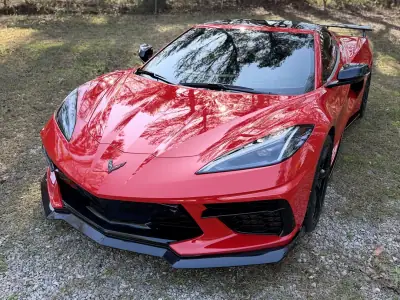
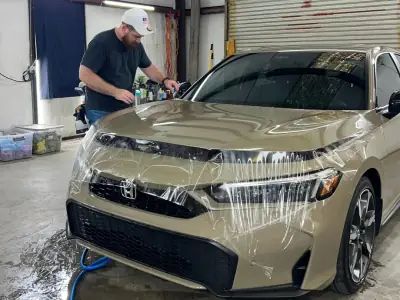
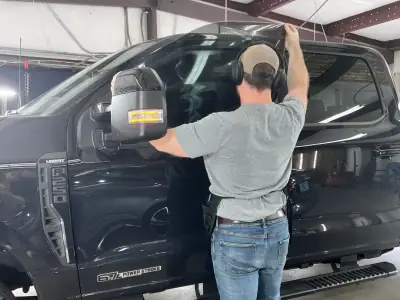
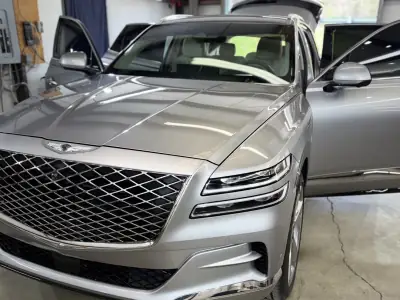
Quick answer: Yes, paint protection film can turn yellow, but it mostly happens with older-generation or low-grade film. Early PPF used films that reacted to UV light and heat over the years and took on an amber tint, especially on white and light-colored cars. Modern premium film is built with UV-stable urethane and a protective top coat specifically to resist that. What keeps film clear in the long run is the quality of the film, the quality of the install, and how the car is cared for. The self-healing film we install in Opelika carries a lifetime warranty against yellowing, cracking, bubbling, and delamination, and you can read the details on our warranty page.
"Will it turn yellow?" is the first worry most people voice when they start looking at paint protection film, and it's a fair one. Anyone who has seen a decade-old clear bra on a white car, with its tired amber edges and dull hood, remembers it. The honest answer isn't "never" and it isn't "always." It depends on what the film is made of, how it was applied, and what the car lives through every day.
At My Awesome Detailer LLC, 2709 Frederick Road in Opelika, we install premium self-healing PPF for drivers across Auburn, Opelika, and Lee County, plus Phenix City and Columbus, GA. This guide explains why film yellows, what changed in modern film, how to spot trouble early, what to ask any installer before you commit, and what to do if you already have film that looks tired. If you're still weighing whether film is the right protection, our PPF cost and value guide for Auburn is a good place to start.
Why paint protection film yellows in the first place
Film yellows when the plastic in it breaks down chemically under sunlight and heat, or when contamination sits on it and stains it. Those are two very different problems, and mixing them up is where a lot of the confusion online comes from.
Cause 1: UV and heat breaking down the film itself
The first generation of consumer paint protection films was often made from materials that were not built to sit in direct sun for years. Ultraviolet light slowly changes the chemistry of some plastics, and the result is a yellow or amber cast. Heat speeds the process up. A film that is slightly cloudy or tinted when new may look fine at first, then drift warmer in color over several summers.
Alabama is a demanding place to find this out. Long, hot, humid summers with strong UV mean a car that lives outside takes far more sun exposure per year than one in a mild climate. A dark car's hood can get hot enough to be uncomfortable to touch. A film that is going to struggle with UV and heat will show it here sooner than almost anywhere.
Cause 2: the adhesive and film edges
Yellowing isn't always the film body. Sometimes it starts at the edges, where adhesive meets paint, or in the adhesive layer itself. Dirt, wax residue, and wash chemicals collect along edges, and over time an edge line can look yellow or brown even when the middle of a panel still looks clear. That's a stain more than a film failure, but it looks the same from ten feet away, which is why it is worth knowing the difference.
Cause 3: stains and contamination on the surface
Bug residue, bird droppings, tree sap, road tar, and hard-water minerals can leave marks on any surface. On film, a long-neglected stain can read as a yellow patch. Most of these can be cleaned off if they're caught early. The ones left for weeks in summer heat can be harder to remove. Our PPF aftercare and maintenance guide covers the safe wash routine in detail.
Cause 4: the wrong products on the film
Some waxes, pastes, and solvents with colorants or petroleum content can build up along film edges and leave a yellowish line where the film meets the paint. This one is entirely preventable and has nothing to do with the film's quality.
Older film versus modern film: what actually changed
The big change is the top layer. Modern premium PPF uses a UV-stable aliphatic thermoplastic urethane film with a self-healing top coat, while early and budget films used materials that were more prone to discoloring. You don't have to memorize chemistry to shop well, but it helps to know the broad picture.
Early paint protection films were developed for demanding uses where looks mattered less than toughness. When the idea moved to consumer cars, some of those early products showed their age quickly in the sun. Over the years, manufacturers reworked the formulas. Today's quality films are designed to stay optically clear, shed dirt more easily, and recover from light swirls with heat, which is the self-healing behavior you may have heard about. For a plain-English explanation of that, see our post on how PPF self-healing works.
That doesn't mean every film sold today is equal. There is still a wide range of products in the market, from established premium films to bargain rolls sold online or installed by shops competing on the lowest number. The difference between them is rarely visible on day one. It shows up in year three, five, and seven.
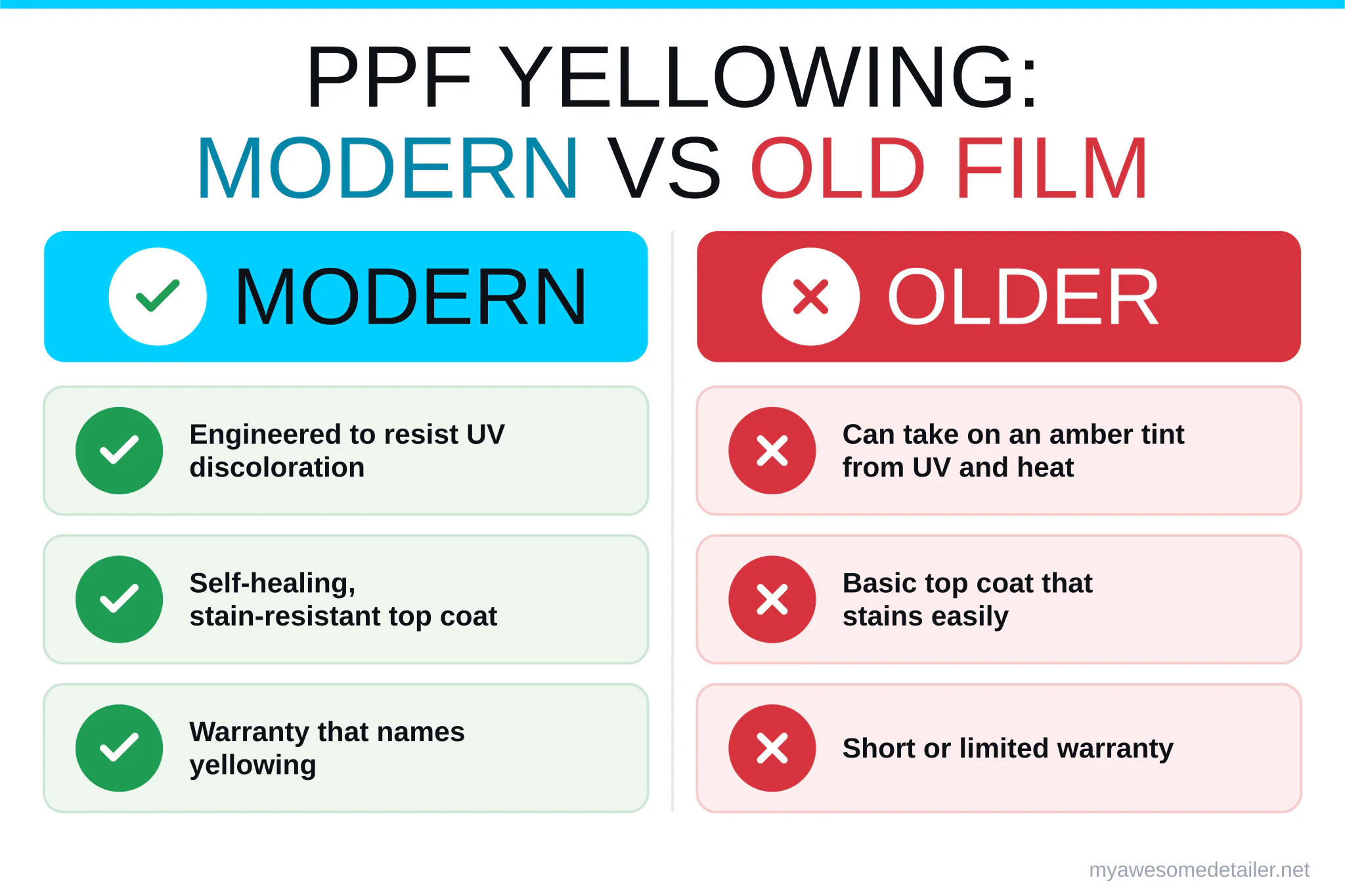
| Factor | Older or budget film | Modern premium film |
|---|---|---|
| UV resistance | Can break down and take on an amber tint over time | Engineered to resist UV discoloration |
| Top coat | Often none, or a basic coat that stains easily | Self-healing, stain-resistant top coat |
| Look when new | Sometimes slightly hazy or with visible orange peel | Optically clear, close to invisible |
| Adhesive | May yellow, harden, or leave residue on removal | Designed for clean, long-term bond and removal |
| Warranty | Short, limited, or hard to claim | Often long-term, and it should name yellowing explicitly |
| Typical failure | Yellowing, cracking, peeling edges | Mostly installer or care related if anything goes wrong |
One caution: no film is guaranteed by being "modern" alone, and nobody can honestly promise a film will look new forever. What you can do is choose film from a reputable maker, have it installed by a shop that stands behind the work, and get the yellowing protection in writing.
How to tell if PPF is starting to yellow
The easiest check is to compare the film to a reference: look at a white or light panel in full sun, and look at the edges, door jambs, and wrapped edges where film meets bare paint. Yellowing is gradual, so you often don't notice it until you compare.
- Color shift against untouched paint. Where film ends and paint continues, a yellow or amber cast on the film side is the classic sign. Check the line along a fender or the edge of a hood.
- Light cars show it first. White, pearl, and silver paint make even a slight tint easy to see. Black cars hide it much longer.
- Edge lines turning tan or brown. This may be contamination in the edge rather than the film, so clean carefully before judging.
- Haze, dullness, or an orange-peel texture. Film that has lost clarity often looks dull in direct light.
- Cracking, chalking, or peeling. These usually come with long UV exposure and are a sign the film is at the end of its life.
Before deciding the film has yellowed, wash the area with a pH-neutral soap and take another look in shade and in sun. A surprising number of "yellow" panels are simply dirty.
Why installer quality matters as much as the film brand
A great film installed badly can fail early, and an average film installed well can outlast expectations, so the person applying it matters as much as the label on the box. When people ask about yellowing, we turn the question around: what happens to the film in year one, and who is responsible when it does?
Here is how installation touches the long-term clarity of the film:
- Paint prep. Film bonds to what is under it. Contamination, bonded dirt, or a poor wash left on the paint can show through, trap debris, and stress the adhesive.
- Edge work. Clean, tucked, wrapped edges stay sealed. Rough or open edges collect dirt, which is exactly what ends up looking yellow later.
- Stretching. Film that has been overstretched around a curve is under constant tension, and tension plus heat is how film lifts, hazes, or fails early.
- Cleanliness during install. Dust, lint, and debris sealed under the film show up as specks, and they don't go away.
- Cure time and aftercare instructions. A shop that explains the first week of care protects the film as it settles. See our guide to how PPF is installed for the full process.
That is why the same film can look great on one car and poor on another. When you compare quotes, you are comparing installers as much as products.
What to ask any shop before you buy PPF
Ask what film they use, whether the warranty names yellowing, who honors it, and what happens if an edge lifts or the film discolors. A shop confident in its work answers these without hesitation.
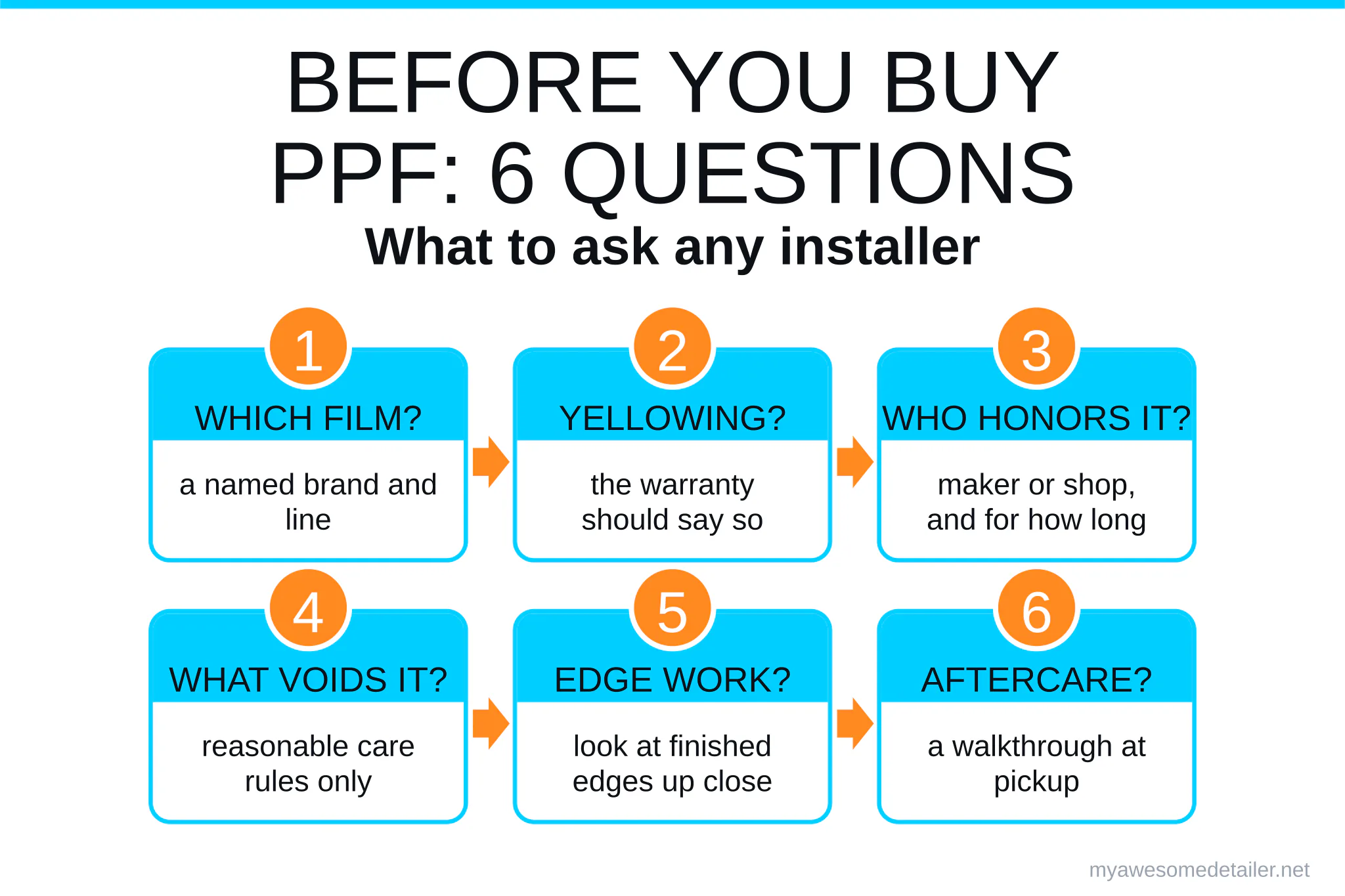
- "What film brand and line do you install?" You want a named product from an established manufacturer, not "a premium film."
- "Does the warranty specifically cover yellowing?" Some warranties cover only defects like peeling or bubbling and exclude discoloration. Read the wording, not the headline.
- "Who handles a claim, and how long does it take?" A warranty from a shop that closes in two years is only as good as the shop.
- "Is the warranty in writing, and what voids it?" Look for reasonable care requirements, not vague exclusions.
- "Can I see finished work and edges up close?" Clean edges and consistent clarity are visible if you look.
- "What will you tell me about washing and care?" Good shops walk you through it at pickup.
At our shop, the premium self-healing film we install carries a lifetime warranty against yellowing, cracking, bubbling, and delamination. We're also an Owner's Pride Select installer, which places us among roughly the top 40 shops in the U.S. You can see how that applies to your car on our warranty page and our PPF services page.
Want film that is built to stay clear?
Tell us about your vehicle and what you want protected, and we'll walk you through film options and warranty details at our Opelika shop. Final pricing depends on the vehicle and coverage.
Does car color change how likely yellowing is to show?
Color doesn't change whether the film ages, but it changes whether you can see it. A slight amber cast is nearly invisible on black, navy, or dark gray paint and obvious on white, pearl, and silver.
That has two practical effects. If you drive a white or light-colored car, film quality and edge cleanliness matter even more, because any shift will be visible from the driveway. If you drive a dark car, you may not notice early yellowing, but the film is still aging. It is worth checking the film against a light reference now and then, such as a white towel held next to it in the sun.
How Alabama sun, heat, and red clay affect PPF
Heat, UV, and dirt are the three local stress factors, and none of them is a problem for a quality film that is kept clean. They are the reasons cheap film shows its age here sooner than it would in a milder place.
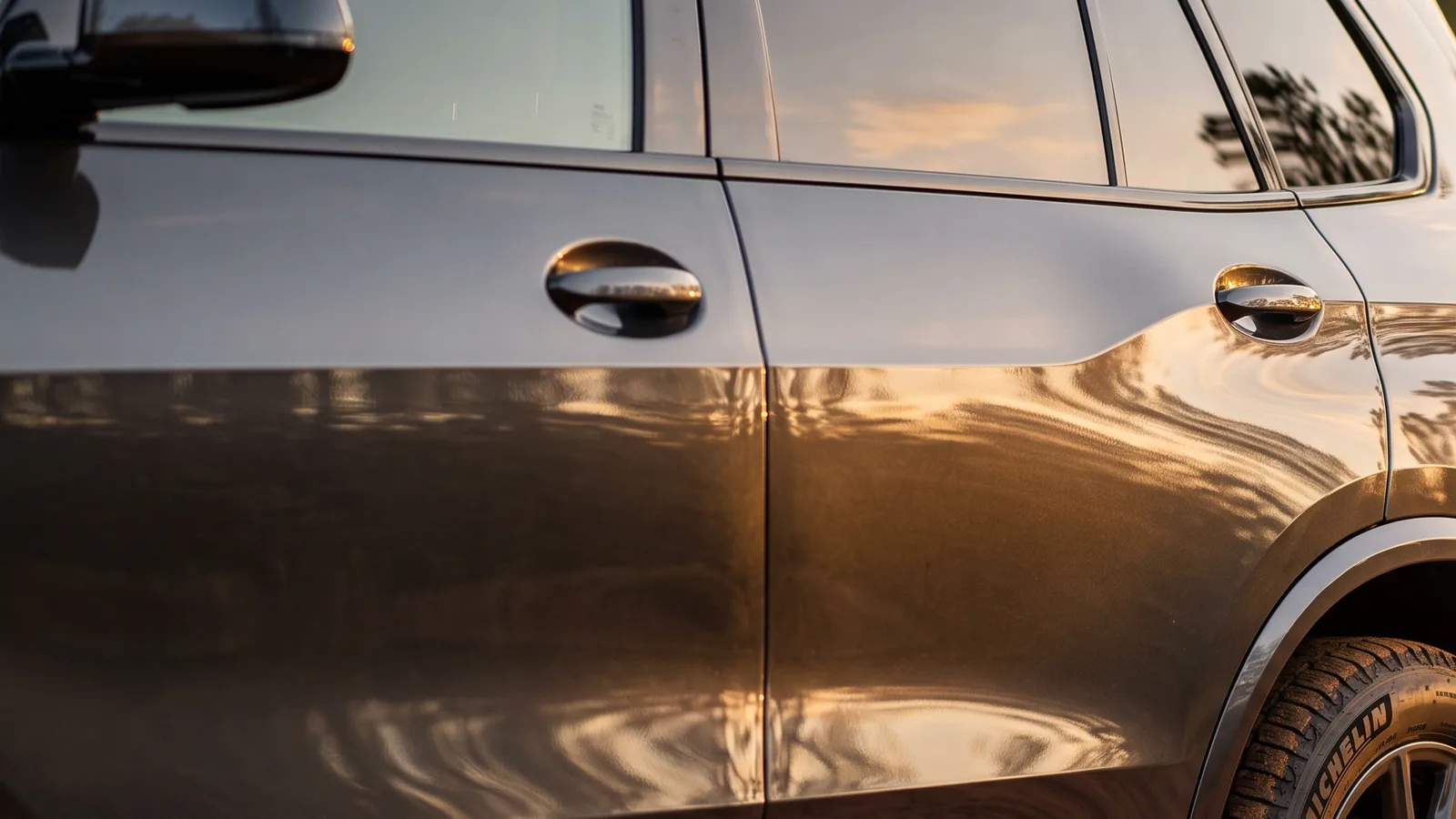
- UV exposure. Strong summer sun beats on the hood, roof leading edge, and mirror caps all day. These high-exposure panels are the first places to check.
- Heat cycling. Film expands and contracts as a parked car goes from cool nights to hot afternoons. Quality adhesive and good edge work handle it. Poor ones don't.
- Red clay and dust. Fine clay clings to edges and in seams. If it's left to dry, it can leave an orange-brown line that looks like yellowing. We wrote about this in red clay and your car.
- Bugs and pollen. Spring pollen and summer lovebugs are acidic and sticky. Rinse them off promptly.
- Parking. A garage or shade keeps UV off the film. If that isn't possible, regular washing matters more.
None of this requires special effort. A wash every week or two, prompt cleanup of bird droppings and bugs, and shade when it's convenient are enough for most drivers.
How to keep PPF clear for as long as possible
The habits that keep film clear are simple: wash gently, rinse contaminants fast, avoid harsh chemicals at the edges, and have anything odd looked at early.
Wash on a regular schedule
Hand wash with a pH-neutral soap and a clean microfiber mitt every one to two weeks. Dirt left on film becomes the stain that gets mistaken for yellowing.
Rinse off the aggressive stuff fast
Bird droppings, bug splatter, and tree sap should come off within a day or two in summer. A damp microfiber towel soaked on the spot for a minute softens most of it.
Be careful with products near the edges
Skip colored waxes, heavy pastes, and strong solvents along film edges. Residue builds up in the edge line and turns tan over time.
Keep pressure washers away from the edges
A strong jet aimed at an edge can lift it and let water and grime underneath. If you use a pressure washer, stay back and never point it along the edge.
Consider a ceramic coating over the film
A ceramic coating on top of PPF makes the surface slicker, so dirt rinses off more easily and stains have a harder time taking hold. We explain how the two work together in ceramic coating over PPF.
Park smart when you can
Shade and covered parking reduce UV and heat on every surface, film included.
Is yellowing covered by warranty?
It depends entirely on the warranty, which is why you should read it before you buy. Some film warranties name yellowing, cracking, bubbling, and delamination. Others list only a few of those. Some exclude damage from improper care or require the work to be done by a certified installer.
| What to check | Why it matters |
|---|---|
| Does it list "yellowing" by name? | If it doesn't, discoloration may not be covered. |
| Is it lifetime or time-limited? | Film ages gradually, so a very short term may expire before problems appear. |
| Who honors it, the maker or the shop? | You want to know who to call and that they will still be in business. |
| What are the care requirements? | Reasonable washing rules are normal. Vague or unreasonable ones are a red flag. |
| Is labor covered, or only film? | Replacement labor is a large part of the cost. |
| Is it transferable? | Matters if you sell the car, and may add to resale appeal. |
Our film's warranty covers yellowing, cracking, bubbling, and delamination for the life of the film, and we explain what that means for your specific vehicle when you come in. For the full terms, see the warranty page.
Common myths about PPF and yellowing
Most of what people repeat about yellow film is either out of date or only half true.
- "All PPF yellows." Not true of premium modern film. It was a real problem with early and budget products, and the reputation stuck.
- "It only happens on white cars." It happens on any color, but it is easiest to see on light paint.
- "A more expensive install means it won't yellow." Price alone proves nothing. Ask about the film, the installer's edge work, and the written warranty.
- "Yellow film means the paint underneath is ruined." Usually the paint under film is in excellent condition. The film took the wear so the paint didn't have to.
- "Waxing the film keeps it from yellowing." Heavy wax near edges can actually cause the yellow-brown line people complain about.
Knowing which claims hold up makes it much easier to separate a sales pitch from straight advice, from us or anyone else.
What to do if your existing PPF looks yellow
First clean it, then compare it to a reference, then decide: if it is dirty, it will come clean; if the film itself has changed color, the options are warranty replacement or professional removal and re-wrap.
- Wash the panel properly. Use a pH-neutral soap, a clean mitt, and plenty of water. Dry it and look again in daylight.
- Check the edges. If the color is confined to the edge lines, it's more likely residue than film failure. A gentle clean of the edge area often helps.
- Compare to bare paint. Look at the film boundary or a hidden spot. If the film clearly has an amber cast versus the paint, the film itself has aged.
- Check your warranty. If the film is under warranty and the warranty names yellowing, contact the installer.
- Don't try to scrape or polish it off. Razor blades, compounds, and aggressive chemicals can cut through the film or damage the paint under it.
- Get a professional opinion. Bring the car to a PPF installer who can tell staining from discoloration and explain your options.
Old film that has truly yellowed can usually be removed with controlled heat and the right technique, and the paint under quality film is generally in excellent condition. Removal is best left to someone who does it routinely, because pulling aged film badly can lift clear coat on paint that wasn't factory original. If you are thinking about replacing old film with new, our PPF coverage options guide explains the difference between partial front, full front, and full body film.
Quick checklist: how to avoid yellowing PPF
- Choose a named, established premium film, not an unbranded roll.
- Get a written warranty that explicitly lists yellowing.
- Choose an installer who does clean edge work and explains aftercare.
- Wash regularly and rinse off bugs, droppings, and sap early.
- Keep pressure washers, harsh solvents, and colored waxes away from the edges.
- Consider a ceramic coating on top of the film for easier cleaning.
- Park in shade or a garage when you can.
- Check the film against a white reference once or twice a year and call your installer if something looks off.
Is PPF still worth it given the yellowing risk?
For most drivers, yes, as long as the film is premium and the warranty is real. The yellowing concern mostly belongs to older or budget film. With a quality product, good installation, and basic care, the film's job, taking the rock chips, bug acid, and scuffs that would otherwise hit your paint, is worth far more than the small risk that remains.
The decision is really about what you drive and how you drive it. A daily driver that sees a lot of highway miles is the textbook case, which we cover in whether PPF is worth it for highway commuters. If your priority is resale, our post on whether PPF protects resale value walks through how buyers see a protected finish. Either way, the right question is not "can film yellow?" but "what film, installed by whom, with what warranty?"
Ready to talk about PPF for your car?
Our Opelika shop installs premium self-healing film and stands behind it with a lifetime warranty against yellowing, cracking, bubbling, and delamination. Pricing depends on the vehicle and the coverage you choose.
Frequently asked questions about PPF yellowing
The questions below are the ones we hear most from Auburn and Opelika drivers. The short versions are also in the FAQ section at the bottom of this page.
Does PPF turn yellow over time?
Older and low-quality film can. Premium modern film is engineered to resist UV discoloration, but no honest installer can promise any product stays perfect forever. That is why the warranty wording matters.
How long does it take for PPF to yellow?
There is no single timeline. Low-grade film on a sun-exposed light-colored car may show a tint within a few years, while quality film can stay clear far longer. Conditions, care, and film quality all play a part.
Does white PPF or clear PPF yellow more?
Clear film on a white car is where yellowing is easiest to see, because there is nothing to hide it. The film isn't aging faster; the color just makes the change visible.
Can yellowed PPF be fixed?
Staining on the surface can often be cleaned. Film that has changed color itself generally can't be polished back. It needs to be replaced, ideally under warranty.
Will a ceramic coating prevent yellowing?
A coating won't change the film's chemistry, but it makes the surface slicker and easier to keep clean, which reduces staining and edge-line buildup.
Is yellowing the same as a lifting edge?
No. A lifting edge is an adhesion problem that lets dirt under the film. Yellowing is a color change. They can show up together, and both should be checked by your installer.
What should I do if I think my film is yellowing?
Wash it, compare it to bare paint in daylight, and call your installer. Don't scrape or polish it. If your film is under warranty, the sooner you report it, the easier it is to sort out.
The bottom line
Yes, PPF can turn yellow, but the film we install today is not the film that earned that reputation. Premium, UV-stable, self-healing urethane in the hands of a careful installer, backed by a warranty that names yellowing, is a very different purchase from a cheap roll. Ask the right questions, read the warranty, wash the car regularly, and the film should do what it was bought to do: stay clear and keep your paint looking new. To talk through film for your vehicle, visit My Awesome Detailer at 2709 Frederick Road in Opelika, call (334) 650-6499, or start on our PPF page.