Quick answer: Self-healing PPF works because its clear top coat is an elastic polymer that "remembers" its original smooth shape. When a light scratch or swirl pushes that top coat out of place, heat from the sun, warm water, or an installer's heat gun lets the polymer relax and flow back flat, so the mark fades or disappears, often within minutes. It can't fix anything that actually cuts through or tears the film: deep scratches, gouges, and the impact marks from hard rock chips stay in the film. The good news is the film took that hit instead of your paint, and a damaged panel can be re-filmed for far less than a repaint.
"Self-healing" is the phrase that sells paint protection film. It's also the phrase that causes the most confusion when customers pick up their cars. Some people expect the film to make any scratch vanish. Others assume it's pure marketing. The truth sits in between, and it's more interesting than either: a piece of real polymer chemistry that works extremely well on the most common kind of damage, and not at all on a few others.
At My Awesome Detailer LLC, 2709 Frederick Road in Opelika, we install premium self-healing paint protection film for drivers from Auburn, Opelika, and across Lee County, plus Phenix City and Columbus, GA. This guide explains how PPF self-healing actually works at the material level, what triggers it, why our Alabama summers make it work better than it does up north, and, just as important, what it can't fix and what happens when the film takes a hit it can't recover from. If you're still deciding whether film is right for your car at all, start with our guide to whether PPF is worth the cost in Auburn.
What is self-healing PPF?
Self-healing PPF is paint protection film with an elastic clear top coat that recovers from light surface damage when it's warmed. The film itself is a clear urethane sheet, typically around 6 to 8 mils thick (roughly 150 to 200 microns), applied over your factory paint. Most of that thickness is the impact-absorbing film body. On top sits a much thinner layer engineered to do one job: stay glossy by bouncing back from the scuffs and swirls that daily driving and washing put on every car.
Think of a quality film as three working layers stacked together:
- The self-healing top coat. A thin, flexible clear layer that faces the world. It takes the light abuse (wash marring, fingernail marks around door handles, brush swirls) and recovers from it with heat.
- The urethane film body. The thick, tough middle that absorbs impacts. When a pebble flies off a gravel truck on I-85, this is the layer that soaks up the energy so your clear coat never feels it.
- The adhesive. A pressure-sensitive adhesive that bonds the film to your paint firmly enough to stay put through years of heat and car washes, yet allows clean removal later.
Older "clear bra" films didn't have a self-healing top coat. They protected the paint, but every swirl and scuff stayed in the film, and after a few years they looked hazy and tired. The self-healing top coat is what changed PPF from something that protected the paint but looked worn to something that protects the paint and keeps looking new. It's also why every film we install is a self-healing film; we don't offer the older kind.
How does self-healing PPF actually work?
The top coat is made of long polymer chains that are cross-linked into a network, a bit like a net, and that net has a "resting" shape it always wants to return to. When something drags across the surface lightly, it doesn't remove material. It pushes the polymer sideways and down, leaving a groove with tiny ridges along the edges. The material is all still there; it's just been shoved out of position.
At normal temperatures the polymer chains are fairly stiff, so the groove stays. Add heat and the chains get more mobile. Because they're tied together in that cross-linked net, they don't just melt or sag. They pull back toward the arrangement they were molded in, the way a stretched rubber band snaps back when you let go. The groove rises, the ridges settle, and the surface goes flat and glossy again. To your eye, the scratch has "healed."
Displaced, not removed: the one rule that explains everything
Here's the key idea that explains both what self-healing can do and what it can't: healing only works when material has been displaced, not removed or cut.
- A light swirl from a dirty wash mitt pushes the top coat around. Nothing is gone. Heat brings it back.
- A key dragged hard across the film slices through the top coat and into the film body. Material is cut or torn away. There's nothing for the polymer to pull back into, so no amount of heat closes it.
Every question about "will this heal?" comes back to that rule. If you remember nothing else from this guide, remember that one.
Why it needs heat to trigger
Self-healing is not instant at room temperature on most films. The polymer needs enough energy to move. On a cool, cloudy morning, a fresh swirl may sit there looking obvious. Park the car in the sun for the afternoon and it's often gone by the time you leave work. That isn't the film being inconsistent; it's the film waiting for the heat it needs to do its job.
How much heat varies from one film to another, and manufacturers don't all publish the same specs, so we won't quote a single magic number. In practice, the triggers that reliably work are:
- Direct sun. A car parked in full sun warms its panels well beyond the air temperature, especially on darker colors. In an Alabama summer, that's usually all the film needs.
- Warm-to-hot water. Pouring warm water over a marked area, or rinsing the car with warm water, speeds up recovery on cooler days.
- A heat gun in trained hands. Installers use controlled heat during and after installation. This is effective but easy to overdo; too much heat in one spot can damage the film or the edges, so it's not a DIY step we recommend.
How fast does PPF self-heal?
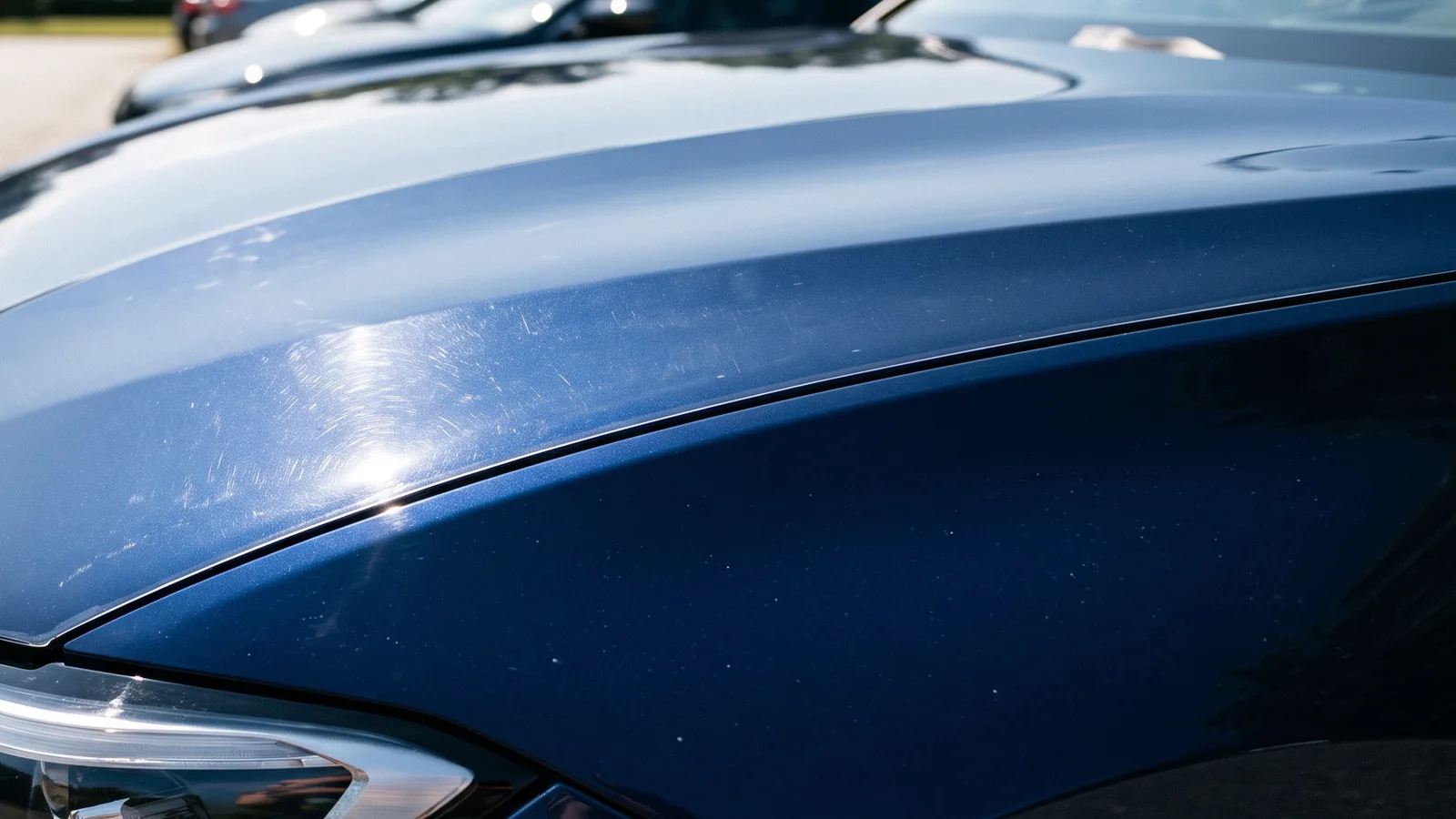
Light wash swirls and fingernail marks on a warm panel often fade within seconds to a few minutes. Slightly deeper marks can take longer, sometimes a full sunny afternoon or a couple of warm days. Marks that are borderline (deeper than a swirl but not cut through the top coat) may improve a lot without disappearing completely. If a mark hasn't changed after several hot, sunny days, it's very likely past what the top coat can recover from.
Fresh film needs to cure first
Brand-new film isn't at full strength on day one. As we explain in our guide to how PPF is installed, most film shouldn't get wet for about 24 to 48 hours after installation, and the self-healing top coat is typically fully active within about a week. If you notice a light mark in the first few days, give the film time and some sun before worrying about it.
What self-healing PPF can fix
Self-healing PPF recovers from the light, everyday surface marks that slowly dull unprotected paint. These are exactly the marks that make a two-year-old car look older than it is, which is why the self-healing property matters so much for how the car looks long-term.
- Wash swirls and marring. The fine circular scratches left by dirty mitts, rough towels, and drying with the wrong cloth. On bare paint, these build up wash after wash and eventually need paint correction to remove. On self-healing film, they usually fade away in the sun.
- Fingernail marks around door handles. The little arc-shaped scuffs in the door handle cups that every car collects. Film on those cups is one of the most satisfying small upgrades we do.
- Light scuffs from bags, keys, and zippers brushing the trunk lip or rear bumper while loading the car.
- Brushes against bushes, branches, and tall grass on a dirt road or a tight driveway, as long as they didn't dig in.
- Light impressions from small, low-energy debris. Grit and fine sand that pepper the front end at highway speed often leave tiny marks in the top coat that recover with heat.
- Pet claw marks that are light enough not to cut, such as a dog jumping up on a door.
Over years of ownership, this is where self-healing film quietly pays you back. Swirls are the single most common reason a car's finish loses its gloss, and with film over the paint, most of them simply don't last.
What self-healing PPF can't fix
Self-healing can't repair damage that cuts, tears, or punctures the film, and it can't fix anything that happened to the paint before the film went on. This is where expectations get set wrong most often, so let's be specific.
Deep scratches that cut through the top coat
If you can catch a fingernail in the scratch, it's almost certainly through the top coat and into the film body. A deliberate key scratch, a shopping cart corner dragged along the door, or a sharp piece of metal will cut material away. There's nothing left to pull back into place, so heat won't close it. The paint underneath is usually fine, because the film absorbed the damage, but the mark stays in the film.
Gouges and tears
A hard scrape from a curb, a pole, or a parking garage column can gouge or tear the film. Once the film is torn, its edges can lift and collect dirt, and the panel should be re-filmed rather than left as-is.
Rock chips: absorbed, not healed
Rock chips deserve their own explanation, because "will PPF heal rock chips?" is one of the questions we hear most. The honest answer: PPF doesn't make a hard rock chip disappear; it stops the chip from ever reaching your paint.
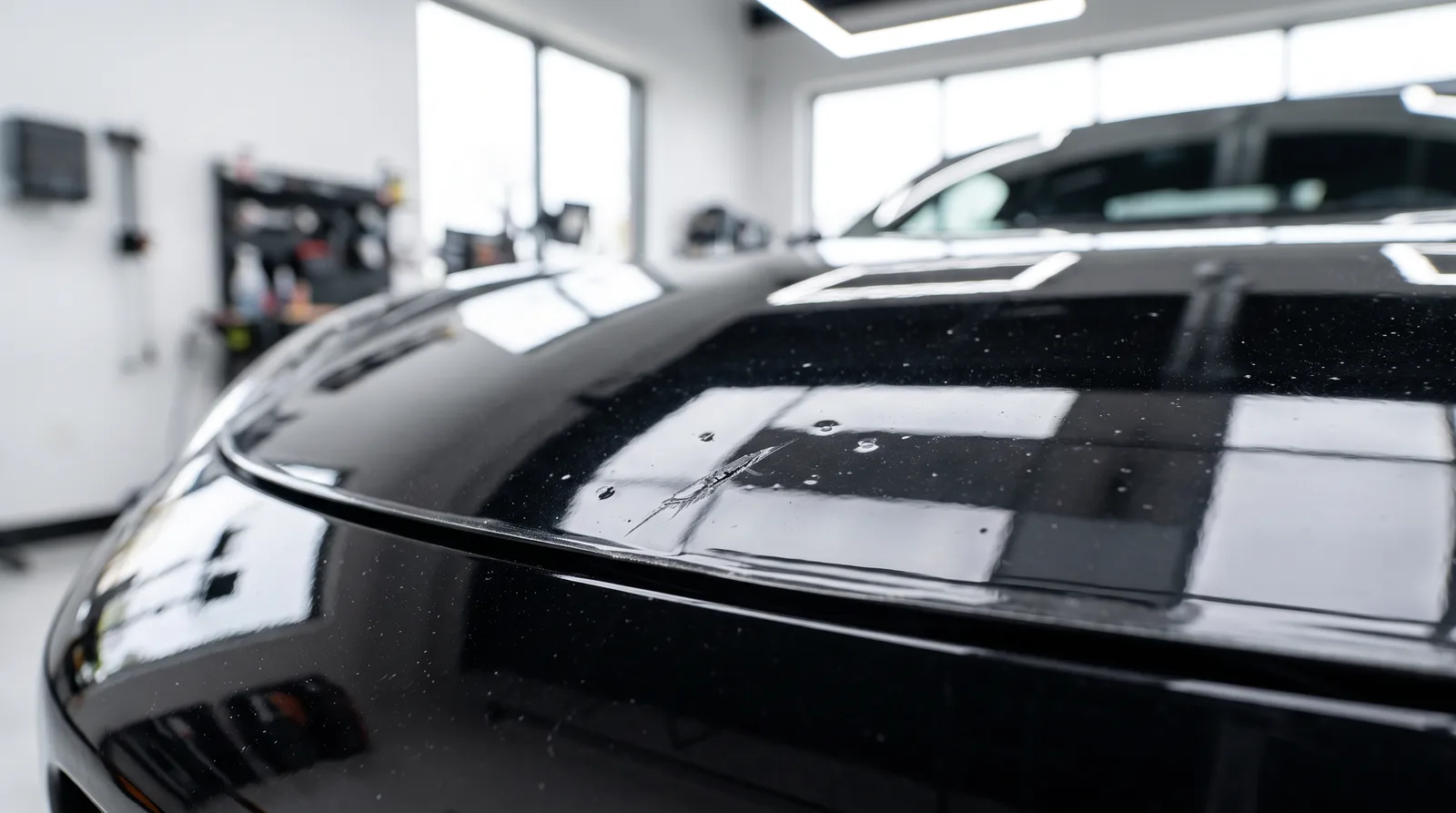
When a rock hits film at highway speed, the thick urethane body flexes and absorbs the energy. Small, light impacts may leave only a faint mark that recovers with heat. A harder impact can leave a small dent, dimple, or pit in the film that stays there. What it doesn't leave is a chip in your clear coat, primer, or bare metal. That's the whole point. A chip in the film is cosmetic and replaceable; a chip in the paint can start to rust and is a real repair job.
So when you see a small dimple in the film on your hood after a trip down I-85, read it as the film working, not failing. If enough of those marks collect over the years to bother you, the panel's film can be replaced and the factory paint underneath will still be untouched.
Damage that was already in the paint
Film is clear. It shows what's under it, and it doesn't fill in existing chips or remove swirls that are already in your paint. That's why paint condition matters before installation: on a new car we typically do a decontamination and prep, and on a car with existing swirls or defects we recommend correcting the paint first so the film locks in a clean finish instead of preserving the flaws. Our PPF installation guide walks through those prep steps.
Stains, etching, and contamination
Self-healing is a physical recovery, not a chemical one. It won't remove stains from tree sap, bird droppings, or bug splatter that sat on the film for days in the heat. Quality films resist staining well, and a ceramic coating over the film helps even more, but the practical fix is the same as on paint: clean contamination off promptly.
Problems that aren't damage at all
Lifting edges, bubbles, or adhesive problems are installation or film issues, not surface damage, so heat doesn't "heal" them either. Those are handled by the installer and the warranty, not by parking in the sun.
Self-healing PPF at a glance: what heals and what doesn't
Use this table as a quick guide to what you're likely to see after different kinds of damage. Results vary somewhat by film, temperature, and how hard the hit was, but the pattern holds.
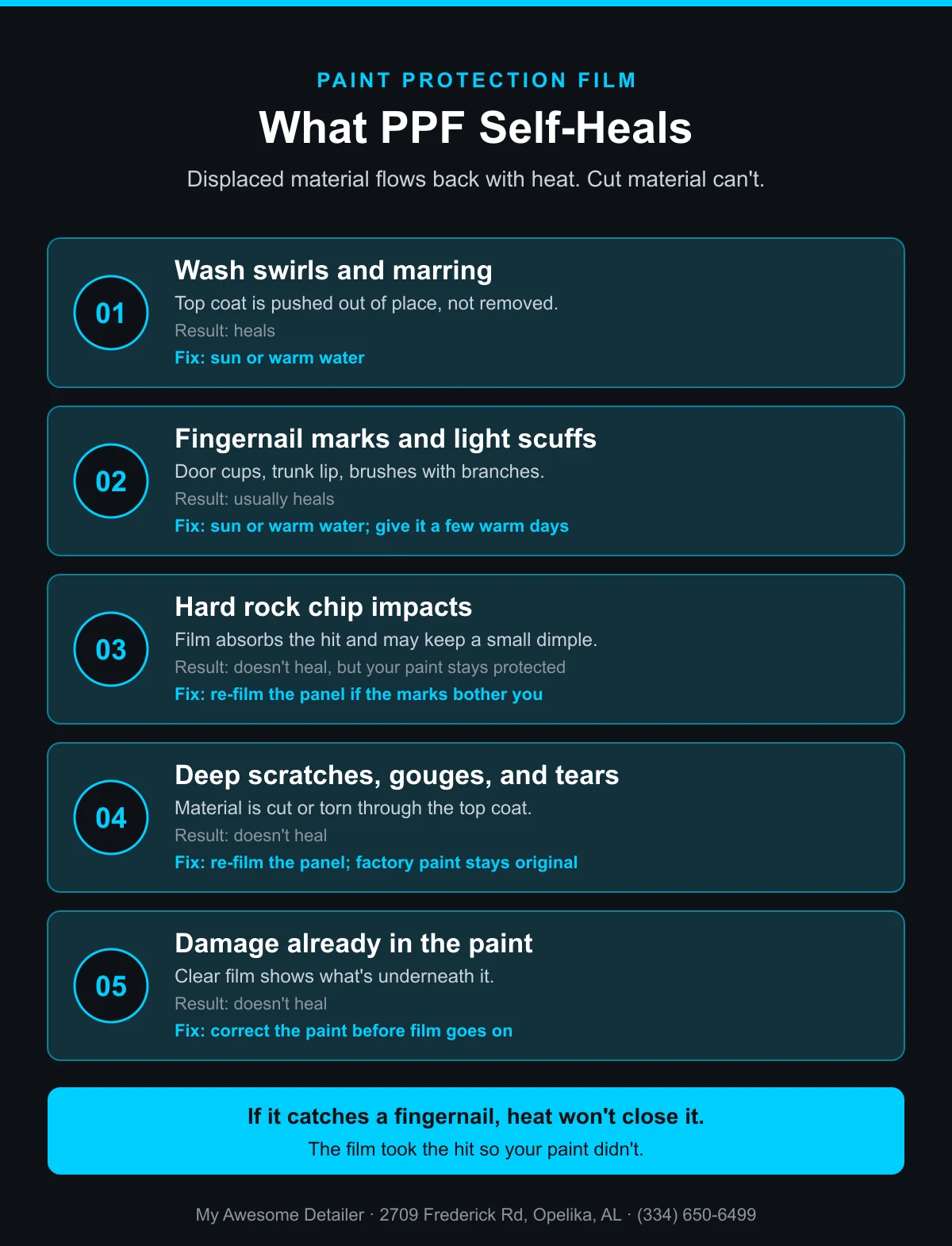
| Type of damage | Does it self-heal? | What actually happens | Typical fix if it doesn't heal |
|---|---|---|---|
| Wash swirls and marring | Yes | Top coat is displaced, not cut; flows back with heat | Sun or warm water |
| Fingernail marks in door cups | Yes | Light displacement; usually recovers quickly | Sun or warm water |
| Light scuffs from bags, keys, branches | Usually | Recovers if it didn't cut the top coat | More heat time; re-film the panel if it stays |
| Small, low-energy grit impacts | Often | Faint marks may relax out over warm days | Usually none needed |
| Hard rock chip impacts | No (paint stays protected) | Film absorbs the hit and may keep a small dimple or pit | Re-film the panel if the marks bother you |
| Deep scratch (catches a fingernail) | No | Material is cut through the top coat | Re-film the panel |
| Gouge or tear | No | Film is torn; edges may lift | Re-film the panel promptly |
| Swirls or chips already in the paint | No | Film shows what's underneath | Correct the paint before installing film |
| Sap, bird dropping, or bug stains | No | Chemical staining, not a shape change | Prompt cleaning; ceramic coating helps prevent it |
Why Alabama heat makes self-healing work better
Self-healing needs heat, and Auburn and Opelika have plenty of it. For a large part of the year, a car parked in a lot at Auburn University, outside an office in Opelika, or in a grocery store lot in Lee County sits in direct sun that warms its panels far beyond the air temperature. That's the exact condition the self-healing top coat needs.
In practical terms, that means:
- Most light swirls take care of themselves from late spring through early fall without you doing anything. Wash the car, park it in the sun, and the light marring from that wash often fades the same day.
- Winter is slower, not broken. On our cooler, cloudy days, light marks may linger until the next sunny afternoon. A warm-water rinse speeds things up if you want them gone sooner.
- Garage-kept cars still heal. If your car lives in the garage, it still spends time in the sun when you drive it and park it. You can also use warm water on any mark you notice.
The same heat that helps healing is also the reason PPF matters so much here. Alabama sun and heat are hard on unprotected paint, and our highways (I-85, US-280, US-431) send plenty of grit and gravel at the front of every car. Film handles both: it takes the impacts, and the heat that would bake your paint instead keeps the film's surface looking fresh.
Self-healing PPF vs. "self-healing" ceramic coating
True self-healing is a property of paint protection film, not of ceramic coatings. You'll see "self-healing ceramic coating" in plenty of ads, and it's worth understanding the difference before you pay for one.
A ceramic coating is a hard, thin chemical layer measured in microns. It makes paint glossier, easier to clean, and more resistant to chemical staining and UV, and it helps reduce light wash marring. But it's far too thin and too hard to absorb a rock or to flow back after a scratch the way PPF's elastic top coat does. A few coatings use more flexible resins and can recover from very faint marks, but the effect is small. We break this down in detail in our guide to what "self-healing ceramic coating" really means.
| Feature | Self-healing PPF | Ceramic coating |
|---|---|---|
| What it is | Clear urethane film, about 6–8 mils thick | Hard chemical layer measured in microns |
| Light swirls | Heals them with heat | Resists them; doesn't truly heal |
| Rock chips | Absorbs the impact; paint stays protected | Can't stop a rock chip |
| Gloss and easy cleaning | Good on its own; better with a coating on top | Excellent; this is its main strength |
| Chemical and UV resistance | Good | Excellent |
| Typical use | High-impact areas or the whole car | Whole car, including over film |
Many of our customers combine the two: film on the impact zones, and a ceramic coating over the film and the rest of the paint. The film handles chips and heals swirls; the coating adds gloss, makes washing easier, and helps the film resist staining. See our guide to ceramic coating over PPF for how that combination works, or visit our ceramic coating page.
Want film that heals the everyday marks?
We install premium self-healing paint protection film in our Opelika shop, with coverage from a partial front to the whole car.
How to help your PPF self-heal
Most of the time you don't need to do anything; the sun handles it. When you want a mark gone faster, gentle heat is the answer. Here's the routine we recommend to our customers.
- Give it sun first. If you spot a light swirl or scuff, park the car with that panel facing the sun for a few hours. Check it at the end of the day before doing anything else.
- Try warm water next. On a cool day, pour warm-to-hot tap water slowly over the area or rinse the car with warm water. Many light marks fade within a minute or two.
- Skip the DIY heat gun. Heat guns can get hot enough to damage the film, lift edges, or affect nearby trim in a few seconds. If a mark doesn't respond to sun and warm water, bring the car by and we'll take a look.
- Don't polish film aggressively. Abrasive compounds and heavy machine polishing can wear the top coat. Film isn't paint, and it shouldn't be corrected like paint.
- Check after a few warm days. If a mark hasn't changed after several hot, sunny days, it's likely cut through the top coat. At that point it's a re-film question, not a healing question.
Habits that keep film looking new
- Wash gently and regularly with a pH-neutral shampoo and clean microfiber. Less marring means less for the film to heal.
- Avoid automatic brush washes. They're hard on any finish and can catch film edges.
- Keep pressure-washer tips away from edges. Hold the nozzle at a distance and don't aim directly at the film's edges.
- Clean off bugs, sap, and bird droppings promptly, especially in summer, since heat speeds up staining.
- Consider a ceramic coating over the film for easier cleaning and extra stain resistance.
Our PPF coverage guide also covers long-term care for each coverage level.
What happens when the film takes damage it can't heal?
When film is damaged beyond what self-healing can recover, the fix is to replace the film on that panel, and your factory paint underneath is usually untouched. This is the part of the PPF story that often gets left out, and it's the most reassuring part.
Compare the two outcomes for the same deep scratch or hard rock strike:
- Without film: the damage is in your paint. Depending on depth, that means touch-up, paint correction, or a body shop repaint and blending, plus a panel that no longer has its original factory finish.
- With film: the damage is in the film. We remove the film from that panel, clean and inspect the paint, and lay fresh film. The original factory paint stays original.
Re-filming a single panel is quoted per panel and depends on the vehicle and the panel, but it's normally a fraction of what a quality repaint would cost, and it's done in our shop without the color-matching worries that come with paintwork. That sacrificial role is exactly what the film is for. You can read more about what's covered on our warranty page.
Does a damaged spot weaken the rest of the film?
No. Damage is local. A dimple from a rock or a scratch in one spot doesn't affect how the rest of the panel heals or protects. The only time to act quickly is a tear or a lifted edge, because those can let dirt and water work under the film over time.
Does self-healing wear out over time?
The self-healing top coat is designed to keep working for the life of the film, and premium films are designed to last around 10 years or more. The film we install is a premium, UV-stable, self-healing film backed by a lifetime warranty, which is a big part of why it holds up so well in Alabama heat.
Two things can shorten the top coat's useful life, and both are avoidable:
- Abrasive polishing or harsh chemicals that wear or attack the top coat.
- Neglect, such as letting heavy contamination sit and bake in for long periods, which can stain the surface in ways heat won't fix.
Budget films are a different story. Cheaper, non-self-healing or low-grade films can yellow, haze, or lose their gloss much sooner. When you compare quotes, ask what film is being installed and whether it's self-healing; the price difference shows up in how the car looks a few years later. Our PPF cost guide covers what drives pricing.
Where self-healing film makes the biggest difference on your car
Self-healing film earns its keep on the panels that take the most impacts and the most handling. If you're deciding how much of the car to cover, these are the areas where both the impact protection and the healing top coat matter most.
| Coverage | What it includes | Typical cost in Auburn-Opelika | Best for |
|---|---|---|---|
| Partial front | Front bumper, partial hood and fenders, mirrors | About $700–$1,200 | Daily drivers on a budget |
| Full front | Full bumper, full hood, full fenders, mirrors | About $1,500–$2,500 | Most highway commuters |
| Full body | Every painted exterior panel | About $5,000–$8,000+ | New, luxury, and enthusiast cars |
Beyond the front end, a few small add-ons get a lot of value from self-healing film:
- Door handle cups for fingernail marks.
- Door edges for parking-lot touches and edge chips.
- Rear bumper top / trunk lip for scuffs from loading bags and gear.
- Rocker panels and behind the wheels where road grit and gravel get thrown up.
For a full breakdown of each tier, see our guide to PPF coverage options, or visit our paint protection film page.
Common myths about self-healing PPF
Myth: "Self-healing film can't be scratched."
It can. It just recovers from light scratches. Deep scratches stay in the film, and that's fine, because the film is sacrificial and replaceable.
Myth: "PPF heals rock chips."
Not exactly. Light impacts can recover, but hard rock chips leave a mark in the film. What film does is keep the chip out of your paint, which is the expensive part.
Myth: "You need a heat gun to make it work."
For everyday marks, the sun does it. Warm water helps on cool days. A heat gun is a professional tool, not a required part of owning film.
Myth: "Self-healing means I can wash it any way I want."
Gentle washing still matters. Healing handles light marring, but brush washes and gritty towels can cause deeper marks, and pressure-washer tips can lift edges.
Myth: "A ceramic coating does the same thing."
It doesn't. Coatings add gloss, easy cleaning, and chemical resistance, but they're too thin to absorb impacts or truly heal. They work best with film, not instead of it.
Why Auburn and Opelika drivers choose us for PPF
Self-healing film only performs as well as it's installed. Clean prep, careful edges, and proper curing all affect how the film protects and how long it looks good.
- Shop-based installs. Every film job is done inside our shop at 2709 Frederick Road, Opelika, in a clean, controlled environment.
- Premium self-healing film with a lifetime warranty, the same film across every coverage tier.
- Paint prep done right, including correction when the paint needs it, so the film locks in a clean finish.
- Owner's Pride Select installer, one of the top ~40 shops in the U.S.
- 4.9 stars from 200+ reviews from drivers across Auburn, Opelika, and Lee County.
Learn more about our team or see all of our services.
Protect your paint before the next rock finds it
Get a free quote on self-healing paint protection film, installed in our Opelika shop.
The bottom line
Self-healing PPF works through simple, clever polymer chemistry: an elastic top coat that flows back into its original smooth shape when it's warmed. In Alabama's heat, that means most wash swirls, fingernail marks, and light scuffs fade on their own, often the same day. What it can't do is close a cut, repair a tear, erase a hard rock impact, or fix damage that was in the paint before the film went on. In those cases the film has already done its real job by taking the hit for your paint, and a damaged panel can be re-filmed while the factory finish underneath stays original. Know that difference going in and self-healing film will meet your expectations.