Quick answer: PPF maintenance is simpler than most people expect. Keep the film dry for the first 24 to 48 hours after install, let it settle for about a week before any serious washing, then hand wash every 1 to 2 weeks with a pH-neutral soap, a clean microfiber mitt, and the two-bucket method. The rules that actually protect your investment are about what not to do: don't blast film edges with a pressure washer, don't use harsh degreasers or solvents on the edges, never scrape debris off with a razor blade, skip aggressive clay and compounds, and stay out of automatic brush washes. Let Alabama sun (or warm water) handle light swirls, because self-healing film fixes those on its own. If an edge lifts, a seam collects dirt, or a stain won't come out, bring it to the installer instead of attacking it yourself.
Paint protection film is one of the best investments you can make in a car's finish, but it isn't a "set it and forget it" product. It's a clear urethane layer that takes the rock chips, bug splatter, and scuffs your paint would otherwise take, and how you wash and treat that layer decides whether it still looks invisible in year eight or starts showing dirty edges and dull spots in year two.
At My Awesome Detailer LLC, 2709 Frederick Road in Opelika, we install premium self-healing PPF for drivers across Auburn, Opelika, and Lee County, plus Phenix City and Columbus, GA. The most common question we get on pickup day is some version of "So how do I take care of this?" This guide is the long answer: the first-week rules, the routine wash, the products that are safe and the ones that aren't, the mistakes we see most often, how self-healing does a lot of the work for you, and when an edge or stain needs professional attention. If you're still deciding on film, start with our PPF cost guide for Auburn and come back here once it's on the car.
Why PPF maintenance matters (and why it's easier than paint)
PPF maintenance matters because the film is now the surface the world touches, and the way you wash it decides how clean its edges stay, how glossy it looks, and how long it lasts. The good news is that caring for film is easier than caring for bare paint, as long as you avoid a short list of habits that damage it.
Think about what the film is doing. It's a thick, clear urethane sheet bonded to your paint with a pressure-sensitive adhesive. On top sits a thin, elastic self-healing top coat. The film body absorbs impacts. The top coat takes the light abuse from washing and daily use and recovers from it with heat. The adhesive holds everything in place through years of heat, rain, and washing.
Each of those layers has one weak point that the wrong care can hit:
- The edges. Every piece of film ends somewhere. A high-pressure jet, a harsh solvent, or a fingernail picking at an edge can start lifting it, and once an edge lifts, dirt and water get underneath.
- The top coat. It's tough against swirls, but it isn't designed for abrasive polishes, gritty clay, or a razor blade. Those cut material away, and heat can't heal what's been removed.
- The surface clarity. Contamination like bird droppings, tree sap, and bug residue that bakes on for days in Alabama heat can stain the film, just like it can etch paint.
Get those three things right and PPF is honestly lower-maintenance than bare clear coat. You don't need to wax it on a schedule, you don't need to polish out swirls, and light marks fade on their own on a warm afternoon. The routine below is mostly about washing it the right way and keeping a few tools away from it.
The first week after installation: PPF aftercare rules
The most important PPF aftercare tips apply to the first week: keep the film dry for about 24 to 48 hours, don't wash it for roughly a week, and don't touch, pick at, or pressure-wash the edges while the adhesive finishes setting. Fresh film isn't at full strength on day one.
During installation, film is floated into place on a slip solution, then squeegeed and heated until the water and air are worked out. A small amount of moisture always remains under the film for a few days and evaporates out through it. The adhesive is also still building its bond. That's why the first week is about patience. We cover the install itself in detail in our guide to how PPF is installed.
Days 1–2: keep it dry
Most film shouldn't get wet for about 24 to 48 hours after installation. If it rains on the way home, don't panic; a light rain isn't the same as a pressure washer aimed at a fresh edge. But don't wash the car, don't run it through a car wash, and if you can, park it in a garage or under cover for the first night or two.
The first week: hands off the edges
For roughly the first week, avoid washing the film, and especially avoid any pressure washing. Don't run a fingernail along the edges to "check" them, and don't peel at a corner that looks slightly raised. Edges on curved panels sometimes look a touch proud of the paint for the first few days and then settle down as the adhesive sets.
Small bubbles, haze, or "water spots" under the film
It's normal to see a few tiny water pockets or a slight cloudy haze under fresh film, especially on large flat panels like the hood. These are leftover slip solution, and in most cases they shrink and disappear on their own within days to a couple of weeks as the moisture evaporates through the film. Warm, sunny weather speeds this up. Don't push on them or try to squeeze them out. If a bubble is still there after a couple of weeks, or if you see trapped dust or a lifting edge, bring the car back to the installer.
Self-healing needs time to come fully online
The self-healing top coat is typically fully active within about a week. If you notice a light mark in the first few days, give it time and some sun before worrying about it. Our guide to how PPF self-healing works explains the science behind that.
| Timeline after install | Do | Don't |
|---|---|---|
| First 24–48 hours | Park under cover if you can; drive normally | Wash the car, use a car wash, or wipe the film with anything wet |
| Days 2–7 | Spot-clean bird droppings gently with a soft, damp microfiber | Pressure wash, touch or pick at edges, apply any wax or sealant |
| Week 1–2 | Let small water pockets evaporate; first gentle hand wash after about a week | Push or squeeze bubbles; aim water jets at edges |
| After about 1 week | Begin the normal 1–2 week hand wash routine; add ceramic coating if planned | Use abrasive polishes, aggressive clay, or harsh solvents |
| Ongoing | Rinse contamination promptly; inspect edges a few times a year | Scrape debris with a blade; use automatic brush washes |
How to care for paint protection film: the routine wash
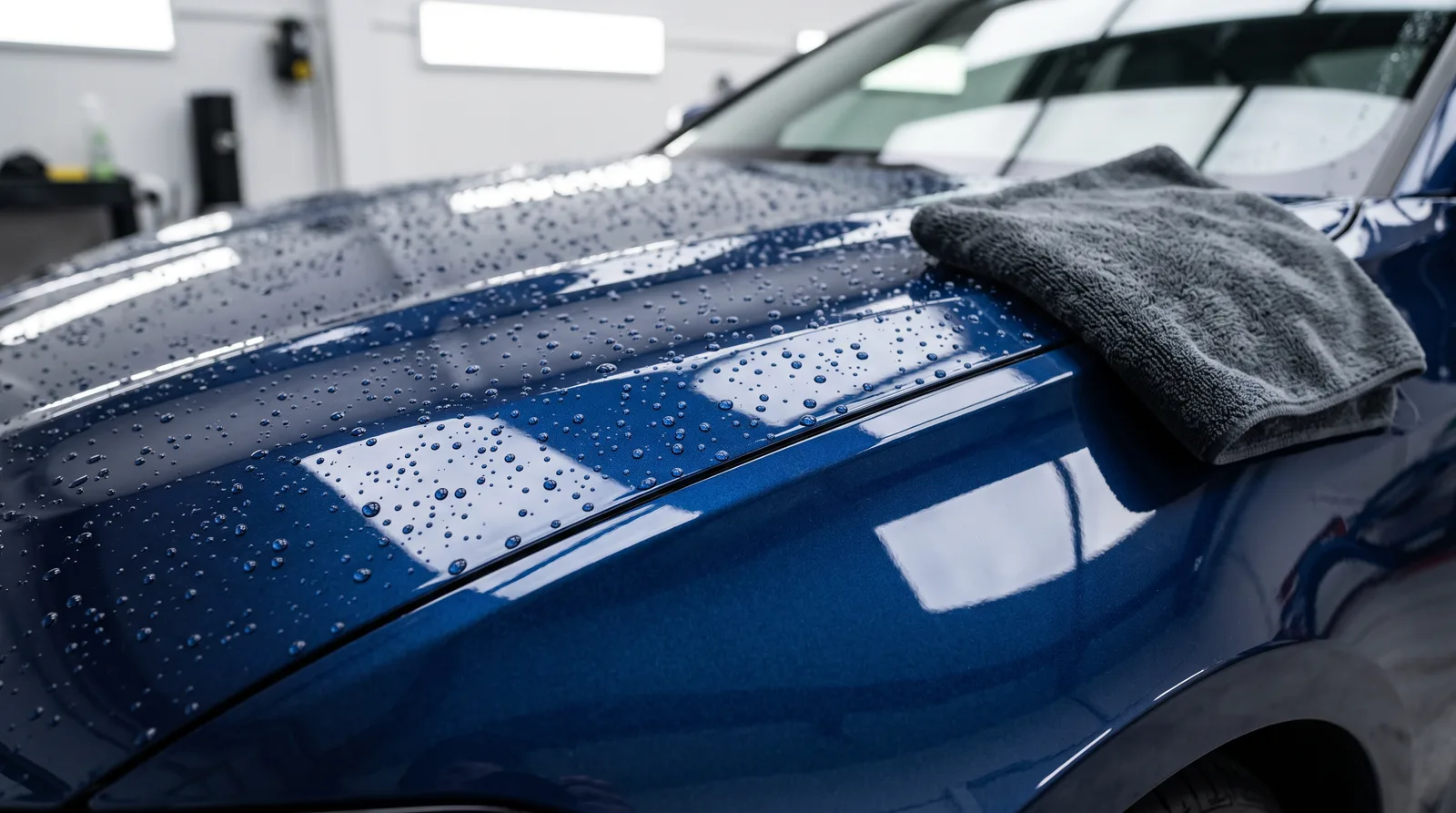
The best way to care for paint protection film is a gentle hand wash every 1 to 2 weeks using a pH-neutral car soap, the two-bucket method, a clean microfiber mitt, and a careful dry. It's the same routine we recommend for ceramic-coated paint, with a little extra attention to edges.
Step 1: Rinse first, from a respectful distance
Start with a thorough rinse to knock off loose grit before a mitt ever touches the film. A garden hose works fine. If you use a pressure washer, use a wide fan tip (25 to 40 degrees), keep the nozzle at least 12 inches from the surface, and never aim the stream directly at a film edge or seam. Spray across or along an edge, not into it. The most common way people lift film is by holding a narrow pressure-washer jet a few inches from the leading edge of the hood.
Step 2: Foam or pre-soak (optional but helpful)
A foam cannon or foam gun with pH-neutral soap adds lubrication and loosens bugs and road film before contact. It's especially useful in summer and love-bug season, when the front end of a Lee County car can be caked after one highway trip. Let the foam dwell for a few minutes, but don't let it dry on the surface in direct sun.
Step 3: Two-bucket contact wash
- One bucket of pH-neutral soap, one bucket of clean rinse water, ideally both with grit guards.
- Use a plush microfiber wash mitt, not a sponge or brush.
- Wash top-down, one panel at a time, with light pressure and straight-line passes.
- Rinse the mitt in the rinse bucket before every reload of soap.
- When you wash across a film edge, move with the edge (from the film onto the paint), not against it, so the mitt doesn't catch and push into it.
Step 4: Rinse and dry carefully
Rinse thoroughly, then dry with a large, plush drying towel or a filtered air blower. Don't let the car air-dry in the sun. Alabama heat evaporates water fast enough to leave mineral spots on film just like on paint. A blower is especially handy for pushing water out of seams, mirror edges, and badges so it doesn't drip and spot later.
How often should you wash PPF?
Every 1 to 2 weeks is the sweet spot for most daily drivers around Auburn and Opelika. Wash weekly if the car lives outside, under trees, or on I-85 and US-280 every day. Garage-kept weekend cars can stretch to every 2 to 3 weeks. Waiting too long doesn't hurt the film directly, but it lets contamination bond, and harder-to-remove contamination tempts people into harsher chemicals and scrubbing, which is where the damage starts.
Want film that's easy to live with from day one?
We install premium self-healing PPF in our Opelika shop and walk every customer through aftercare at pickup.
What NOT to do: the PPF mistakes that cause real damage
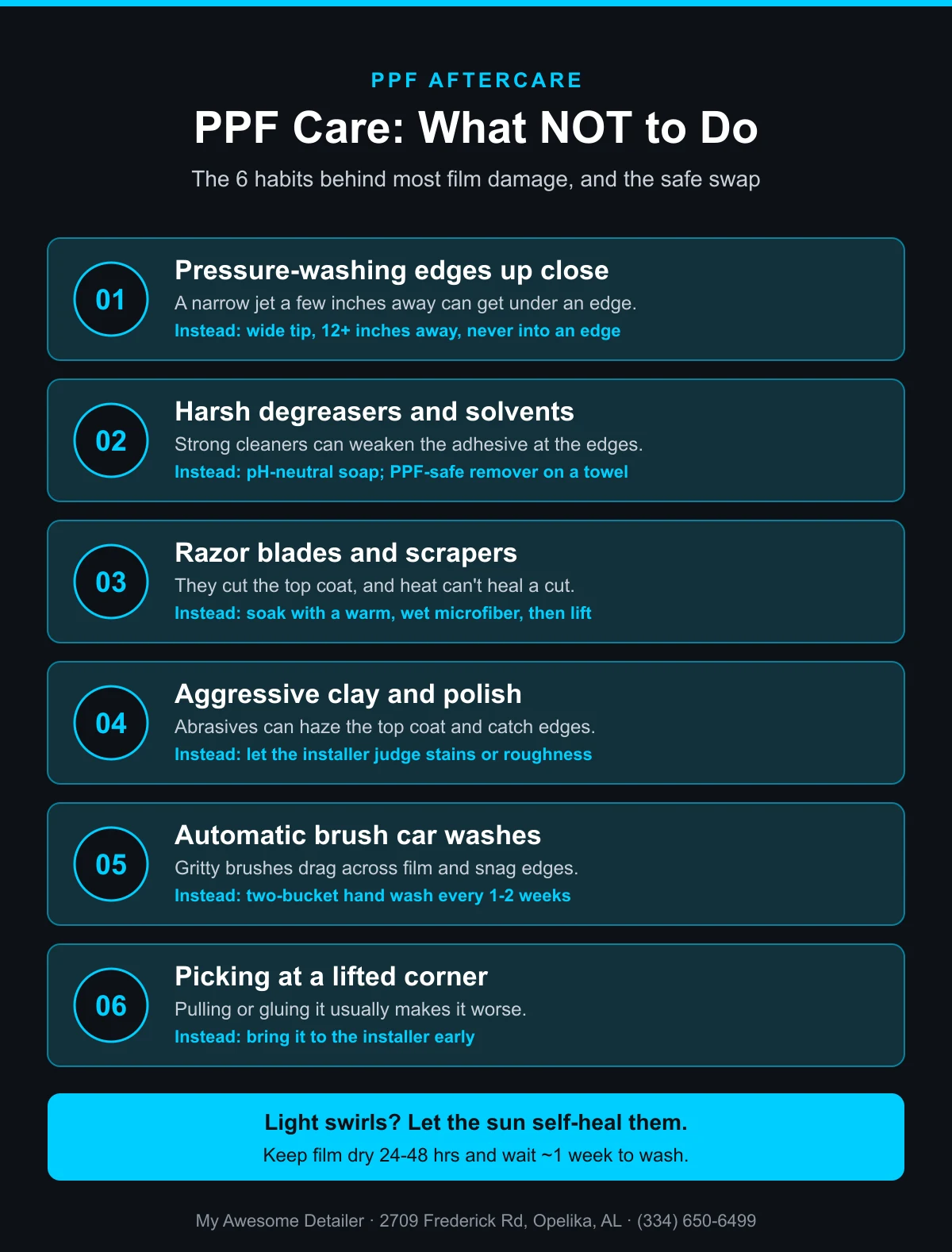
Most PPF problems we see aren't film failures; they're caused by a handful of well-meaning habits: pressure washing edges, harsh degreasers, razor blades, aggressive clay and polish, and automatic brush washes. Avoid these and you've handled most of PPF maintenance.
1. Harsh degreasers and solvents on the edges
Strong degreasers, undiluted all-purpose cleaners, citrus degreasers at full strength, and solvents like acetone or lacquer thinner can attack the adhesive at the film's edge. Engine degreaser overspray and wheel-cleaner runoff are common culprits, because they get sprayed near the bumper and fenders and left to sit. Over time, that weakens the edge, which then starts collecting a dark line of dirt or lifts entirely. If you need a bug, tar, or sap remover, use one that's labeled safe for PPF, apply it to a microfiber towel rather than spraying the edge directly, and rinse it off promptly.
2. Razor blades and scrapers
Never use a razor blade, plastic scraper, or your fingernail to remove dried bugs, tar, sap, or a stuck-on sticker from film. A blade will cut the self-healing top coat and can slice right through the film. That's damage heat can't heal, because material has been removed. Soften the contamination instead: soak a microfiber towel in warm soapy water or a PPF-safe remover, lay it over the spot for a few minutes, then lift it off gently. Repeat rather than scrape.
3. Aggressive clay and abrasive polishes
Clay bars, especially medium and heavy grades, are abrasive by design. On bare paint, they pull out bonded contamination. On film, aggressive clay can haze or mar the top coat, and a heavy hand at an edge can catch and lift it. The same goes for compounds and cutting polishes. Film rarely needs either. If the film feels rough or looks stained, that's a job for the installer, who can judge whether a light decontamination or a re-film is the right fix.
4. Automatic brush car washes
Tunnel washes with spinning brushes or cloth strips drag grit from hundreds of other cars across your film and can catch edges, especially on the bumper and mirrors. They also tend to use stronger detergents. A touchless wash is less risky in a pinch, but its high-pressure jets and harsh chemicals still aren't ideal for edges. Hand washing is the safest option.
5. Pressure-washing edges up close
We mentioned it above, and it's worth repeating because it's the single most common cause of lifted film we see: a narrow, high-pressure jet held close to an edge can get under it in one pass. Wide tip, at least a foot away, and never straight into an edge.
6. Wax and products with colorants or strong solvents
You don't need to wax PPF. If you want extra slickness, use a spray sealant or ceramic booster labeled safe for film. Avoid pastes and waxes with colorants or strong petroleum solvents, which can build up along edges and leave a stained or yellowish line where the film meets the paint.
7. Picking at a lifted corner
If you notice a corner starting to lift, leave it alone. Pulling on it, pressing it down with your thumb, or gluing it will usually make it worse and can contaminate the adhesive. Bring the car to the installer, who can clean and reset or replace that section properly.
Safe vs. unsafe PPF products at a glance
Use gentle, pH-neutral, film-safe products, and keep anything abrasive, harsh, or sharp away from the film. Here's a quick reference you can keep on your phone for the next trip to the auto parts store.
| Product or tool | Safe on PPF? | Notes |
|---|---|---|
| pH-neutral car wash soap | Yes | Use for every routine wash |
| Plush microfiber wash mitt and towels | Yes | Keep them clean; wash separately from shop rags |
| Foam cannon / foam gun | Yes | Great pre-wash for bugs and road film |
| PPF-safe bug, tar, and sap remover | Yes, occasionally | Apply to a towel, not directly on edges; rinse promptly |
| Spray sealant or ceramic booster (film-safe) | Yes | Optional; every 2–3 months if you want extra slickness |
| Quick detailer spray | Yes | Spot-clean fresh bird droppings and bugs |
| Pressure washer (wide tip, 12+ inches away) | With care | Never aim directly into film edges or seams |
| Touchless automatic wash | Occasionally | Less risky than brushes, but strong chemicals and jets hit edges |
| Harsh degreasers, undiluted APC, acetone | No | Can weaken adhesive and lift edges |
| Medium/heavy clay bar, compound, cutting polish | No | Abrasive; can haze the top coat and catch edges |
| Razor blades and scrapers | No | Cut the film; damage can't self-heal |
| Automatic brush or cloth tunnel washes | No | Grit, friction, and edge snagging |
| Paste wax with colorants or strong solvents | No | Can stain or build up along edges |
How self-healing keeps PPF looking new
Self-healing PPF has an elastic top coat that recovers from light scratches and swirls when it's warmed, so most everyday wash marks disappear on their own in the sun. That's a big part of why PPF maintenance is easier than bare paint.
On bare paint, every slightly dirty wash, every rough towel, and every fingernail around a door handle leaves a tiny scratch in the clear coat. Those build up over years until the paint looks hazy in direct sun and needs paint correction to bring it back. On self-healing film, those same light marks push the top coat out of shape without removing material. Add heat and the polymer relaxes back to flat. The swirl fades, often within minutes on a hot day.
That means your aftercare plan can be simple:
- Light swirls or wash marks? Park in the sun for an afternoon, or rinse the area with warm water. Alabama summers do most of the work for you.
- A mark that fades but doesn't disappear? Give it a couple of warm, sunny days.
- A mark you can catch with a fingernail? It's likely cut through the top coat. Heat won't close it, but your paint underneath is protected. If it bothers you, that panel can be re-filmed.
- Rock-chip dimples in the film? Hard impacts can leave a small pit in the film itself. That's the film doing its job. The paint underneath is intact.
What heat doesn't fix: stains from contamination that sat too long, lifting edges, or adhesive issues. Those are handled by prompt cleaning on your end and by the installer and the warranty on ours. Don't use a heat gun on film yourself. Installers use controlled heat, but it's easy to overdo and can damage the film or its edges.
Alabama-specific PPF aftercare tips for Auburn and Opelika
Lee County's heat, pollen, love bugs, red clay, and summer storms all affect PPF, so a little seasonal adjustment goes a long way. Here's what we tell customers who drive out of our Opelika shop.
Summer heat: rinse contamination fast
Bird droppings, tree sap, and bug splatter are acidic or sticky, and in a 95°F parking lot they bake onto the film quickly. Quality film resists staining well, but nothing is stain-proof if contamination sits for days in full sun. Keep a quick detailer spray and a clean microfiber towel in the car and remove fresh droppings the same day. Wash in the morning or evening, or in the shade, so soap and water don't dry on hot panels.
Love-bug season
Love-bug swarms in late spring and late summer can coat the front end of a car after one drive down I-85. On film, bug residue is much easier to remove than on bare paint, but it still shouldn't sit. Pre-soak with foam or a PPF-safe bug remover applied to a towel, let it dwell briefly, then wash gently. Never scrape them off. Our guide on bird droppings, sap, and love bugs covers the cleanup in more detail.
Spring pollen and red clay dust
Pollen and fine red clay dust are gritty. Wiping them off dry with a towel is a fast way to mar any surface. Always rinse first, then wash. In heavy pollen weeks, a weekly rinse, even without a full wash, keeps grit from building up along edges and seams.
Highway miles
Commuters on I-85 toward Montgomery or US-280 toward Birmingham put their film to work every day. Inspect the leading edge of the hood and the bumper a few times a year for rock-chip dimples, edge wear, or any section that looks different from the rest. Our guide to PPF for highway commuters explains why those areas take the most abuse.
Adding ceramic coating over PPF for easier maintenance
A ceramic coating on top of PPF makes the film much easier to wash, adds gloss and chemical resistance, and doesn't block self-healing. For many of our customers, it's the single biggest maintenance upgrade after the film itself.
A coated film sheds water, dirt, bugs, and pollen far more easily, which means less scrubbing and fewer chances to mar the surface. It also gives contamination one more layer to sit on before it reaches the film. The key is timing: coating should go on after the film has had its full cure window, typically at least a week, and after a professional has checked every edge for proper adhesion. Coating over a lifting or uncured edge can trap moisture underneath. We cover the full process in our guide to ceramic coating over PPF, and our ceramic coating maintenance guide lays out the wash routine for coated surfaces, which is nearly identical to the PPF routine above.
| Maintenance factor | PPF alone | PPF + ceramic coating |
|---|---|---|
| Recommended wash interval | Every 1–2 weeks | Every 1–2 weeks, usually faster and easier |
| Water beading | Moderate | Strong |
| Bug and sap removal | Easier than bare paint | Easiest; contamination releases with less effort |
| Gloss | High | Higher, with a deeper look |
| Self-healing | Yes | Yes; heat still reaches the film |
| Optional topper | Film-safe sealant every 2–3 months | Ceramic booster every 2–3 months |
When PPF edges or panels need professional attention
Bring your car to the installer if an edge lifts, a seam turns dark with dirt, bubbles appear after the first couple of weeks, a stain won't wash out, or the film is torn. These are fixable, but DIY fixes usually make them worse.
Lifting edges
A small lifted corner can often be cleaned and reset if it's caught early. Left alone, it collects dirt and water, spreads, and eventually needs the section replaced. Don't press it down, glue it, or trim it yourself.
Dirt lines along edges
A thin dark line along an edge usually means wax, polish residue, or grime has built up against it, or the edge isn't fully sealed. Gentle cleaning with a soft brush and soapy water often handles buildup. If the line is under the film, it's an installer issue.
Bubbles that appear later
Tiny water pockets in the first couple of weeks are normal. Bubbles that appear months later, or that grow, point to an adhesive or installation issue. The premium self-healing film we install carries a lifetime warranty against yellowing, cracking, bubbling, and delamination, so this is exactly the kind of thing to bring back to us. See our warranty page for details.
Stains that won't wash out
If a bird dropping, sap spot, or bug stain is still visible after a careful wash and a PPF-safe remover, don't reach for clay or polish. Let the installer evaluate it. Some stains fade with time and sun; others are best handled by replacing that panel's film.
Torn or gouged film
A curb, a parking garage column, or a hard scrape can tear the film. Once torn, its edges can lift and catch dirt. The paint underneath is usually fine, which is the whole point, and the fix is to re-film that panel, which is far simpler and cheaper than repainting it.
A yearly check-in
We recommend a quick professional inspection about once a year: every edge, every seam, and every high-impact area. It takes a few minutes and catches small issues while they're still small.
A simple PPF maintenance schedule
Here's the whole routine on one page.
- Day 1–2: Keep the film dry. No washing.
- First week: No pressure washing, no washing beyond gentle spot-cleaning, hands off the edges.
- Every 1–2 weeks: Two-bucket hand wash with pH-neutral soap, then a careful towel or blower dry.
- Same day, as needed: Remove bird droppings, sap, and bugs with a quick detailer or PPF-safe remover on a towel.
- Every 2–3 months (optional): Film-safe spray sealant or ceramic booster.
- A few times a year: Look over edges, seams, and the leading edge of the hood and bumper.
- Once a year: Professional inspection, and a maintenance detail if you want one.
That's it. No wax schedule, no polishing, no swirl removal. Most of the time PPF maintenance is just a good hand wash and a little restraint.
Why Auburn and Opelika drivers choose My Awesome Detailer for PPF
Good aftercare starts with a good install, and we do every film install in a controlled shop environment in Opelika. Film has to go on clean, decontaminated paint in a space free of dust and wind, with every edge carefully finished and sealed. That's why all of our installs happen at the shop, never in a driveway or parking lot, and it's a big reason our customers' edges hold up to years of washing.
- Owner's Pride Select installer: My Awesome Detailer is one of only about 40 shops in the U.S. to earn Owner's Pride Select status.
- 4.9 stars from 200+ reviews from drivers across Auburn, Opelika, and Lee County.
- Premium self-healing film with a lifetime warranty against yellowing, cracking, bubbling, and delamination.
- Aftercare you can actually follow: we walk you through the first-week rules and the wash routine at pickup, and we're a phone call away if an edge or stain ever looks off.
Explore our paint protection film and ceramic coating services, or call (334) 650-6499 to talk through coverage for your vehicle.
Have film that needs a check-up?
Lifting edge, stubborn stain, or just want a second opinion? Bring it by our Opelika shop and we'll take a look.
The bottom line on PPF aftercare
PPF maintenance comes down to a gentle routine and a short list of things to avoid. Keep the film dry for the first 24 to 48 hours and leave it alone for the first week. After that, hand wash every 1 to 2 weeks with pH-neutral soap and the two-bucket method, dry it carefully, and rinse off bird droppings, sap, and love bugs the same day. Keep pressure washers off the edges, keep harsh degreasers, razor blades, aggressive clay, and abrasive polishes away from the film, and skip the brush car wash. Let the sun and the self-healing top coat handle light swirls. When an edge lifts or a stain won't budge, call the installer instead of fixing it yourself. Do that, and your film will keep your paint factory-fresh for years in Auburn and Opelika's heat.