Quick answer: Yes. For drivers who commute on I-85 toward Montgomery or US-280 toward Birmingham, PPF is usually worth it, and it is worth more for them than for almost anyone else. Highway commuters pile up two to three times the miles of a mostly-local driver, nearly all of them at 65 to 75 mph behind trucks, which is exactly the combination that chips a hood and sandblasts a bumper. A full-front package in the Auburn-Opelika area typically runs about $1,500 to $2,500, while repainting a chipped bumper, hood, and fenders often costs $2,500 to $4,500 or more. Spread over five years of heavy commuting, full-front film works out to roughly a penny or two per mile. For a mostly-local driver, the same film is still a good idea on a newer or dark car, but the case is far less urgent.
If you live in Auburn or Opelika and work in Montgomery, Birmingham, Columbus, or anywhere else down a four-lane highway, you already know what your front bumper looks like after a year. The hood leading edge starts to look peppered. The bumper picks up white specks you can feel with a fingernail. The mirrors take a hit or two. None of it happened in a single trip. It happened a few rocks at a time, every morning and every evening, at highway speed.
At My Awesome Detailer LLC, 2709 Frederick Road in Opelika, we install premium self-healing paint protection film for drivers across Auburn, Opelika, and Lee County, plus Phenix City and Columbus, GA. A large share of the people who ask us "is PPF worth it?" turn out to be highway commuters, and the honest answer for them is different from the answer for someone who drives three miles to campus. This guide walks through why highway miles are so much harder on paint, runs the actual math for a heavy commuter versus a mostly-local driver, and helps you pick the right coverage for your drive. For the full price breakdown by coverage level, see our PPF cost guide for Auburn.
Why highway commuting is so hard on paint
Highway driving chips paint faster than city driving because of three things working together: speed, following traffic, and sheer mileage. Any one of them is manageable. All three at once, five days a week, is what turns a clean front end into a pitted one in a year or two.
Speed multiplies impact energy
The energy a rock carries into your paint rises with the square of the speed it hits at. That's basic physics, and it's the single biggest reason highway miles do so much more damage. A pebble you meet at 70 mph hits with roughly four times the energy of the same pebble at 35 mph. Around town, a lot of debris simply bounces off the clear coat. On the interstate, the same debris punches through the clear and the color coat and leaves a chip down to primer or bare metal.
Speed also matters from the other direction. Your own car is moving into the debris, and the truck ahead of you is throwing it backward off its tires at highway speed too. Close the gap on a rock that's already moving toward you, and the impact gets even harder.
Trucks throw more debris, higher
Both of the big commute corridors out of Lee County carry heavy truck traffic. I-85 is the main freight route between Atlanta and Montgomery. US-280 carries plenty of trucks too, including loads of gravel, sand, and construction material. Big tires pick up gravel and road grit and fling it backward at the height of a car's hood and bumper. Trucks hauling aggregate can shed material on their own. Construction zones and freshly patched shoulders add loose stone to the lane.
If you spend 45 minutes or more each way following that traffic, your front end is taking a steady stream of small hits the whole time. You won't notice most of them. Your paint will.
Mileage adds up faster than people expect
A round trip from Auburn to downtown Montgomery is somewhere around 110 to 120 miles. Do that five days a week for most of the year and you're looking at well over 25,000 miles annually, before weekend trips. A commute up US-280 toward the Birmingham area is longer still. Compare that with a typical in-town driver in Auburn or Opelika who might put on 8,000 to 12,000 miles a year, mostly under 45 mph.
More miles at higher speed means far more chances for a rock to find your hood. That's the whole persona-specific case in one sentence: a highway commuter's front end sees far more high-energy impacts per year than a local driver's, so the protection pays back far faster.
Sandblasting, not just chips
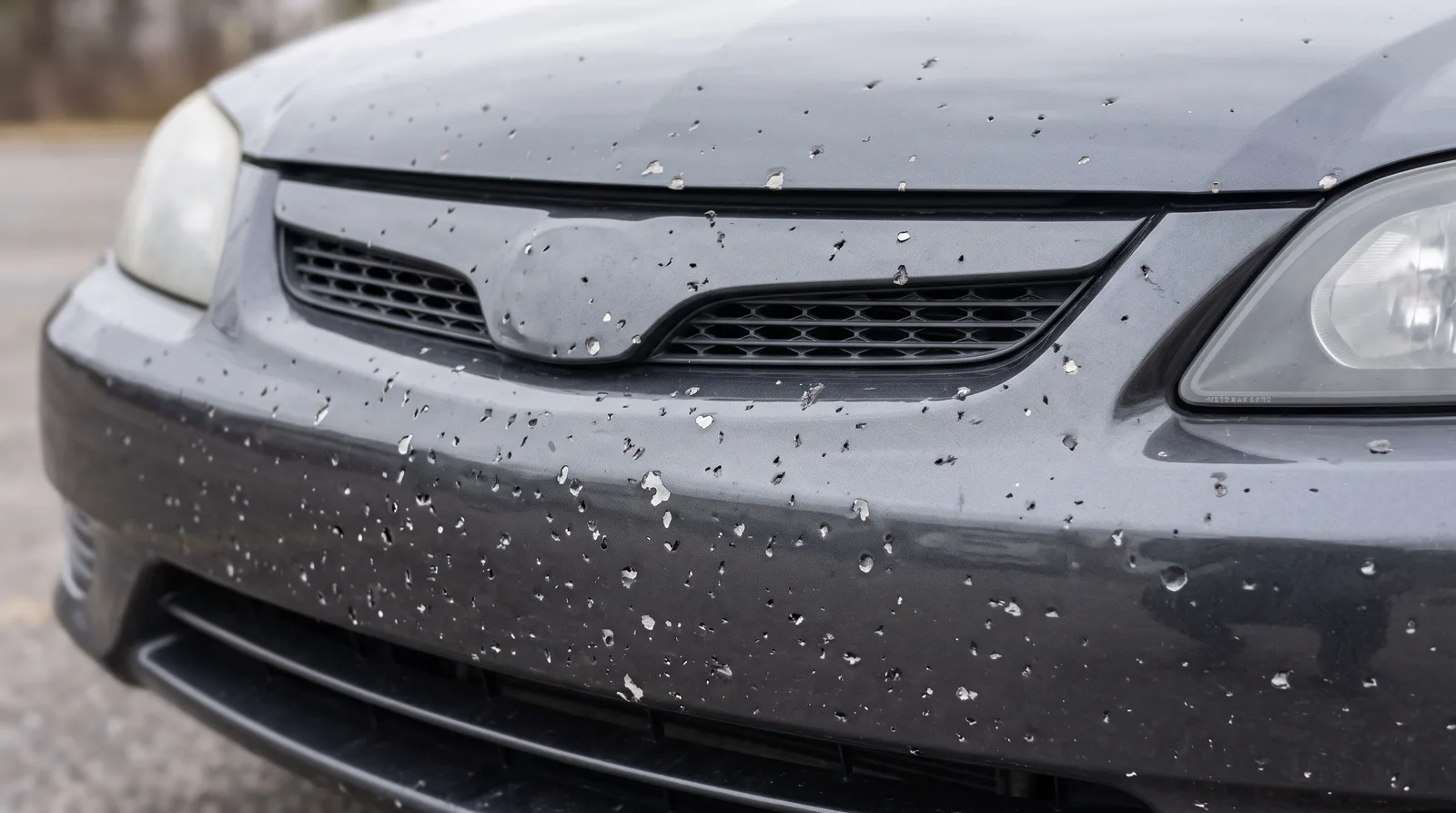
Rock chips get the attention, but heavy commuters also deal with sandblasting: a fine, dull haze of tiny pits across the bumper and the lower edge of the hood, caused by sand and grit at speed. Up close it looks like the paint has lost its gloss in one spot. It can't be polished out completely once the pits go through the clear coat, and it's one of the clearest tells that a car has lived on the highway.
Highway commuter vs. mostly-local driver: the side-by-side
The same car, the same paint, and the same film can make a very different amount of financial sense depending on how you drive it. Here's how the two driving profiles compare on the factors that actually determine paint damage. The mileage figures are typical estimates for the Auburn-Opelika area, not a guarantee for any specific driver.
| Factor | I-85 / US-280 highway commuter | Mostly-local Auburn/Opelika driver |
|---|---|---|
| Typical annual miles | 20,000–30,000+ | 8,000–12,000 |
| Share of miles at 60+ mph | Most of them | A small share |
| Impact energy per hit | About 4× a 35 mph hit at 70 mph | Mostly low-speed impacts |
| Time spent behind trucks | Daily, often 45+ minutes each way | Occasional |
| Sandblasting risk | High on bumper and hood edge | Low to moderate |
| How fast the front end looks worn | Often within 1–2 years | Usually much later |
| Recommended coverage | Full front (hood, fenders, bumper, mirrors, headlights) | Partial front, or full front on newer/dark/high-value cars |
The point isn't that local drivers never get chips. They do, especially on Opelika Road, the bypass, and the occasional trip to Atlanta. The point is that the commuter's risk is concentrated, predictable, and daily, which is the exact situation insurance-style protection is built for.
The math: is PPF worth it on a daily commute?
For a heavy highway commuter, full-front PPF typically costs less than one repaint of the panels it protects, and works out to about one to two cents per mile over five years. Let's walk through the numbers using the typical Auburn-Opelika ranges from our pricing guides.
What the film costs
- Partial front (bumper, leading edge of the hood and fenders, mirrors): about $700–$1,200
- Full front (full hood, full fenders, bumper, mirrors, headlights, no visible line across the hood): about $1,500–$2,500
- Full body (every painted panel): about $5,000–$8,000+
Your exact quote depends on the vehicle's size, the complexity of its body lines, and whether the paint needs correction before film goes on. Our guide to PPF coverage options explains exactly what each tier includes.
What doing nothing costs
Professionally refinishing a chipped front panel typically runs $500 to $1,200 per panel. A chipped bumper, hood, and both fenders can easily reach $2,500 to $4,500 or more. And even a good repaint is no longer factory paint, which buyers and appraisers notice. Touch-up paint is cheaper, but it never really disappears on a dark car, and on a commuter car the chips keep coming back faster than you can dab them.
Cost per mile, commuter vs. local driver
Here's an illustration using a mid-range full-front price of $2,000 over five years of ownership. The mileage figures are examples, so plug in your own.
| Scenario (5 years) | Total miles | Full-front PPF cost | Cost per mile | Likely repaint bill without film |
|---|---|---|---|---|
| Auburn → Montgomery commuter, ~25,000 mi/yr | ~125,000 | ~$2,000 | ~1.6¢ | Front end likely chipped; $2,500–$4,500+ to refinish |
| US-280 toward Birmingham, ~30,000 mi/yr | ~150,000 | ~$2,000 | ~1.3¢ | Front end likely chipped; possibly more than one repaint |
| Mostly-local driver, ~10,000 mi/yr | ~50,000 | ~$2,000 | ~4¢ | Some chips; repaint often optional |
| Mostly-local driver with partial front | ~50,000 | ~$950 | ~1.9¢ | Leading edges protected; rear of hood exposed |
Two things stand out. First, the heavier your commute, the cheaper the film becomes per mile, while the damage it prevents gets more certain. Second, for a heavy commuter, the "repaint bill without film" isn't a maybe. Five years of daily interstate miles will almost always leave a front end that either needs refinishing or visibly drags down the car's value.
For a mostly-local driver, film is still a smart buy on a new, dark, or expensive car, but a partial front often delivers most of the value for about half the money.
Commute on I-85 or US-280?
Tell us your vehicle and your daily drive, and we'll quote the coverage that actually fits it, installed in our Opelika shop.
Which PPF coverage makes sense for highway driving?
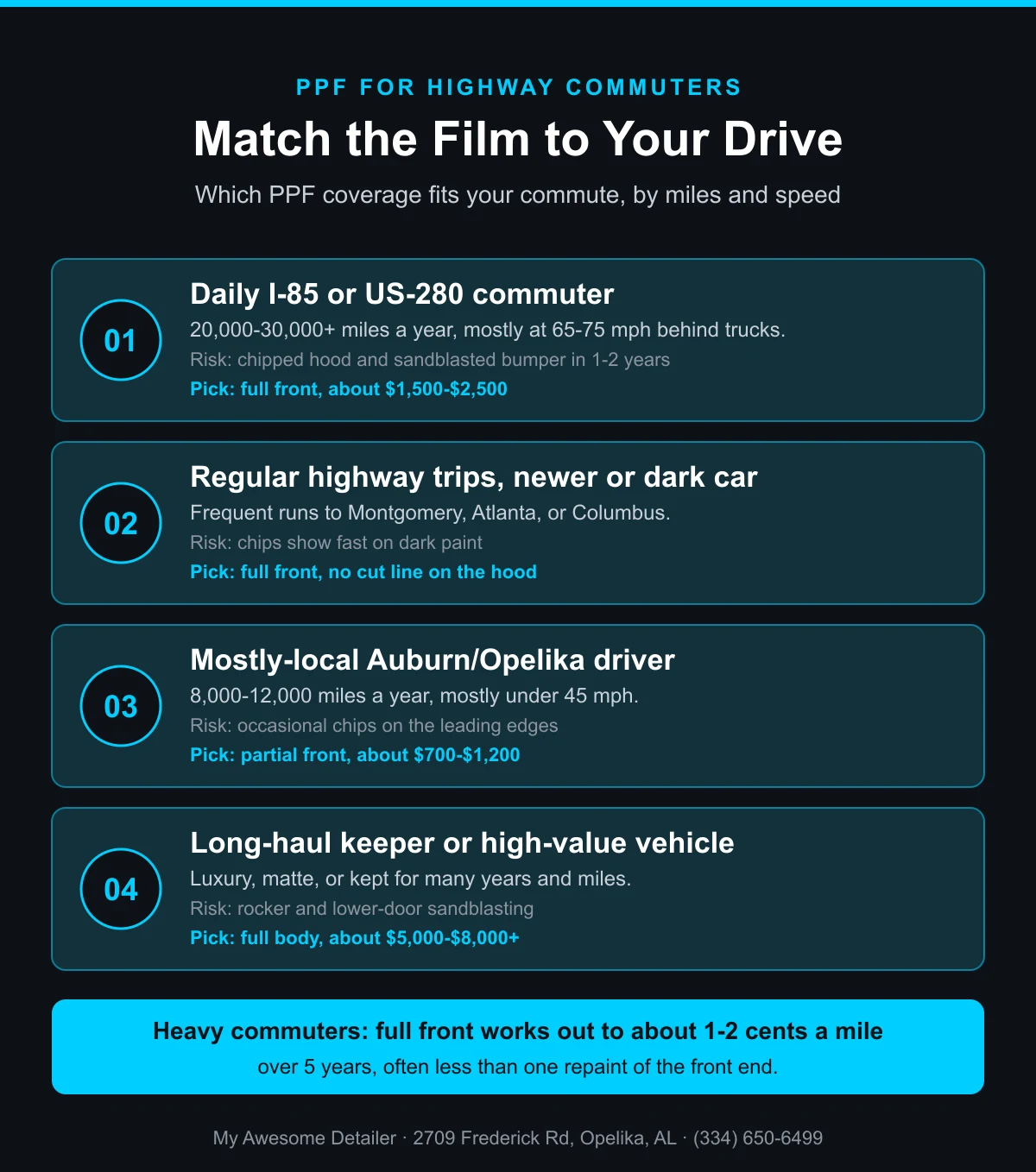
For most I-85 and US-280 commuters, full-front PPF is the right call, because it covers every forward-facing panel that takes highway debris and leaves no film edge in the middle of the hood. The infographic below summarizes how we match coverage to the way you drive.
Full front: the commuter default
Full front wraps the entire hood, both front fenders, the front bumper, the side mirrors, and the headlights. That's every surface that faces oncoming debris at 70 mph. Because the whole hood is covered, there's no cut line partway back where chips can start collecting right behind the film. For a car that spends hours a week on the interstate, that seamless coverage is what keeps the front end looking factory-new.
Partial front: good, with a catch for commuters
Partial front covers the bumper, the first section of the hood and fenders, and the mirrors. It's a great value for local drivers. For heavy commuters, the catch is the exposed rear portion of the hood. At highway speed, debris doesn't only hit the leading edge. Rocks that clear the bumper often land farther back on the hood, and over enough miles that unprotected area starts to show chips while the filmed area stays perfect. On a dark car, that contrast becomes very visible.
Full body: for long-haul keepers and high-value vehicles
Full-body film makes the most sense if you drive a luxury or exotic vehicle, have a matte finish, or plan to keep a car for many years and many highway miles. Heavy commuters also deal with debris kicked up by their own front tires onto the rocker panels and lower doors, and full-body film covers those areas too. If rocker-panel sandblasting is a concern on your vehicle, bring it up when you request a quote and we'll talk through your options.
What PPF doesn't cover
Paint protection film protects paint and headlights. It doesn't go on your windshield, so it won't prevent windshield chips or cracks from highway rocks. We mention it because highway commuters sometimes expect a full-front package to protect the glass too. It doesn't, and an honest shop should tell you that up front.
How self-healing film handles the daily highway grind
Quality PPF absorbs rock impacts in a thick urethane layer and has a self-healing topcoat that lets light scratches and swirl marks disappear with heat. For a commuter, that matters in two ways.
First, the film takes the hit instead of your paint. The urethane body of the film flexes and spreads out the impact of a small stone, so the rock marks the film rather than chipping through to primer. A hard enough hit can still damage the film itself, but replacing a section of film is far simpler than refinishing a painted panel, and the paint underneath stays factory-original.
Second, everyday wear doesn't accumulate the way it does on bare paint. Light swirls from washing, the fine marks from bug and road-grime cleanup, and minor scuffs fade back out when the film warms up. Alabama sun does a lot of that work for you on a hot afternoon in the parking lot. We explain how that works in detail in our guide to how PPF self-healing works.
The premium self-healing film we install at My Awesome Detailer is backed by a lifetime warranty against yellowing, cracking, bubbling, and delamination. For someone putting 25,000 highway miles a year on a car, that warranty is a large part of the value: the protection is meant to last as long as you own the vehicle.
The commute corridors around Auburn and Opelika
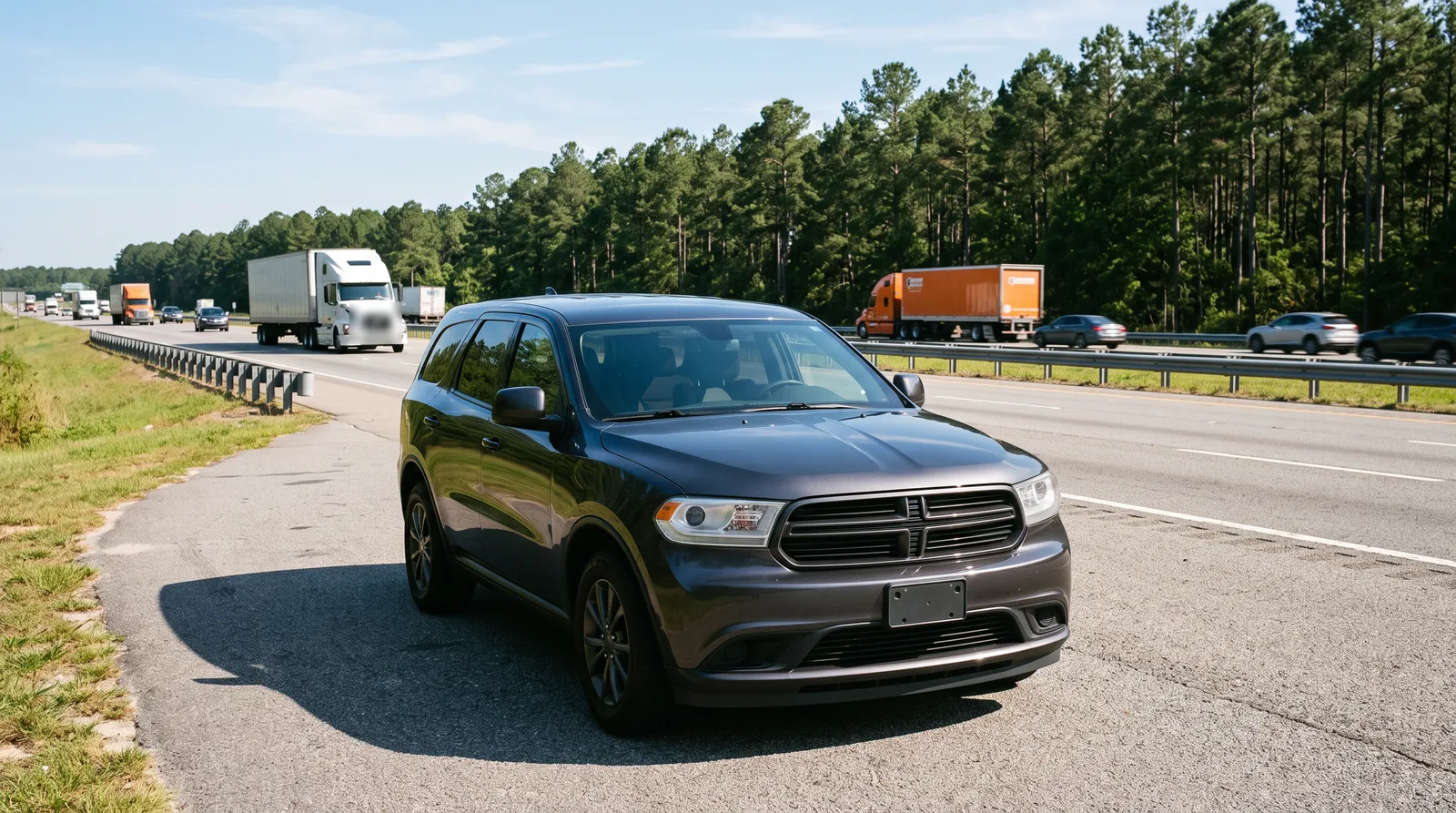
Not every Lee County commute is the same, but the routes that put the most stress on paint share one trait: long stretches at highway speed in mixed truck traffic. Here's how the common commutes we see at the shop compare.
I-85 southwest toward Montgomery
This is the classic heavy commute for Auburn and Opelika residents who work at state offices, the bases, hospitals, or manufacturing plants around Montgomery. It's roughly an hour each way, almost all of it at interstate speed, and I-85 is a major freight route. Daily Montgomery commuters are some of the best candidates for full-front film we see.
I-85 northeast toward LaGrange, West Point, and Atlanta
Drivers heading northeast for jobs along the I-85 corridor into Georgia face the same mix of interstate speed and truck traffic. Even if you only make the Atlanta run a few times a month, those trips add a lot of high-speed miles quickly, and Atlanta-area traffic means more time packed tightly behind other vehicles.
US-280 northwest toward Alexander City and Birmingham
US-280 is a four-lane divided highway for much of the run toward Birmingham, with stretches through rural areas where gravel and construction material move by truck. It's a long drive, and long drives at speed are exactly where chips accumulate. Commuters who work in the Birmingham area or around Lake Martin often rack up some of the highest annual mileage of anyone we protect.
East toward Phenix City and Columbus, GA
Drivers working in Phenix City or Columbus spend a lot of time on US-280 and US-431 heading east. The mileage isn't quite as high as the Birmingham run, but it's still daily highway driving, and it's still worth weighing full-front coverage if the car is newer or dark.
If your drive fits any of these patterns five days a week, put yourself in the "highway commuter" column of the comparison table above. If you only make these trips now and then, you're probably closer to the mostly-local profile.
When to get PPF if you commute
The best time to install PPF on a commuter car is as soon as possible after you buy it, ideally before it logs its first few thousand highway miles. Film protects paint from future damage. It doesn't erase chips that are already there.
New car, new commute
If you just bought a vehicle and you know it'll be doing the Montgomery or Birmingham run, the first few weeks are the ideal window. The paint is at its best, it needs only light preparation, and the film locks in a flawless front end before the first month of interstate miles does its damage. Our guide to new car protection in Auburn covers how film fits with ceramic coating and tint in a complete package.
Already have chips?
If your car already has a few chips, PPF can still be worth it, especially if you plan to keep commuting in it for years. The existing chips will still be there under the film, but no new ones will join them on the covered panels. Depending on the damage, small chips can sometimes be touched up before film goes on. If the front end is badly sandblasted or heavily chipped, it may make more sense to address the paint first. We'll look at it in person and give you a straight answer on whether film, repair, or both makes sense.
New job with a longer drive?
A lot of people come to us after their commute changes: a new job in Montgomery, a move out toward Lake Martin, a transfer that puts them on US-280 every day. If your annual mileage is about to double, that's the moment to reconsider protection. The car that didn't really need film for your old 10-minute drive may need it now.
Practical paint care tips for I-85 and US-280 commuters
Film handles the impacts, but a few habits make a real difference for any highway commuter's paint.
- Leave room behind trucks. Giving trucks a few extra car lengths, especially ones hauling gravel or sand, cuts down on how much debris reaches your front end. Debris thrown backward off big tires tends to drop before it travels far.
- Avoid riding in a truck's lane through construction zones. Loose stone on freshly patched pavement is a big source of chips. A lane change when traffic allows can help.
- Wash bugs off promptly. Highway miles mean bug splatter, and in Alabama's heat, insect residue can etch unprotected clear coat quickly, especially during love-bug season. Film gives you a protected surface that wipes clean, but prompt cleaning still keeps it looking its best.
- Use gentle washing methods. Hand washing with a pH-neutral soap keeps film and paint looking their best. Avoid harsh brushes and aggressive pressure washing near film edges.
- Consider ceramic coating over the film. A coating on top of PPF makes bugs, road film, and brake dust easier to wash off, which matters when you're cleaning a highway car every week. Read more in our guide to ceramic coating over PPF.
PPF and resale value for high-mileage cars
High-mileage cars are judged harder on condition, so a chip-free front end does more for a commuter car at resale time than for a low-mileage one. When a buyer or appraiser sees 120,000 miles on the odometer, they expect a worn front end. A car with that mileage and a clean, factory-original hood and bumper stands out immediately.
Without film, a commuter car often reaches trade-in time with exactly the damage that triggers a reconditioning deduction: a chipped hood, a sandblasted bumper, and maybe a repainted panel or two that the appraiser will question. With film that's been cared for, that deduction often disappears. PPF won't add a line item to the book value, but it removes some of the easiest reasons for a dealer to offer less. We dig into this in our guide to whether PPF protects resale value.
Is PPF worth it for your commute? A quick decision guide
Use these questions to decide quickly whether film makes sense for your daily drive.
PPF is very likely worth it if:
- You drive I-85, US-280, or another four-lane highway most workdays.
- Your commute is 30+ minutes each way at highway speed.
- You put 15,000 or more miles a year on the car.
- The car is newer, dark-colored, or expensive to repaint.
- You plan to keep the vehicle for three years or more.
Partial front or a ceramic coating may be enough if:
- You mostly drive around Auburn and Opelika at city speeds.
- Your annual mileage is under about 10,000.
- The car is light-colored, where small chips are less visible.
- You plan to sell or trade the car within a year or two.
A ceramic coating won't stop rock chips. Only film does that. But for a low-mileage local car, a coating's gloss, UV protection, and easy cleaning can be the more useful upgrade. Learn more on our ceramic coating page, or see how film and coating compare on our paint protection film page.
Why commuters choose My Awesome Detailer for PPF
We install film in a controlled shop environment in Opelika, which is exactly what a precision film install needs. PPF has to go on clean, decontaminated paint in a space free of dust and wind, and every panel is carefully fitted and its edges sealed so the film holds up to years of highway wind and pressure washing. That's why we do all of our installs at the shop, not in a driveway or parking lot.
- Owner's Pride Select installer: My Awesome Detailer is one of only about 40 shops in the U.S. to earn Owner's Pride Select status.
- 4.9 stars from 200+ reviews from drivers across Auburn, Opelika, and Lee County.
- Premium self-healing film with a lifetime warranty against yellowing, cracking, bubbling, and delamination. See our warranty page for details.
- Honest recommendations: if a partial front or a coating fits your drive better than full-front film, we'll tell you.
Most commuters drop the car off at our shop at 2709 Frederick Road and plan around the install time we give them with the quote. Call (334) 650-6499 or request a quote online to get started.
Protect your front end before the next 10,000 highway miles
Get a free full-front PPF quote for your commuter car from Lee County's Owner's Pride Select shop.
The bottom line
Is PPF worth it for a daily commute? For drivers who spend real time on I-85 toward Montgomery or US-280 toward Birmingham, the answer is a clear yes. Those miles are high-speed, high-volume, and spent behind the trucks that throw the most debris, and that adds up to far more paint damage per year than local driving. Full-front film typically costs less than one repaint of the panels it protects, works out to a penny or two per mile over five years, keeps the paint factory-original, and helps a high-mileage car hold its value. For mostly-local drivers, film is still a solid investment on newer, darker, or more valuable cars, but a partial front or a ceramic coating may be the smarter spend. Either way, the best time to protect a commuter car is before the chips start, not after.