Quick answer: Yes, PPF can help protect resale value, but not by adding a line item to the appraisal. What it does is keep the front end of your car free of the rock chips, sandblasting, and road rash that appraisers and buyers notice first, so the car lands in a better condition grade and the paint underneath stays factory-original. On a typical $25,000 to $45,000 truck or SUV, that difference in condition often matters more at sale time than the film's cost, especially if you'd otherwise face $2,500 to $4,500+ to repaint a chipped hood, bumper, and fenders. The film only helps if it still looks good, though: clear, edges intact, no yellowing. Aging or damaged film can hurt a sale, and sometimes it's smarter to remove or replace it before listing.
People who sell cars in Auburn and Opelika eventually learn the same lesson: buyers don't read the window sticker, they look at the paint. A hood covered in pinpoint chips makes a four-year-old SUV look like it has twice the miles. A clean, glossy front end makes the same SUV look like somebody cared. Paint protection film (PPF) is one of the most direct ways to control which of those two cars you end up selling.
At My Awesome Detailer LLC, 2709 Frederick Road in Opelika, we install premium self-healing paint protection film for drivers from Auburn, Opelika, and across Lee County, plus Phenix City and Columbus, GA. This guide answers the question we hear from people planning ahead and from people about to sell: does paint protection film help resale? We'll cover how PPF affects appraisals and private-sale prices, when it pays for itself and when it doesn't, what to do with film that's getting old, and how to present a protected car so buyers actually give you credit for it. If you're still pricing film, our PPF cost guide for Auburn lays out the numbers in detail.
Does PPF increase resale value?
PPF doesn't raise a car's book value, but it protects the condition that book value depends on. No pricing guide adds a fixed amount because a car has film. What every appraisal does weigh is exterior condition, and the front end is where condition gets lost first. Film keeps that area clean, which keeps the car in a higher condition grade and keeps the buyer from mentally subtracting the cost of a repaint.
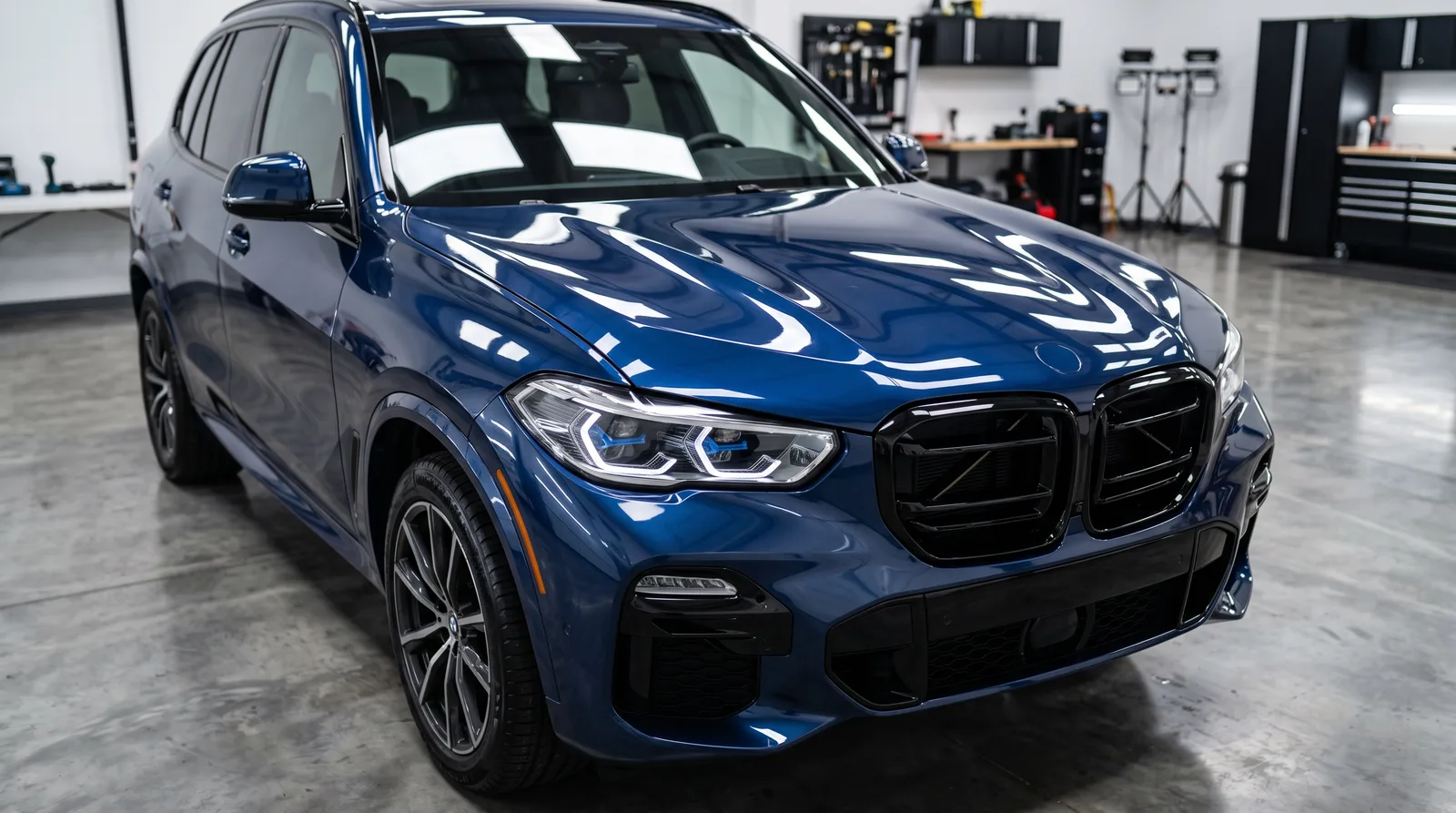
That distinction matters, because it changes how you should think about the purchase. PPF isn't an upgrade that "adds value" the way a factory option package does. It's insurance for the value you already paid for. The return shows up as damage that never happened: no chip clusters on the hood, no sandblasted bumper, no mismatched respray that a careful buyer spots in the parking lot.
Where the value actually comes from
- A better condition grade. Dealers and online buyers sort cars into condition tiers. Front-end chips and road rash are among the most common reasons a car drops a tier.
- Original factory paint. Film keeps the paint under it factory-original. Refinished panels can show up on a paint-depth gauge, and some buyers treat any repaint as a red flag, even when it was only for chips.
- Less to negotiate over. Every visible flaw is a talking point for a lower offer. A clean front end removes one of the easiest ones.
- A faster sale. Cars that photograph well get more attention. A glossy, chip-free hood looks better in listing photos than any description of "minor cosmetic wear."
Where it doesn't come from
Be honest with yourself about what film won't do. It won't fix a mechanical problem, a bad accident history, high mileage, or a worn interior. It won't make a $14,000 commuter sell for $18,000. And it won't help at all if the film itself looks worse than the paint would have. Resale value is the sum of the whole car; film protects one important part of it.
How dealers and private buyers judge your paint
To understand how PPF affects resale, it helps to know what actually happens when someone evaluates your car. Whether it's a trade-in desk, an instant online offer, or a buyer meeting you in a parking lot off Opelika Road, the paint check follows a predictable pattern.
The trade-in walkaround
An appraiser walks the car, usually starting at the front. They look down the hood under good light for chips and pitting, check the bumper face for sandblasting and scuffs, run a hand along the leading edges of the fenders and mirrors, and look for color or texture mismatches that suggest a panel has been repainted. Many carry a paint-depth gauge. Anything they find becomes a reconditioning cost they subtract from your offer, and they price it at what it costs them to fix, plus a margin.
The online instant offer
Online buyers ask you to rate your car's condition and then verify it at inspection. If you select "excellent" and the inspector finds a chipped hood, the offer gets revised down. A clean front end lets you choose the higher condition honestly, which is where most of the money in these offers is.
The private buyer
Private buyers are less systematic, but they're more emotional. They often decide how they feel about a car in the first 30 seconds, and the front end is what they see walking up. A hood covered in white specks tells them the car was driven hard. A flawless one tells them the opposite, and it makes them more willing to believe everything else you say about how the car was cared for.
Here's how those condition details tend to play out in each setting:
| What the buyer sees | Trade-in / dealer | Online instant offer | Private buyer |
|---|---|---|---|
| Chip-free, glossy front end (well-kept film) | No front-end recon deduction | Supports a higher condition rating | Strong first impression; easier to hold your price |
| Dozens of hood and bumper chips | Deduction for respray or chip repair | Condition downgrade at inspection | An easy reason to offer less |
| Repainted front panels (after chips) | May flag on a paint gauge; questions about history | May be noted at inspection | Some buyers ask "was it in an accident?" |
| Yellowed, peeling, or lifting film | Treated as damage; removal cost deducted | Condition downgrade | Looks neglected; can be worse than bare paint |
The last row is the one most people don't expect, and we'll come back to it. Film is only a selling point while it still looks like nothing is there.
The math: PPF cost vs. what rock chips cost you at sale time
The cleanest way to judge PPF resale value is to compare two costs: what the film costs up front, and what the chips it prevents would cost you, either in repairs before you sell or in a lower offer if you don't fix them.
Here are the typical PPF price ranges in the Auburn-Opelika area for 2026, as covered in our PPF coverage options guide:
| Coverage | Typical price (Auburn-Opelika, 2026) | What it covers | Resale role |
|---|---|---|---|
| Partial front | ~$700–$1,200 | Bumper, leading edge of hood and fenders, mirrors | Protects the worst-hit areas; a visible film line on the hood |
| Full front | ~$1,500–$2,500 | Full bumper, full hood, full fenders, mirrors, headlights | The best value for resale on most daily drivers; no hood cut line |
| Full body | ~$5,000–$8,000+ | Every painted exterior panel | For luxury, exotic, matte, collector, and long-term keepers |
Now the other side. Professionally refinishing chipped front panels typically runs about $500 to $1,200 per panel. A chipped hood, bumper, and both fenders can easily reach $2,500 to $4,500 or more, and the result is no longer factory paint. Skip the repair and sell the car as-is, and the buyer or dealer will knock off their own estimate of that cost, plus a cushion for their trouble.
| Scenario at sale time | Typical cost | What you end up with |
|---|---|---|
| Full-front PPF installed when the car was new | ~$1,500–$2,500 once | Original, chip-free front end; nothing to fix before listing |
| Repaint hood, bumper, and both fenders before selling | ~$2,500–$4,500+ | Clean look, but refinished paint a buyer may notice |
| Repaint just the bumper | ~$500–$1,000 | Bumper fixed; hood chips still visible |
| Touch-up paint dabs | ~$15–$40 DIY | Chips sealed against rust, but the dabs are obvious up close |
| Sell as-is with chips | $0 now | Lower condition grade and a weaker negotiating position |
Those are typical ranges, not quotes, and your car's numbers will depend on its color, size, and how many miles it covers. But the pattern is consistent: if you'd otherwise end up repainting the front end, a full-front package costs less than the fix and leaves you with better paint.
When PPF pays for itself on resale
- Higher-value vehicles. On a $40,000+ truck, SUV, or performance car, condition differences are worth more dollars, and buyers in that range look harder at the paint.
- Highway commuters. If you run I-85 toward Montgomery or Atlanta, US-280, or US-431 regularly, your front end takes a steady beating from gravel trucks and construction zones.
- Dark and hard-to-match colors. Chips show more on black, deep blue, and red, and tri-coat whites and metallics are harder to repaint invisibly.
- Cars you'll keep three years or more. Chips accumulate. The longer you own the car, the more damage film has a chance to prevent.
- Matte or special finishes. Matte paint can't be polished or spot-repaired like gloss paint. Protecting it matters at sale time.
When resale alone won't justify it
- Lower-value commuters you'll sell soon. On a $12,000 car you're trading in next year, film is about enjoying a clean car, not about getting your money back.
- Leases with modest mileage. Film can help you avoid excess-wear charges on a lease return, but if you drive mostly around town, the savings may be small. It depends on your lease terms.
- Cars that already have heavy chip damage. Film over existing chips locks them in. Paint repair or correction has to come first, which changes the math.
Planning to keep your car looking like new?
Get a free quote on self-healing paint protection film, installed in our Opelika shop.
Why chip-free front panels are an appraisable selling point
Most features that "help resale" are hard to see. A maintenance log is a stack of paper. A new set of tires is easy to overlook. A chip-free hood is different: it's visible from across the lot, it shows up in listing photos, and it holds up under the close inspection a serious buyer or appraiser gives the front of the car.
Why the front end matters most
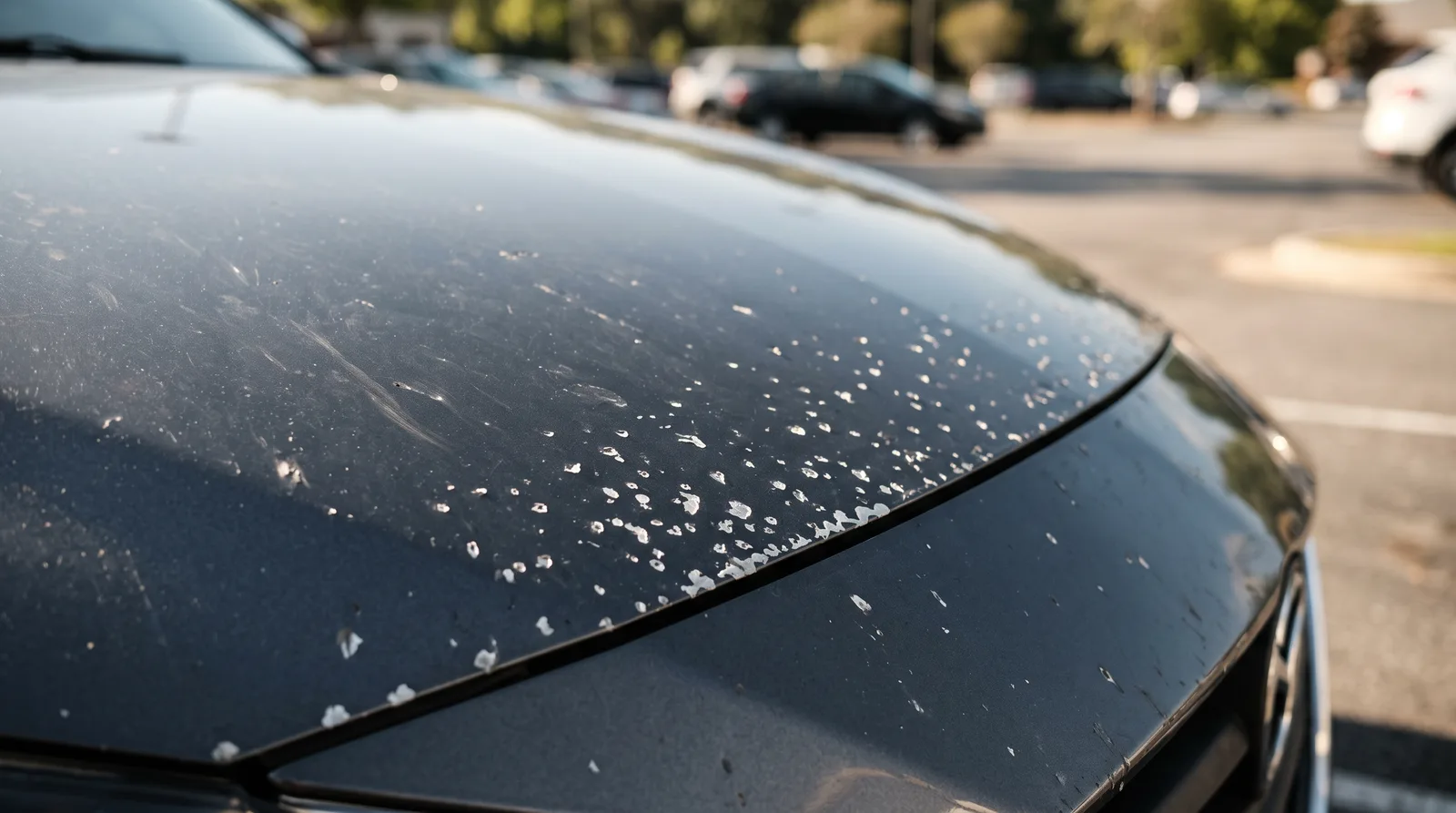
The front of a car does almost all of the work of pushing through road debris. The bumper face, the leading edge of the hood, the front of the fenders, and the mirror caps catch the pebbles, sand, and grit that the vehicle ahead kicks up. On Alabama highways, add the spring and fall love bug seasons, construction zones, and gravel spilling off work trucks. A daily commuter can pick up visible chips within the first year, and they don't go away on their own.
Why original paint beats a respray
When chips get bad enough, many owners repaint the front end before selling. It looks clean, but it creates a new question. A paint-depth gauge or a sharp eye can pick up panels that were refinished, and a buyer who finds one wonders why. Was it chips, or was it a collision that doesn't show on the history report? Even if you have a good answer, you're now explaining instead of selling. Film avoids the question entirely, because the factory paint underneath was never touched.
Why it supports everything else you tell the buyer
Sellers say "it's been well taken care of" about almost every car. A buyer who sees a flawless front end on a car with real miles on it is more inclined to believe it. In our experience, condition you can see makes the claims you can't see more believable, from oil changes to how the interior was treated.
What "well-maintained film" means to a buyer
Here's the part of the PPF resale value story that most sales pitches skip: film helps resale only while it still looks invisible. A buyer doesn't give you credit for film. They give you credit for a front end that looks perfect. Film that has yellowed, cracked, lifted at the edges, or collected dirt along its seams does the opposite. It looks like damage, and it suggests the car wasn't cared for.
The good news is that quality film, installed well and cared for reasonably, stays clear for a long time. Quality paint protection film typically lasts around 10 years, and the premium self-healing film we install carries a lifetime warranty against yellowing, cracking, bubbling, and delamination. Here's what a buyer or appraiser checks, whether they realize it or not:
| Checkpoint | What helps resale | What hurts resale |
|---|---|---|
| Clarity | Film is invisible; paint color looks true | Yellow or cloudy tint, especially obvious on white and silver |
| Edges | Edges wrapped or tucked cleanly and sealed down | Lifted, peeling, or dirt-lined edges |
| Surface | Glossy, smooth, light swirls self-healed | Cracks, deep scratches, tears, or bubbles |
| Coverage line | Full-panel coverage with no visible line on the hood | A partial-hood line that has collected grime |
| Paperwork | Install receipt, film type, warranty details | No records; buyer has to guess what's on the car |
Self-healing keeps the finish looking new
Modern film has an elastic top coat that recovers from light swirls and wash marks when it's warmed by the sun or warm water. In an Alabama summer, that happens naturally on a lot of days. It means the film doesn't build up the haze of swirl marks that older "clear bra" films did, which is a big reason film installed today ages much better than film from a decade ago. Our guide on how PPF self-healing works explains what it can and can't fix.
Ceramic coating on top makes it easier to keep clean
Many owners add a ceramic coating over their film. It doesn't add impact protection, but it makes the film easier to wash, helps it shed bugs and grime, and helps keep the edges cleaner. If you want the front end to look its best when it's time to sell, that combination is worth considering. We cover it in ceramic coating over PPF.
Should you remove old PPF before selling your car?
If you're asking about PPF before selling your car, there are two very different situations. If your film is in good shape, leave it alone. It's still protecting the paint, and it's an easy selling point to mention. If it's aging badly, it can drag down the first impression, and removal or replacement may be worth it before you list.
Keep the film if:
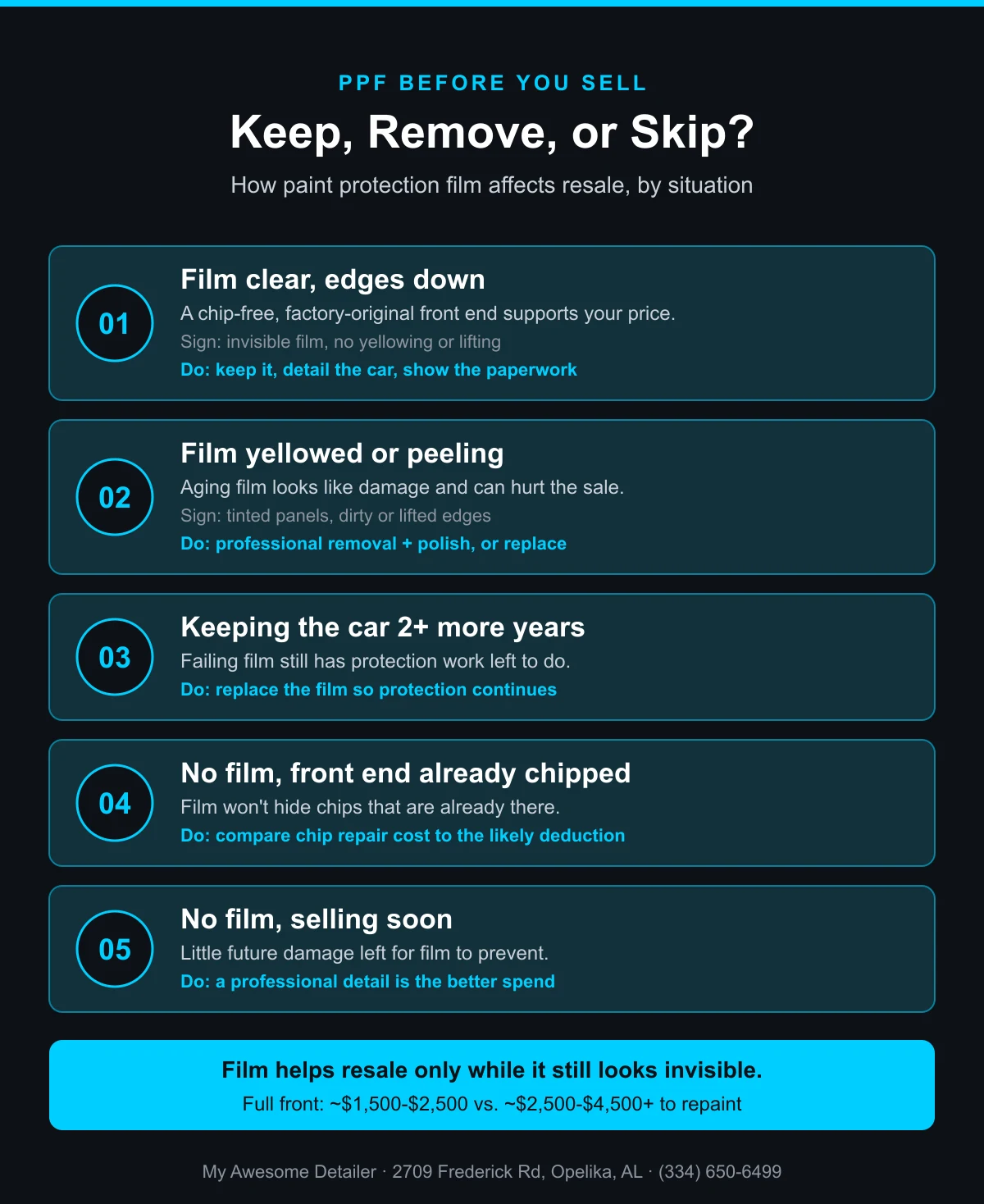
- It's clear, with no yellowing you can see against unfilmed panels.
- The edges are down and clean.
- The surface is smooth with no cracks, tears, or bubbles.
- You can show the buyer what's on the car and when it was installed.
Consider removal or replacement if:
- The film has yellowed. Older or budget films can discolor over time, and it's most obvious on light colors where the filmed panels no longer match the rest of the car.
- The edges are lifting or peeling. Lifted edges trap dirt and look like damage to anyone walking up.
- It's cracked or torn. Film that has taken hard hits has done its job, but it looks rough.
- It's an old partial kit with an obvious line. A grimy line across the hood tells a buyer exactly where the protection stopped.
What happens to the paint underneath
When quality film is removed correctly, the paint underneath is typically in excellent condition, because it has been shielded from chips, UV, and contamination the whole time. Professional removal uses controlled heat and patience so the adhesive releases cleanly. Pulling old film yourself, especially film that has baked in the Alabama sun for years, risks leaving adhesive residue or, on paint that was previously repaired, lifting paint with it. If the film has been on for a long time, have it removed by a shop that does this work regularly.
Once the film is off, a light polish usually brings the paint up to match the surrounding panels. At that point you have two options: sell with clean, original paint, or put fresh film on if you're keeping the car a while longer. If you're deciding between those, the timing of your sale is the key question.
Timing it before a sale
| Your situation | Best move for resale |
|---|---|
| Selling within a few weeks, film in good shape | Keep it; wash and detail the car; have your paperwork ready |
| Selling within a few weeks, film yellowed or peeling | Professional removal plus a polish; sell with clean original paint |
| Keeping the car another two or more years, film failing | Replace the film so the protection continues |
| Selling soon, no film, front end already chipped | Don't install film now; it won't hide chips. Compare chip repair cost to the likely deduction |
| Selling soon, no film, paint still clean | A detail and polish is usually the better spend than new film |
That last row is worth repeating: installing PPF right before a sale is rarely a good resale move. The film protects against future damage, and if you're selling next month there isn't much future left. Put that money into a thorough professional detail instead.
Partial, full front, or full body: which coverage is best for resale?
If resale is part of why you're considering film, the coverage you choose matters almost as much as the decision to get film at all.
Partial front
Partial front kits protect the bumper and the first part of the hood and fenders. They stop most of the worst bumper damage at the lowest cost. The trade-off is a visible line across the hood where the film ends, and chips can still build up on the unprotected rear portion of the hood. For resale, it's a reasonable budget option on a lower-value car, but buyers may notice the line, especially if it has collected grime.
Full front
Full front covers the entire hood, full fenders, full bumper, mirrors, and headlights, with no line on the hood. For most daily drivers, it's the sweet spot for resale: it protects every panel that faces the road, it's invisible when installed well, and it costs a fraction of what a full repaint would. This is the package we recommend most often to Auburn and Opelika commuters.
Full body
Full-body film protects every painted panel, including doors, rockers, quarter panels, roof, and trunk. It makes the most sense on luxury, exotic, and collector vehicles, matte finishes, and cars you plan to keep a long time. It also protects against the door dings, parking lot scuffs, and rocker-panel sandblasting that front-only coverage doesn't touch. On high-value cars, where paint condition is a big part of the price, it's the strongest resale play.
Add high-impact extras
Many owners add rocker panels, door edges, door cups behind the handles, and the rear bumper's loading area on SUVs and trucks. These spots show wear that buyers notice when they open doors and the tailgate, and they're inexpensive to cover compared to a full body.
How to present a car with PPF so buyers give you credit
Film does its job quietly. If you don't tell the buyer it's there, they may never know why the front end looks so good, and they'll give you less credit for it than you deserve. A little presentation goes a long way.
Keep the paperwork
Save the invoice from your installation, along with the film type, the coverage you chose, and the warranty information. Put it in the same folder as your maintenance records. A buyer who sees a dated receipt for protection installed when the car was new has a concrete reason to trust the condition. If you want to know what's covered under your warranty, see our warranty page or ask us directly.
Say it in the listing
Mention the film plainly: "Full-front paint protection film installed when new; factory paint, no chips." Then let your photos prove it. Take a well-lit photo looking down the hood and one straight on at the bumper. Buyers scrolling listings respond to evidence, not adjectives.
Detail before you list
Give the car a full wash and detail before photos and showings. Clean the film edges gently with a soft brush and a quality cleaner, dry the car fully, and make sure no wax or polish residue is stuck along the film seams. A clean car with clean film looks newer than it is.
Show the buyer the edges
If a buyer looks closely, show them how the film wraps the edges of the hood and fenders. A tidy installation with edges sealed down signals quality work, and it answers their unspoken question about whether the film will start peeling as soon as they own it.
Looking after your film so it's still a selling point years from now
A few simple habits keep film looking new and keep it working for your resale value over the years you own the car.
- Wait before the first wash. Give the film time to settle after installation, following your installer's aftercare instructions.
- Hand wash or use touchless washes. Brush tunnel washes can mar the top coat and catch film edges.
- Keep pressure washers away from edges. Spray at an angle and keep the tip at a safe distance so water doesn't get under the film.
- Remove bugs and bird droppings promptly. In an Alabama summer, they bake onto the surface fast. Film protects the paint, but cleaning it soon keeps the film looking its best.
- Use film-safe products. Avoid harsh solvents and abrasive polishes on the film, and don't let wax build up along the edges.
- Get damage looked at early. If a panel takes a hit that tears or lifts the film, have it checked. A damaged section can usually be re-filmed without redoing the whole car.
Parking in a garage or shade when you can also helps. Our Alabama heat is great for activating the film's self-healing, but years of direct sun and UV are hard on any exterior finish.
Common myths about PPF and resale value
Myth: "Dealers don't care about PPF, so it doesn't help."
Dealers may not add money for film, but they absolutely care about chips, sandblasting, and repainted panels. Film helps by keeping those deductions off the appraisal.
Myth: "Film damages the paint when it comes off."
Quality film removed correctly comes off cleanly, and the paint underneath is usually in better shape than the rest of the car. Problems mostly come from cheap film, careless removal, or paint that was poorly repainted before the film went on.
Myth: "I can put PPF on right before selling to boost the price."
Film protects against damage that hasn't happened yet. It won't hide existing chips, and if you're selling soon there's little damage left for it to prevent. A detail is the better pre-sale spend.
Myth: "Any film is fine; buyers can't tell the difference."
Buyers can tell the difference between film that is invisible and film that is yellow, cloudy, or peeling. Budget film that ages badly can hurt resale more than no film at all.
Myth: "A ceramic coating gives the same resale protection."
Coatings add gloss, easier washing, and chemical resistance, which help appearance. They're too thin to stop rock chips. For front-end chip protection, film is the tool; a coating works best on top of it. Our post on ceramic coating and resale value covers what coatings do for a sale.
Why Auburn and Opelika drivers choose us for PPF
Film only protects resale value if it's installed well enough to stay invisible for years. That comes down to prep, fit, and the film itself.
- Shop-based installs. Every film job is done inside our shop at 2709 Frederick Road, Opelika, in a clean, controlled environment.
- Premium self-healing film with a lifetime warranty against yellowing, cracking, bubbling, and delamination.
- Paint prep done right, including decontamination and correction when the paint needs it, so the film locks in a clean finish. See how it works in our PPF installation process guide.
- Owner's Pride Select installer, one of the top ~40 shops in the U.S.
- 4.9 stars from 200+ reviews from drivers across Auburn, Opelika, and Lee County.
Explore our paint protection film services, learn more about our team, or see all of our services.
Protect the paint you'll be selling someday
Get a free PPF quote, or bring in older film for an honest keep-or-replace assessment at our Opelika shop.
The bottom line
Does paint protection film help resale? Yes, in the way that counts: it keeps the front end of your car chip-free and its paint factory-original, which keeps the car in a better condition grade and takes away the easiest reasons for a buyer or dealer to offer less. It pays off most on higher-value vehicles, highway commuters, dark or hard-to-match colors, and cars you'll keep for years. It pays off least on low-value cars you're selling soon, and installing film right before a sale rarely makes sense. Above all, film helps only while it still looks invisible. Keep it clean, keep the paperwork, and if older film has yellowed or started peeling, have it removed or replaced before you list. Do that, and your film turns into something a buyer can see for themselves: a front end that looks the way the car did on day one.