Quick answer: Yes, PPF is worth it on a regular daily driver if you plan to keep the car for four years or more. Paint protection film isn't an exotic-car luxury. It's chip insurance, and the cars that collect the most chips are the ones driven every day. In the Auburn-Opelika area, a partial front typically runs about $700 to $1,200 and a full front about $1,500 to $2,500. Spread over seven years of ownership, full front works out to roughly $215 to $360 a year, or about $18 to $30 a month, to keep the front end factory-original. Where it's usually not worth it: a car you'll sell within a year or two, or one whose front end is already heavily chipped.
Ask most people what kind of car gets paint protection film and they'll picture a Porsche, a Corvette, or something with a price tag that makes a rock chip feel like a disaster. That's where PPF got its reputation. But the cars that actually take the most abuse aren't the ones parked in climate-controlled garages and driven on sunny Sundays. They're the family SUVs, commuter sedans, and work trucks that go to work, school, practice, the grocery store, and Jordan-Hare on game day, every week, all year.
At My Awesome Detailer LLC, 2709 Frederick Road in Opelika, a big share of the paint protection film we install goes on normal cars: Camrys, RAV4s, Accords, Tahoes, F-150s, Model Ys. Their owners aren't trying to protect a collector car. They just want the car they bought to still look like it did when they bought it. This guide pushes back on the "PPF is only for exotics" myth, walks through the cost-per-year math for a daily driver, and is honest about the cases where film isn't the right spend. If you want the full price breakdown first, start with our PPF cost guide for Auburn.
The myth: "PPF is only for exotic cars"
PPF earned its exotic-car reputation because that's where it first became common, not because it only makes sense there. High-end sports cars were the early adopters for a few reasons: their paint is expensive to refinish, their owners are picky about originality, and their low, wide front ends catch a lot of debris. All of that is true. None of it means a $35,000 sedan doesn't benefit.
Where the myth comes from
For years, film was thicker, harder to install, more visible, and priced like a specialty product. Early films could yellow, and installs often left obvious edges. If you were going to put up with that, it had to be for a car where a single chip felt unacceptable. Modern film is a different product. Today's premium urethane films are clear, thin enough to follow body lines closely, and topped with a self-healing layer that makes light scratches fade with heat. Pricing also came down to the point where a partial front on a normal sedan costs less than a set of good tires.
Why it's backwards for most people
Think about who actually puts miles on a car. An exotic might see 3,000 miles a year, mostly on dry days, mostly kept at a careful distance from other traffic. A daily driver in Lee County might see 12,000 to 15,000 miles a year, in rain and pollen and love-bug season, behind dump trucks on the bypass and pickups on Opelika Road. Rock chips are a function of miles and exposure. The car that's out there the most is the car that gets chipped the most.
There's also a simple ownership difference. Exotic owners often trade cars frequently. Daily-driver owners tend to keep their cars a long time, frequently six, eight, or ten years. The longer you keep a car, the more years film has to pay you back.
The "too minor to repaint, too ugly to ignore" problem
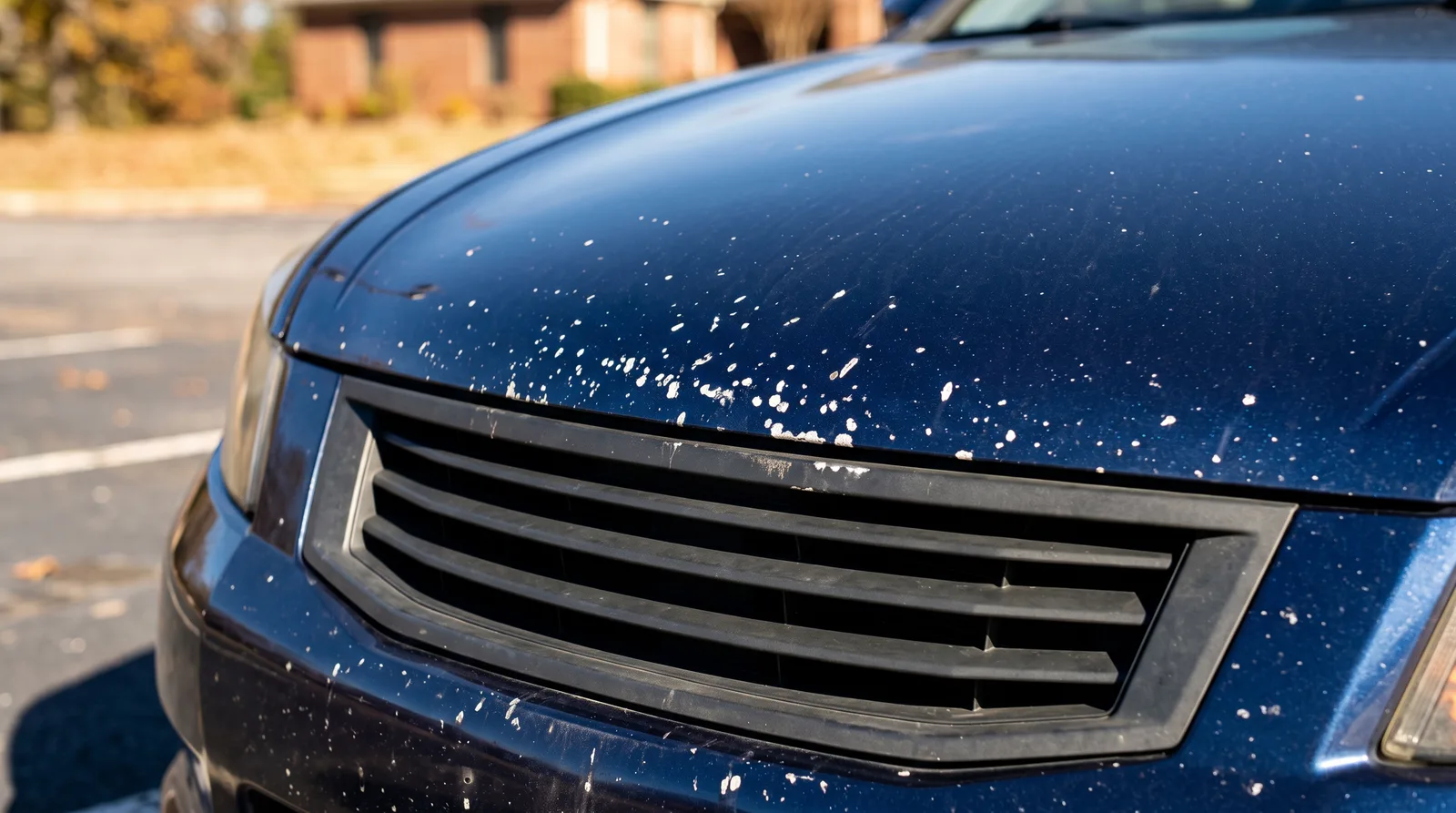
The real case for PPF on a daily driver isn't the catastrophic hit. It's the slow pile-up of small chips that never justify a repaint but make the car look older every year. We call it chip limbo, and almost every daily driver ends up there.
Here's how it usually goes. Six months in, you notice one white speck on the hood. It's tiny. You're not going to spend $600 refinishing a hood over one chip. A year later there are five. Two years in, the leading edge of the hood and the front bumper look peppered in bright sun, and the dark car you were proud of now looks tired from the front. Still, none of it is "bad enough" to justify a body shop bill, so you live with it. That's the problem: the damage that film prevents is exactly the damage most people never fix.
Why chips are harder to fix than they look
- Touch-up paint rarely disappears. A dabbed chip is filled, but it usually still shows as a small raised or dull spot, especially on dark or metallic colors. It stops rust; it doesn't restore the finish.
- Paint correction can't remove a chip. Polishing removes swirls and light scratches in the clear coat. A chip is missing paint, so there's nothing to polish back. Our guide to car scratch repair, paint correction, and touch-up explains which damage each fix can and can't handle.
- A repaint is no longer factory paint. Professionally refinishing a front panel typically runs $500 to $1,200 per panel. A bumper, hood, and both fenders can reach $2,500 to $4,500 or more, and the result is a respray, not the original finish.
- Chips keep coming. Even if you repaint, the very next season of driving starts the cycle over.
So the choice for most daily drivers isn't "PPF or repaint." It's "PPF or slowly accept a chipped front end." Framed that way, the film is a lot easier to justify.
The cost-per-year math for a daily driver
The fairest way to judge PPF on a normal car is cost per year of ownership, because that's how you actually experience the benefit. A $1,800 install sounds like a lot in one bill. Over seven years, it's about $257 a year, or roughly $21 a month, for a front end that stays factory-original the whole time.
These are typical Auburn-Opelika price ranges. Your exact quote depends on the vehicle's size, how complex its body lines are, and whether the paint needs any correction before the film goes on.
| Coverage | Typical price | Per year (4-yr ownership) | Per year (7-yr ownership) | Per year (10-yr ownership) |
|---|---|---|---|---|
| Partial front (bumper, leading edge of hood and fenders, mirrors) | $700–$1,200 | $175–$300 | $100–$171 | $70–$120 |
| Full front (full hood, fenders, bumper, mirrors, headlights) | $1,500–$2,500 | $375–$625 | $214–$357 | $150–$250 |
| Full body (every painted panel) | $5,000–$8,000+ | $1,250–$2,000+ | $714–$1,143+ | $500–$800+ |
Two things jump out. First, ownership length matters more than the sticker price. The same full-front package costs less than half as much per year if you keep the car ten years instead of four. Second, for most daily drivers, the front-end packages are where the value lives. Full-body film is a great product, but on a normal car it's usually more protection than the risk calls for.
Compare that with doing nothing
"Doing nothing" isn't free. It just moves the cost to later, in one of three forms:
- A repaint bill of $2,500 to $4,500+ for the front end if the chips eventually bother you enough.
- A lower trade-in or private-sale price, because a chipped, sandblasted front end is one of the first things a buyer or appraiser sees. We cover that in detail in our guide to whether PPF protects resale value.
- Living with it: seven years of looking at a front end you don't love on a car you paid good money for.
Only you can put a price on the third one, but for a lot of our customers it's the deciding factor. They didn't buy a new car to have it look used by year two.
Exotic vs. daily driver: who gets more out of the film?
Here's the same question looked at side by side. The figures are typical examples, not a guarantee for any specific car.
| Factor | Weekend exotic | Lee County daily driver |
|---|---|---|
| Typical annual miles | 2,000–5,000 | 10,000–15,000+ |
| Driven in rain, pollen, and love-bug season | Rarely | Constantly |
| Time behind trucks and construction traffic | Minimal | Daily |
| Typical years of ownership | Often 2–4 | Often 6–10 |
| Chances of chips in the first 3 years | Low to moderate | High |
| Cost of one front-end repaint vs. car value | Small share | Large share |
| Who pays less per chip prevented | — | Usually the daily driver |
The last row is the whole argument. Film costs roughly the same on both cars for the same coverage area. The daily driver puts that film to work far more often, for far longer.
Want the real number for your car?
Tell us your vehicle and how long you plan to keep it, and we'll quote the coverage that fits, installed in our Opelika shop.
Which daily drivers benefit most from PPF
PPF is worth the most on a normal car when the paint is new, dark, hard to match, or attached to a car you'll keep for years. If two or more of the points below describe your car, film is very likely a good spend.
You plan to keep it four years or more
This is the biggest single factor. Film's value accumulates every year it's on the car. If you're the type who drives a car until the wheels fall off, front-end film is one of the best long-term protection buys you can make.
The paint is dark
Black, dark gray, deep blue, and dark red show every chip as a bright white or gray dot. On a white or silver car, small chips blend in much better. Dark-colored daily drivers are the cars where chip limbo is most visible, so they benefit most.
The paint is soft or hard to match
Some factory paints are softer and chip more easily than others, and tri-coat pearls and many modern metallics are notoriously hard to color-match in a repaint. If your car wears one of those finishes, protecting the original paint is worth more, because "just repaint it later" is a worse option.
It's new or nearly new
The best time to install film is before the chips start. A new car's paint needs only light preparation, and film locks in a flawless front end from day one. Our guide to new car protection in Auburn explains how film fits alongside ceramic coating and tint.
It sees highway miles
Even mostly-local drivers make trips to Atlanta, Montgomery, Birmingham, or the beach. If you also commute on I-85 or US-280, the case gets much stronger; we ran those numbers in our guide for I-85 and US-280 commuters.
It's a truck or SUV with a big, flat hood
Large, upright front ends present more surface area to oncoming debris, and big hoods make a chipped leading edge very obvious. Lifted trucks and SUVs also tend to follow other trucks, which throw gravel at exactly hood height.
Which coverage makes sense on a daily driver?
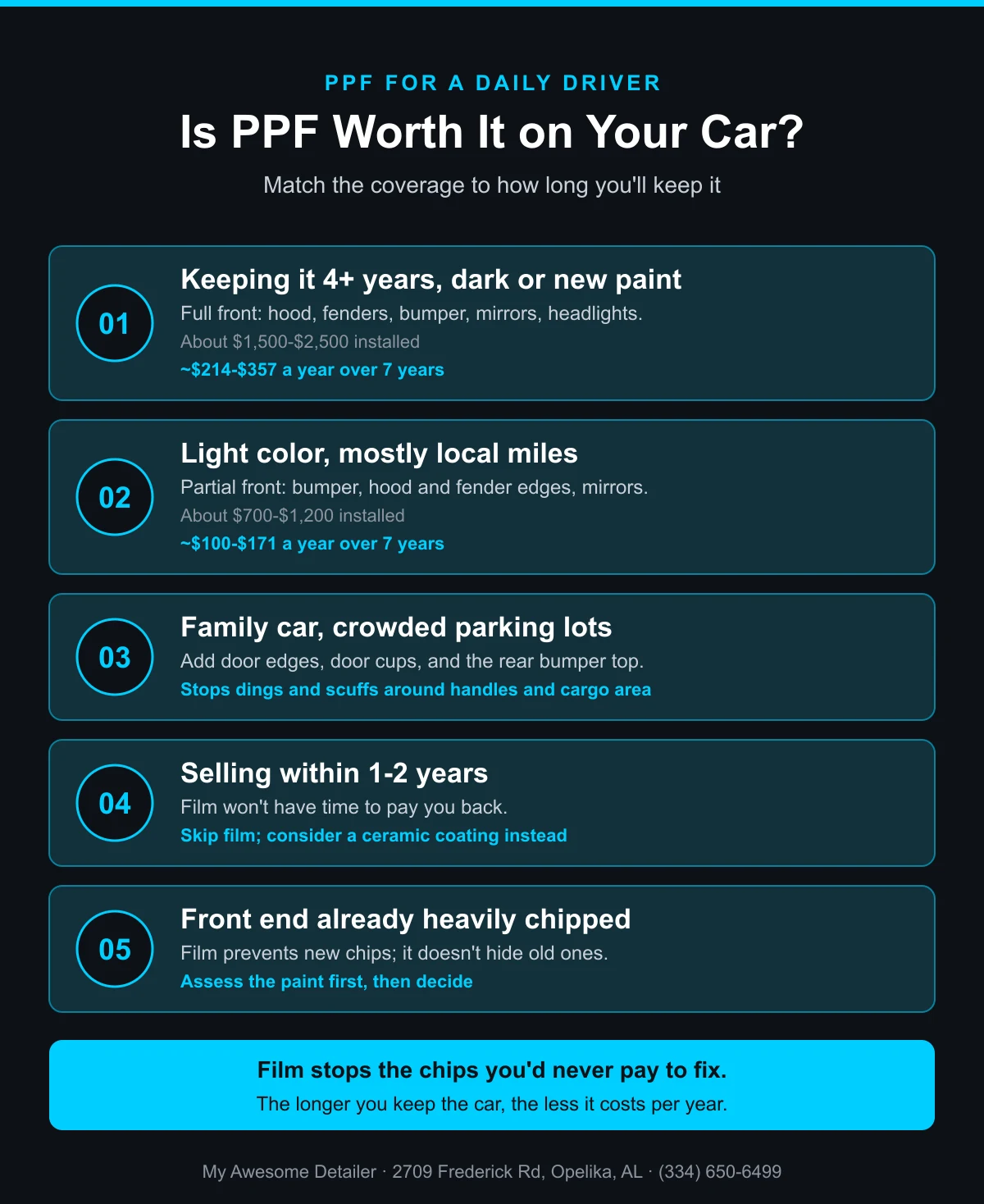
For most daily drivers, the decision is between partial front and full front, and the right answer depends on color, mileage, and how long you'll keep the car. The infographic below sums up how we usually match coverage to a normal car.
Partial front: the budget sweet spot
Partial front covers the bumper, the first section of the hood and fenders, and the mirrors, the surfaces that take most of the direct hits. On a light-colored car that mostly stays in town, it delivers most of the protection for about half the price of full front. The trade-off is a film edge partway up the hood. On light colors that line is hard to spot; on dark colors, the uncovered rear section of the hood can slowly pick up chips while the filmed section stays perfect.
Full front: the daily-driver default
Full front wraps the whole hood, both front fenders, the bumper, the mirrors, and the headlights. There's no visible line across the hood and no exposed section behind it. For a dark car, a new car, or any car you'll keep five years or more, this is the package we recommend most often for normal vehicles. Our PPF coverage options guide breaks down exactly what each tier includes.
Add-ons that make sense on normal cars
- Door edges and door cups: protects against parking-lot dings and fingernail scratches around the handles, a constant on family cars.
- Rear bumper top: covers the loading area where groceries, sports bags, and coolers slide in and out.
- Rocker panels: helpful on trucks and SUVs that throw debris from their own front tires onto the lower doors.
Full body: usually more than a daily driver needs
Full-body film makes sense on luxury vehicles, matte finishes, and cars you intend to keep in near-perfect condition for a very long time. On a typical daily driver, most of the risk is concentrated on the front end, so full body often costs more than the problem it solves. If you're curious, we're happy to quote it, but we won't push it on a commuter sedan.
When PPF isn't worth it on a daily driver
Film is a great buy for a lot of normal cars, but not all of them, and an honest shop should tell you when to skip it. Here are the cases where we usually suggest another option.
- You'll sell or trade the car within a year or two. The film won't have time to pay you back, and you're unlikely to recover the cost at trade-in.
- The front end is already heavily chipped. Film protects against future damage; it doesn't hide existing chips. If the hood and bumper are already peppered, it may make more sense to address the paint first, or to put the money toward other protection.
- The car is older and already has a repaint. If the front end is no longer original paint, the "keep it factory" argument is weaker. Film can still prevent new chips, but the value case is softer.
- You rarely drive it and it's light-colored. A white or silver car that sees 5,000 local miles a year may never build up enough visible damage to justify film.
For those cars, a ceramic coating or a good maintenance routine is often the smarter spend. That brings us to how the options compare.
PPF vs. ceramic coating vs. touch-up on a normal car
Only paint protection film stops rock chips. Ceramic coating and touch-up paint solve different problems. People often compare them as if they're interchangeable, so here's how they line up on a daily driver.
| Option | Stops rock chips? | Main benefit | Best for |
|---|---|---|---|
| Paint protection film | Yes, on covered panels | Physical impact protection; self-healing light scratches | Front ends of cars you'll keep 4+ years |
| Ceramic coating | No | Gloss, UV protection, easier washing, chemical and bug-etch resistance | Whole-car shine and easy upkeep |
| Touch-up paint | No (repairs after the fact) | Seals chips against rust | Occasional chips you've already got |
| PPF front + ceramic coating | Yes, on the front end | Chip protection where it matters plus easy cleaning everywhere | The most common daily-driver combo we install |
That last row is the combination many of our daily-driver customers choose: front-end film where the chips happen, and a ceramic coating over the rest of the car (and often over the film too) for gloss and easy washing. Learn more on our ceramic coating page, or see the film options on our paint protection film page.
What daily-driver life with PPF actually looks like
Once it's installed, PPF on a daily driver is mostly invisible. You wash the car, drive the car, and the front end just keeps looking new. Here's what that looks like through a normal Lee County year.
Spring pollen and love-bug season
Auburn and Opelika get a thick coat of yellow pine pollen every spring, and love bugs swarm in May and again in late summer. Love-bug residue is acidic, and in Alabama heat it can etch bare clear coat if it sits. A filmed front end gives that residue a tough, replaceable surface to sit on, and with a coating on top, bugs wash off with far less scrubbing.
Summer heat
Self-healing film responds to warmth. Light swirls from washing and minor scuffs fade as the film heats up, and a hot afternoon in an Opelika parking lot does a lot of that work for you. We explain the mechanism in our guide to how PPF self-healing works.
Game days, school runs, and parking lots
Daily drivers spend a lot of time packed into crowded lots: campus, Tiger Town, school pickup lines, and game-day parking around Jordan-Hare. Door-edge and door-cup film help with the dings and scratches that come with that life. Front-end film keeps the chips from the drive there off your hood.
Washing and maintenance
Caring for film is simple. Hand wash with a pH-neutral soap, avoid harsh brushes, and keep pressure-washer tips away from film edges. Automatic brush washes are best avoided. Our PPF aftercare guide covers the routine in detail.
How long it lasts
Quality paint protection film typically lasts around 10 years with reasonable care, which lines up nicely with how long many people keep a daily driver. The premium self-healing film we install is backed by a lifetime warranty against yellowing, cracking, bubbling, and delamination. See our warranty page for the details.
Common objections from daily-driver owners
Most hesitation about film on a normal car comes from a few old assumptions. Here are the ones we hear most often at the shop, with straight answers.
"Won't it look like a plastic cover on my car?"
Not with modern premium film and a careful install. Today's film is optically clear and glossy, and on a clean install it's very hard to spot from normal viewing distance. The edges are wrapped or finished along natural body lines where possible, which is also why full front looks cleaner than partial front on dark cars: there's no cut line across the middle of the hood.
"I'll just drive carefully and stay back from trucks."
Following distance helps, and we recommend it. But a daily driver can't control the pickup that merges in front of it, the gravel spilled at a construction entrance, or the debris kicked up by the car in the next lane. Careful driving reduces chips. It doesn't stop them.
"My car isn't nice enough to bother."
This is the exotic-car myth again. The question isn't whether the car is fancy. It's whether you'll keep it long enough, and care enough about how it looks, for a few hundred dollars a year to be worth a clean front end. For many owners of perfectly ordinary cars, the answer is yes.
"Can't I just add it later if chips show up?"
You can, but you'll be sealing in whatever chips are already there. Film works best on fresh paint, which is why the first months of ownership are the ideal window.
A quick decision guide: is PPF worth it on your regular car?
Use these checklists to decide in a minute or two.
PPF is very likely worth it if:
- You plan to keep the car four years or more.
- The car is new or nearly new, and the front end is still clean.
- The paint is dark, metallic, or a hard-to-match pearl.
- You drive 10,000+ miles a year, or regularly take the interstate.
- Small chips bother you, even when they're "not worth fixing."
You can probably skip film (or choose a coating) if:
- You'll sell or trade the car within a year or two.
- The front end is already heavily chipped or has been repainted.
- The car is light-colored and mostly sits or makes short local trips.
- Your main goal is shine and easy washing rather than chip protection.
Getting PPF on your daily driver at My Awesome Detailer
We install every film package inside our Opelika shop, because a precise PPF install needs clean, decontaminated paint and a dust-free, wind-free space. Every panel is carefully fitted and its edges sealed, so the film holds up to years of daily driving, weather, and washing.
- Owner's Pride Select installer: My Awesome Detailer is one of only about 40 shops in the U.S. with Owner's Pride Select status.
- 4.9 stars from 200+ reviews from drivers across Auburn, Opelika, and Lee County.
- Premium self-healing film with a lifetime warranty against yellowing, cracking, bubbling, and delamination.
- Honest recommendations: if partial front, a ceramic coating, or no film at all fits your car better, we'll say so.
Most customers drop the car off at 2709 Frederick Road and plan around the install time we give them with the quote. We serve Auburn, Opelika, and the Lee County area, and plenty of customers come over from Phenix City and Columbus, GA. Call (334) 650-6499 or request a quote online.
Keep your daily driver looking new
Get a free partial- or full-front PPF quote from Lee County's Owner's Pride Select shop.
The bottom line
Is PPF worth it on a regular car? For most daily drivers you plan to keep for four years or more, yes. Paint protection film isn't a luxury reserved for exotics. It's practical chip insurance, and the cars that need it most are the ones driven every day. It prevents exactly the kind of damage most owners never fix: chips too small to justify a repaint but too visible to ignore. Spread over the years you'll own the car, a partial or full front typically costs a few hundred dollars a year or less, and keeps the front end factory-original the whole time. Skip it if you'll trade the car soon or the front end is already heavily chipped. Otherwise, the best time to protect a daily driver is before the first chip, not after the fifth.