Quick answer: Yes, PPF for trucks is one of the smartest protection buys a pickup owner can make. A truck's tall, flat hood and upright grille take gravel head-on, its own tires sandblast the rockers and lower doors, and the bed rails and tailgate get scuffed every time cargo slides in or out. For most pickups in Auburn and Opelika, a full-front package (full hood, full fenders, front bumper, mirrors, headlights) is the right baseline, typically in the $1,500 to $2,500 range depending on the truck's size and trim, with bed rail film, tailgate film, and rocker coverage added to match how you use it. Final pricing always depends on the vehicle.
Pickups do real work in Lee County. They pull boats to Lake Martin and Lake Harding, haul mulch and lumber on Saturdays, run county gravel roads to hunting leases and job sites, and still get washed up for church on Sunday. That mix of work and daily driving is exactly why truck paint wears out faster than the paint on a sedan or crossover sitting next to it in a Tiger Town parking lot.
At My Awesome Detailer LLC, 2709 Frederick Road in Opelika, we install paint protection film in our shop on full-size trucks, mid-size pickups, and heavy-duty rigs. This guide covers paint protection film for pickup trucks in general: where truck paint actually gets damaged, which coverage zones match which kind of driving, how bed rail and tailgate film work, what film can and can't do on a working truck, and what it typically costs here. If you drive a Ford F-150 and you're weighing a coating as well, our ceramic coating guide for the Ford F-150 pairs naturally with this one.
Why trucks need paint protection film more than most vehicles
Trucks combine three things that destroy paint: a big, upright front end that catches debris square, large tires that throw gravel back at the body, and a cargo bed that gets loaded and unloaded by hand. A sedan usually deals with one of those. A pickup deals with all three, every week.
A tall, flat front end catches everything
Modern pickups have some of the tallest, flattest hoods on the road. The grille stands nearly vertical, the leading edge of the hood sits high, and the hood itself is a huge, mostly horizontal surface. On a sloped crossover hood, a lot of road debris glances off. On a truck, it hits square and stays visible. On I-85 behind a dump truck, or on Highway 280 behind a gravel hauler, a truck's front end can collect more chips in a month than a sedan does in a year.
Big tires sandblast the lower body
All-terrain and mud-terrain tires grip well on red clay and chert gravel, but their open tread blocks pick up stones and fling them backward and outward. On a pickup, the rocker panels, the lower doors, the bottom of the bed sides, and the area just behind each wheel opening sit right in that spray pattern. Lifted trucks and trucks with wider tires get it worst. This is self-inflicted damage, and no amount of following distance prevents it.
The bed is a work surface
The bed rail caps and the top of the tailgate are painted, and they're also where people rest a cooler, slide a sheet of plywood, drag a toolbox, set a kayak, or lean a ladder. Every one of those contacts leaves a scuff. Over a few years, the bed rails of a working truck often look worse than any other painted surface on it, even when the front end is in good shape.
Trucks are expensive to repaint, and buyers look closely
Truck panels are large. Repainting a hood, a pair of fenders, or a bed side means a lot of material and a lot of blending, and an aftermarket respray is never quite the original factory finish. Clean original paint is one of the things used-truck buyers check first. Film protects that original paint so you don't have to choose between using the truck and keeping it nice. For the resale side in more depth, see does PPF protect resale value.
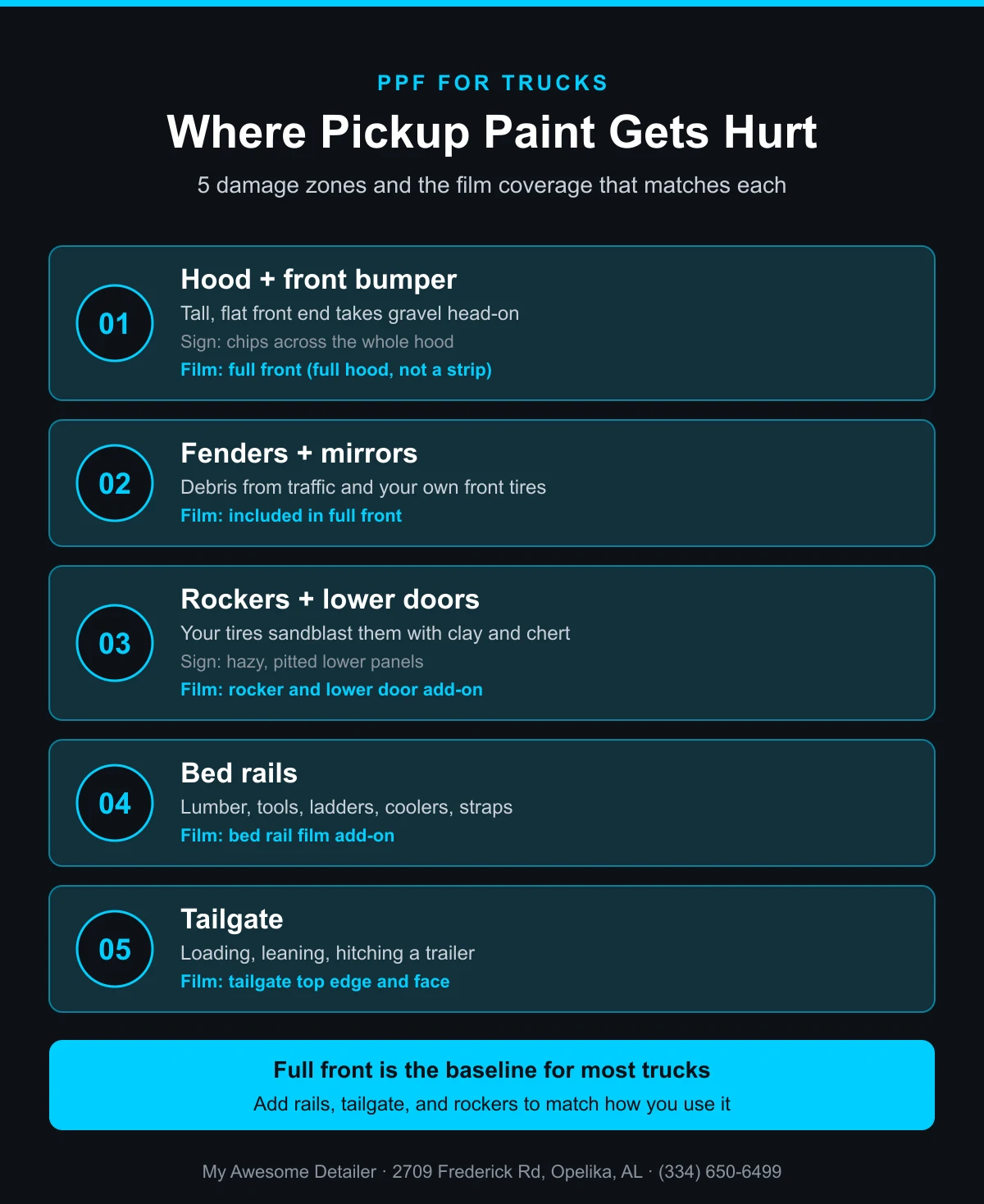
Truck damage zones and the film coverage that matches each one
Paint damage on a pickup is predictable, and each damage zone maps to a specific piece of paint protection film. Knowing which zones apply to how you use your truck is the fastest way to choose coverage without paying for panels that don't need it.
| Zone | Main threat | Highway commuter truck | Gravel road and work truck | Film recommendation |
|---|---|---|---|---|
| Hood (leading edge and full surface) | Rock chips from traffic and gravel | High | Very high | Full hood (full front) |
| Front bumper (painted areas) | Direct impact, chips, bugs | High | Very high | Included in partial and full front |
| Front fenders | Chips, tire spray off the front wheels | Moderate to high | Very high | Full fenders (full front) |
| Mirrors and headlights | Chips, pitting, brush contact | Moderate | High | Included in full front |
| A-pillars and roof leading edge | Chips off a tall, upright windshield | Moderate | Moderate to high | Add-on |
| Rocker panels and lower doors | Your own tire spray, clay, sand | Low to moderate | Very high | Add-on |
| Behind the wheel openings | Gravel thrown by the rear tires | Low to moderate | High | Add-on |
| Bed rail caps | Cargo, tools, ladders, coolers | Moderate | Very high | Bed rail film add-on |
| Tailgate top edge and face | Loading, hitch work, leaning, bumper scuffs | Moderate | High | Tailgate film add-on |
| Door edges and handle cups | Door dings, keys, rings, work gloves | Moderate | Moderate to high | Add-on |
| Upper body sides | Branches on narrow lease roads and trails | Low | High | Full body |
Hood and bumper: the gravel-road front end
The hood and front bumper are where nearly every truck shows damage first. On a highway-driven truck, chips concentrate on the first couple of feet of the hood and across the bumper. On a truck that runs county gravel roads, chips spread across the entire hood because rocks thrown up by oncoming and lead vehicles arc higher and land farther back. That's the main reason we steer most truck owners toward a full hood instead of the partial hood strip that's common on commuter cars: a partial strip leaves a visible line where chips stop and start, and on a big truck hood that line is easy to see.
Fenders and mirrors
Truck fenders are tall and sit right next to the front tires, so they take debris from traffic ahead and spray from the truck's own wheels. The mirror caps on modern pickups are large and stick out into the airstream, and towing mirrors stick out even more. Both are included in a standard full-front package.
A-pillars and the roof edge
A truck's windshield stands more upright than a car's, and the painted A-pillars and the front edge of the roof catch chips that clear the hood. It's a small area, but it's highly visible on darker colors, and it's an easy add-on to a front-end package for trucks that see a lot of highway miles.
Rocker panels and lower doors: off-road splash
Rocker panels and lower doors are the zone owners underestimate most. A truck that only drives pavement still picks up some sand and grit there, but a truck that runs red clay roads, field edges, boat ramps, or creek crossings gets its lower body sandblasted by its own tires. Dried red clay is gritty, and wiping it off a lower door with a towel is like using fine sandpaper. Rocker and lower door film takes that abuse instead of your clear coat. Pair it with film on the panel areas just behind each wheel opening for trucks with aggressive tires.
Bed rails and tailgate: cargo scuffs
Bed rail and tailgate film get their own section below, because they're the piece of coverage that's truly specific to pickups.
Not sure which zones your truck needs?
Bring it by our Opelika shop and we'll walk it with you and recommend coverage based on how you actually use it.
Truck bed rail film and tailgate film explained
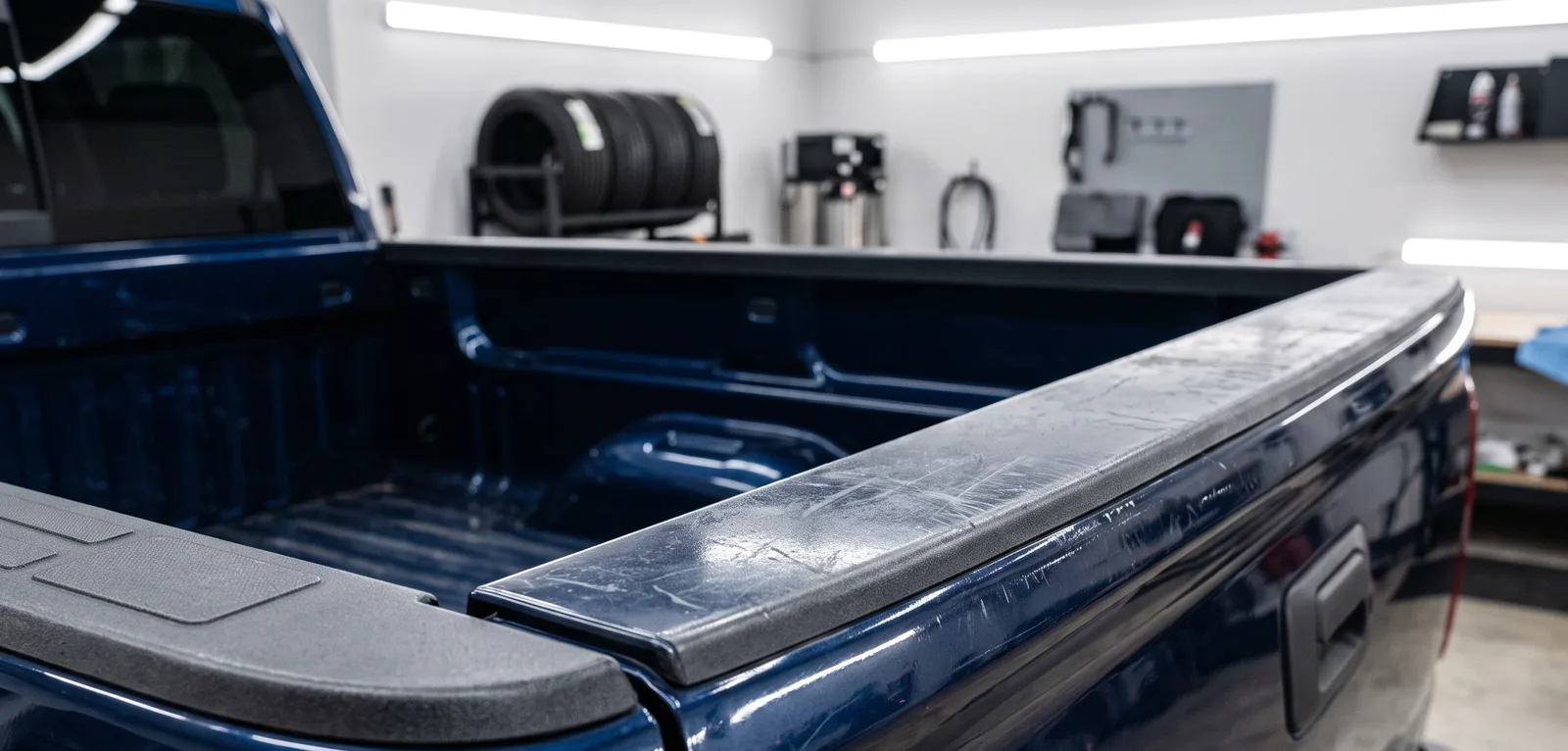
Truck bed rail film is clear paint protection film applied to the painted top caps of the bed sides, and tailgate film covers the painted top edge and face of the tailgate. Together they protect the surfaces that cargo and hands touch most, which on a working pickup is often where the worst scratches end up.
What bed rail film protects against
- Sliding cargo: plywood, lumber, drywall, and fence posts dragged over the rail on the way in or out.
- Tools and toolboxes: metal edges set down on the rail while you dig for something in the bed.
- Ladders and kayaks: long items that rest across the rails and shift as you drive.
- Coolers and gear on game day: anything set on the rail while you set up at a tailgate.
- Tie-down straps: ratchet straps that rub the rail edge under tension, especially with grit trapped underneath.
- Belt buckles, rivets, and zippers: leaning over the side to reach into the bed is the most common source of fine scratches.
What tailgate film protects against
The tailgate top edge takes scuffs from cargo being loaded, from people sitting or leaning on it, and from items set on it while the gate is down. The tailgate face takes scrapes from hitching a trailer, from bumpers at the boat ramp, and from loading anything that rests against it. A clear film on the top edge and the upper face keeps those marks in the film instead of the paint.
How bed rail film fits with bed liners and rail caps
A spray-in or drop-in bed liner protects the floor and inside walls of the bed, but most liners stop short of the painted top rail, or only cover part of it. That leaves the painted rail exposed. Plastic rail caps are another option, but they change the look of the truck, can trap grit underneath, and don't suit every owner. Clear film keeps the original look, follows the shape of the rail, and works alongside a liner. Some trucks have tonneau covers or rail systems mounted to the bed. We work around that hardware and tell you up front if any part of the rail can't be covered on your setup.
What bed rail film won't do
Clear film is tough, but it's not armor. A heavy, sharp object dropped point-first onto a rail can cut through film. The difference is that the damage stops at the film, so the paint underneath usually stays intact and that section of film can be replaced. For constant heavy-duty abuse, like daily contractor loads of block or steel, film still helps, but it becomes a wear item that may need replacing sooner than film on the hood.
PPF coverage packages for pickup trucks
Most truck owners land in one of four coverage levels, and the right one depends on how much of the truck's life is spent on gravel, at work, or hauling. Here's how they compare. Every range below is typical for the Auburn-Opelika area in 2026, and your quote depends on your truck's size, trim, and condition.
| Coverage level | What's covered | Best for | Typical price range |
|---|---|---|---|
| Partial front | Front bumper, partial hood and fenders, mirrors | Budget-focused highway driving | About $700 to $1,200 |
| Full front | Full hood, full fenders, front bumper, mirrors, headlights | Most pickups, the recommended baseline | About $1,500 to $2,500 |
| Full front plus truck add-ons | Full front plus bed rails, tailgate, rockers and lower doors, door edges, A-pillars | Work trucks, gravel roads, frequent hauling and towing | Full front range plus add-ons, quoted to your truck |
| Full body | Every painted panel, including bed sides, rails, and tailgate | New trucks, dark colors, owners who want zero chip worry | About $5,000 to $8,000 or more |
Larger trucks, heavy-duty pickups with big grilles and wide fenders, and lifted trucks tend to land toward the upper end of each range because there's simply more surface and more complex shapes to cover. Mid-size pickups often land lower. For a general breakdown of each package, see our guide to partial, full-front, and full-body PPF coverage, and for the full cost picture, the PPF cost guide for Auburn.
Why partial front is a weaker fit on trucks
Partial front kits cover the bumper and the leading 18 to 24 inches or so of the hood and fenders. On a sedan, that catches a large share of the chips. On a tall truck that sees gravel, chips land all over the hood, and the edge of a partial kit becomes visible as unprotected paint behind it starts collecting chips. Partial front still beats nothing, but for most trucks full front is better value per year of protection.
When full body makes sense on a truck
Full body is worth considering if the truck is new, if it's a dark color where every scuff shows, if it runs narrow lease roads where branches drag the sides, or if you plan to keep it for many years and want the whole thing protected. It also simplifies care: every painted surface is under film, so washing and maintenance are the same everywhere.
Matching coverage to how you use your truck
The fastest way to pick coverage is to be honest about where your truck spends its time. Here are the patterns we see most often around Lee County.
The highway commuter pickup
Drives I-85 to Montgomery or Columbus, mostly pavement, light hauling on weekends. Full front is the right call, with A-pillars as an easy add-on. Bed rail film is optional, depending on how often the bed is used. For more on highway driving specifically, see is PPF worth it for highway commuters.
The gravel road and lake truck
Runs county roads, lake access lots, and boat ramps at Lake Martin or Lake Harding, and tows a boat or trailer. Full front plus rockers and lower doors, the areas behind the wheel openings, and tailgate film. Towing adds stone spray from the trailer tires and scrapes from hitching up, so the tailgate face and rear bumper surround deserve attention.
The work truck
Hauls materials and tools during the week. Full front plus bed rails and tailgate are the priorities, since cargo damage happens daily. Door edges and handle cups are worth adding for trucks that get in and out of all day with work gloves and keys.
The hunting and off-road truck
Runs field roads, leases, and trails, often lifted with aggressive tires. This is the strongest case for extensive side coverage or full body: rockers, lower doors, rear quarter areas, and upper body sides all take abuse from tire spray and brush.
The weekend truck that rarely sees dirt
A clean truck that mostly sits nice and drives pavement. Full front protects the inevitable highway chips, and ceramic coating on top makes washing quick. Bed rail film is a nice-to-have if you ever plan to haul anything.
Alabama conditions that are hard on truck paint
East Alabama adds a few local threats on top of normal truck wear: red clay, heat and UV, love bugs, and pine sap. Film handles some of these directly and helps with the others.
Red clay and chert gravel
Red clay dries into fine, gritty dust that clings to the lower body. Chert gravel on county roads is sharp and hard. Together they cause most of the lower-body wear on area trucks. Film absorbs chips and abrasion that would otherwise reach the clear coat.
Heat and UV
Trucks often sit outdoors at job sites, in fields, and in lots all day in the Alabama sun. Quality paint protection film is UV-stable, and premium self-healing film uses heat to let light swirls and fine scratches fade on their own. A sunny afternoon in Opelika can do some of that work for you. To see how that works, read how PPF self-healing works.
Love bugs and bug splatter
Twice a year, love bug season coats the front of every truck on the highway. Their remains are acidic and can etch clear coat if left to bake in the sun. Film puts a sacrificial layer between the bugs and the paint, and a ceramic coating on top makes them much easier to wash off.
Pine sap and tree debris
Parking under pines at a hunting camp or job site leaves sap on hoods and bed rails. It's easier to remove from film and coated surfaces than from bare paint, though it should still come off promptly.
PPF plus ceramic coating on trucks
Paint protection film and ceramic coating solve different problems, and many truck owners use both. Film stops physical damage: chips, scuffs, and abrasion. Ceramic coating makes surfaces slick and hydrophobic, so mud, clay, bugs, and road grime release easily when you wash. Coating can go over the film and over the remaining unfilmed panels so the whole truck washes the same way.
A common truck setup is full front PPF plus bed rail and tailgate film, with a ceramic coating over the entire truck, including the film. That gives impact protection where trucks take hits and easy cleaning everywhere. Our post on ceramic coating over PPF explains how the two layers work together, and if you drive an F-150, the Ford F-150 ceramic coating guide covers that truck's coating details. You can see coating options on our ceramic coating page.
What to expect when you bring your truck in
Every PPF install we do happens inside our Opelika shop, because a clean, precise install needs decontaminated paint and a dust-free, wind-free space. On a truck, that matters even more: there are large panels, deep body lines, sensors in the bumper, and plenty of edges that have to be wrapped and sealed so pressure washing and mud don't lift them later.
- Walkaround and quote: we look at your truck with you, note any existing chips or scratches, and recommend coverage based on how you use it.
- Wash and decontamination: the paint is washed and decontaminated so no grit or residue ends up under the film.
- Paint correction if needed: film locks in whatever is underneath, so swirls or light scratches on the panels being covered are best corrected first. See our paint correction guide for how that works.
- Film installation: film is cut for your truck, laid on each panel, and edges are wrapped where the panel design allows.
- Inspection and cure: we inspect every panel and give you aftercare instructions for the first days while the film settles.
For a detailed look at the install day itself, see how PPF is installed.
Existing chips and damage
Film doesn't erase chips that are already there. Small chips can be touched up before film goes on so they're less visible, and the film then stops new damage. If the front end of a used truck is heavily chipped, it's worth talking through options before installing film over it.
Caring for PPF on a truck
PPF on a truck needs the same basic care as film on any vehicle, with a little extra attention to edges and the lower body.
- Rinse clay off before it dries hard: a thorough rinse before touching the surface keeps grit from dragging across film or paint.
- Pressure wash with care: keep the nozzle at a reasonable distance and avoid blasting directly at film edges.
- Skip harsh brushes on the lower body: use a clean wash mitt, and a separate one for the dirtiest lower panels.
- Clean bugs and sap promptly: film resists them, but fresh is always easier.
- Avoid automatic brush washes: they're hard on any finish, filmed or not.
Our full PPF aftercare guide covers washing, products to avoid, and what to do if an edge ever lifts.
Is PPF for trucks worth it? The cost math
For most pickup owners, full-front PPF costs less than repairing the damage it prevents, and it protects original paint that a respray can't fully replace. Repainting a single chipped or scuffed panel commonly runs about $500 to $1,200 per panel, and a truck's hood, fenders, and bumper together can reach $2,500 to $4,500 or more. A full-front package typically runs about $1,500 to $2,500, and it prevents the damage instead of fixing it after the fact.
| Approach | Typical cost range | Result |
|---|---|---|
| Do nothing, touch up chips occasionally | Low upfront | Chips accumulate, front end and rails look worn within a few years |
| Repaint front end later | About $2,500 to $4,500 or more | Aftermarket paint, no longer original finish |
| Full front PPF now | About $1,500 to $2,500 | Original paint protected from chips on the most-hit panels |
| Full front plus bed rails, tailgate, rockers | Full front range plus add-ons, quoted to your truck | Front, cargo surfaces, and lower body protected |
Trucks also tend to hold their value well, and a used-truck buyer will notice a clean, chip-free front end and unscuffed bed rails. That doesn't guarantee a higher sale price, but it removes one of the most common reasons buyers negotiate down.
Common questions truck owners ask us
"Will film look obvious on my truck?"
Quality film is very hard to spot once installed, especially on large flat panels like a truck hood. Edges are wrapped where possible. On full-front installs, there's usually a seam where the film stops on the fenders, positioned along a body line so it's hard to see.
"What about matte or special finishes?"
Matte and satin finishes need matte film to keep their look. If your truck has a factory matte finish or special paint, tell us when you request a quote.
"Can film go over chrome or plastic trim?"
Film is designed for painted surfaces. Textured black plastic, chrome bumpers, and step bars are usually left unfilmed. We'll point out which surfaces on your truck are painted and worth protecting.
"Does film affect front sensors and cameras?"
Installers trim around parking sensors, radar, and cameras so they keep working as intended. We check your truck's sensor layout before installing.
Getting PPF on your truck at My Awesome Detailer
We install paint protection film on pickups of every size inside our shop at 2709 Frederick Road in Opelika.
- Owner's Pride Select installer: My Awesome Detailer is one of only about 40 shops in the U.S. with Owner's Pride Select status.
- 4.9 stars from 200+ reviews from drivers across Auburn, Opelika, and Lee County.
- Premium self-healing film with warranty coverage. See our warranty page for details.
- Honest coverage recommendations: if full front is all your truck needs, we'll say so. If bed rails, tailgate, or rockers make sense for how you use it, we'll explain why.
Drop the truck off at our shop and plan around the install time we give you with your quote. We serve Auburn, Opelika, and the Lee County area, and many customers come over from Phenix City and Columbus, GA. See all film options on our paint protection film page, call (334) 650-6499, or request a quote online.
Protect the truck you actually use
Get a free PPF quote for your pickup, from full front to bed rails and tailgate, from Lee County's Owner's Pride Select shop.
The bottom line
Paint protection film for trucks works because a pickup's damage is so predictable: the tall front end catches gravel, the tires sandblast the lower body, and the bed rails and tailgate get scuffed by cargo. Full front PPF is the right baseline for most pickups in Auburn and Opelika. Add bed rail and tailgate film if you haul, rockers and lower doors if you drive gravel or clay, and consider full body if the truck is new, dark, or headed down narrow lease roads. Put a ceramic coating on top for easy cleaning, wash the clay off gently, and your truck can keep its factory paint while it keeps doing real work.