Quick answer: The biggest ceramic coating myths are that it is scratch-proof, that you never have to wash the car again, that one coating lasts forever, and that it replaces paint protection film. None of them are true. A ceramic coating is scratch-resistant, not scratch-proof, it makes washing easier but does not eliminate it, its life depends on the product and how the car is maintained, and it protects against chemicals and UV, not rock chips. Knowing where the real limits are is what lets Auburn and Opelika drivers get full value out of a coating.
Ceramic coating has been marketed hard for a decade, and a lot of what gets repeated in parking lots, comment sections and sales pitches is simply wrong. Some of it is harmless exaggeration. Some of it sets owners up to be disappointed, or to damage the very coating they paid for. This guide from My Awesome Detailer LLC in Opelika goes through the myths we hear most often, says plainly what is true, and explains what a coating realistically does for a car living in east Alabama.
We are a shop-only studio at 2709 Frederick Road, so every car we coat is prepped, corrected and cured indoors under controlled light. That matters for this topic, because most coating disappointments trace back to one of two things: expectations that were never realistic, or prep and aftercare that were skipped. Both are fixable once you know the facts.
What a ceramic coating actually is (and is not)
A ceramic coating is a liquid, silica-based (SiO2) protective layer that is applied to clean, corrected paint and cures into a thin, hard, transparent shell that bonds to the clear coat. It is not wax, it is not a sealant that wipes off in a few weeks, and it is not a film. Think of it as a semi-permanent skin that sits on top of your clear coat and takes the abuse in its place.
What it does well:
- Chemical resistance: bird droppings, bug acids, tree sap and road film have a harder time etching into a coated surface.
- UV resistance: it helps slow the oxidation and fading that Alabama sun causes on clear coat.
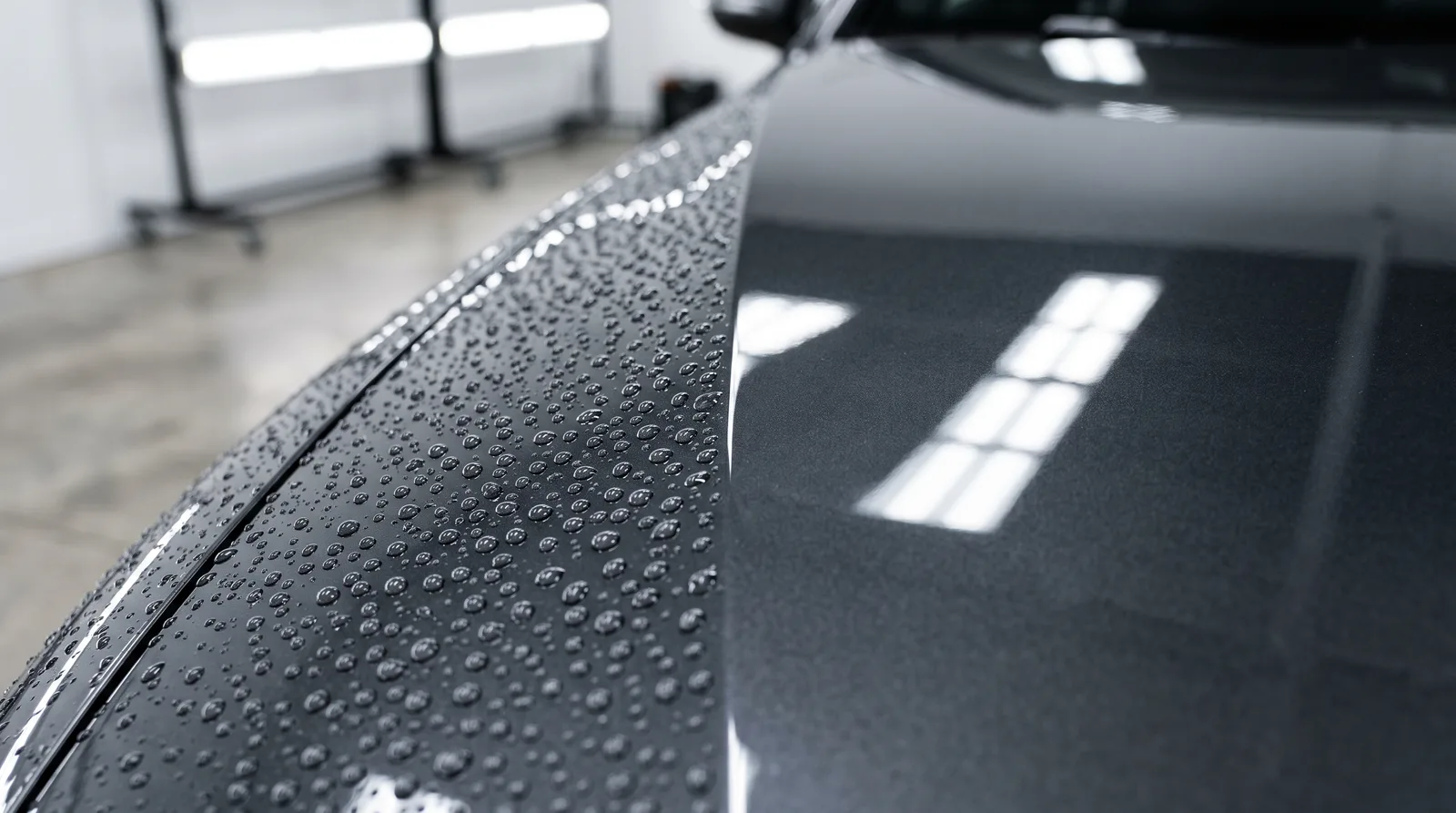
- Hydrophobic behavior: water beads and sheets off, and dirt has a harder time bonding, which makes washing faster.
- Gloss and depth: a coating on corrected paint looks deeper and wetter than the same paint under wax.
What it does not do: stop rock chips, stop deep scratches, fix existing damage, or make a car immune to neglect. Every myth below comes from stretching those first four benefits into promises the chemistry cannot keep.
Want to know what a coating would do for your car?
Our Service Builder is a short interview about your vehicle, typically 3-5 minutes. We text you a code, and your exact price is on the screen.
Myth 1: "Ceramic coating is scratch-proof"
The truth: it is scratch-resistant at best, and the amount of resistance is modest. A coating adds a harder surface than bare clear coat, so it resists the very light marring that comes from normal washing and wiping. It does not make paint immune to scratches. Keys, belt buckles, zippers, a branch on a tight driveway, a rough drying towel with grit in it, or a shopping cart will still mark a coated car.
Where this myth comes from is the word "hardness." Some coatings are marketed with a pencil-hardness rating such as 9H. That number measures how a thin cured coating resists a standardized pencil test in a lab, on a flat test panel. It does not translate to "nothing can scratch my car." A real vehicle is exposed to gritty dust, sand, road debris and human error, and a layer only a few microns thick has limits.
Here is how it plays out in practice:
- Light swirls from washing: a coating makes them less likely, because the surface is slicker and dirt does not grind in as easily. Poor technique still causes them.
- Deeper scratches: a scratch that goes through the coating and into the clear coat is still a scratch.
- Rock chips: a coating is far too thin to absorb the impact of a stone at highway speed. Only a physical film does that.
Some coating systems are described as self-healing. The idea is that very fine marks can relax and disappear when the surface is warmed by sun or warm water. That is real for hairline marks and it is a nice feature, but it is also not a license to scrape the car. We explain the mechanism and its limits in What Is Self-Healing Ceramic Coating?.
What to do about it: wash with the two-bucket method, use clean microfiber, and accept that a coating lowers your risk of light marring rather than removing it. If your priority is surviving rock chips on the hood and bumper, that is a job for paint protection film, which we cover in Myth 4.
Myth 2: "You never have to wash it again"
The truth: a coating makes the car easier to clean, not self-cleaning. Because the surface is slick and water-repellent, dirt and road film do not grip as hard, and a lot of it rinses off with a pressure rinse or a gentle wash. That is a real convenience. But road film, pollen, red clay dust, bugs, and bird droppings still land on a coated car, and they still need to be removed.
In fact, skipping washes is one of the fastest ways to make a coating look dull. Two things happen:
- Contamination builds up on top of the coating. A film of dirt covers the slick surface, so water stops beading and the car looks like the coating has failed, when really it is buried.
- Acidic contaminants sit longer. A coating slows etching, but bird droppings and bug residue left for days in the Alabama heat can still mark the surface.
East Alabama makes this more important, not less. Spring pollen coats everything in a yellow film, red clay dust gets kicked up on any road near a construction site, and love bugs arrive twice a year. We walk through the specifics in our guide to ceramic coating and bird droppings, sap and love bugs.
A realistic routine for a coated car looks like this:
- Wash every one to two weeks with a pH-neutral, coating-safe soap and a clean microfiber mitt.
- Rinse bird droppings, sap and bug splatter as soon as you see them.
- Use a ceramic booster spray every couple of months if your coating system calls for it.
- Get periodic professional maintenance so someone qualified inspects the surface.
The full routine is in Ceramic Coating Maintenance in Auburn. The honest summary: you will wash a coated car, but less effort and less time per wash than an uncoated one, and the results last longer.
Myth 3: "One coating lasts forever"
The truth: coatings are durable, not immortal, and the life of a coating depends on the product, the prep, the environment and the care it gets. A coating is a sacrificial layer. It is built to take the abuse so your clear coat does not, which means it wears over time, the same way a good set of tires does.
The factors that decide how long a coating performs:
| Factor | What it changes |
|---|---|
| Coating formulation | Single-layer pro-grade systems and multi-layer systems wear differently. More layers and denser formulations generally last longer. |
| Paint prep and correction | A coating bonds to the surface beneath it. Swirls, haze and contamination left underneath get locked in and can shorten life. |
| Cure conditions | Indoor, controlled-environment curing helps the coating bond fully. This is one reason we install in the shop. |
| Washing method | Tunnel washes, harsh detergents and dish soap strip performance faster than gentle hand washing. |
| Sun and heat exposure | A garaged car sees less UV and heat cycling than a car parked outside all day at an Alabama job site. |
| Maintenance schedule | Booster products and professional maintenance visits can extend how long the surface keeps performing. |
That is why we do not quote a single number of years and call it a day. How long a coating lasts is a range, and the honest answer depends on the car. We go deeper in How Long Does Ceramic Coating Last in Alabama Heat?.
At My Awesome Detailer, the two coating options are built around that reality:
- Coating Club: a pro-grade, single-layer coating that we maintain with a ceramic performance maintenance visit every 90 days, paid as a monthly membership. It keeps performing while the membership is active and current.
- Select, For Life: our multi-layer, self-healing coating, paid once and owned outright.
Neither is a "set it and forget it" product. The details of what each plan covers are on our warranty page, and we would rather you read the real terms than rely on a myth about forever.
Myth 4: "Ceramic coating replaces paint protection film"
The truth: they protect against different things, and the best protection on a car often uses both. A ceramic coating is a thin chemical and UV shield with great gloss and easy cleaning. Paint protection film (PPF) is a thick, flexible urethane film that physically absorbs impact. One is a coating, the other is armor.
| Threat | Ceramic coating | Paint protection film |
|---|---|---|
| Rock chips and road debris | Minimal protection | Strong protection, its main job |
| Bird droppings, bug acids, sap | Strong resistance | Strong resistance |
| UV and oxidation | Helps slow fading | Helps slow fading of the film-covered area |
| Light swirl marks | Slicker surface lowers risk | Film can self-heal light marks |
| Gloss and easy cleaning | Excellent | Good (a coating on top improves it) |
| Coverage | Whole car, including glass, wheels and trim | Typically high-impact panels, or a full wrap if chosen |
If your drive includes interstate miles and gravel, PPF on the front end is the real protection against chips, and a coating on top of it adds the slick, easy-to-clean finish. The two work together, and we cover that combination in Ceramic Coating Over PPF. For a head-to-head view that also includes wax, read Ceramic Coating vs PPF vs Wax. If you want to talk through which one fits your car and your commute, our PPF page and ceramic coating page are the places to start.
Myth 5: "You can skip paint correction because the coating will fill scratches"
The truth: a coating does not fill defects, it magnifies them. A coating cures as a clear, glossy layer, which makes the paint underneath look sharper. If swirls, water spots or scratches are present when the coating goes on, they become part of the finish, locked under a hard layer, and are harder to remove later without cutting through the coating.
This is why the prep stage is where a coating job is won or lost. A proper installation includes a decontamination wash, clay treatment where needed, machine paint correction to the level the paint and the budget warrant, and a panel wipe to remove polishing oils before the coating is applied. Our process is laid out in Ceramic Coating Process, Step by Step.
Be wary of any pitch that implies a coating is a shortcut around prep. The coating is the last 10 percent of the work. The first 90 percent is what you cannot see.
Myth 6: "Ceramic coating is just expensive wax"
The truth: the chemistry, durability and maintenance are completely different. Wax and sealants sit on the surface and wear away in weeks to a few months. A ceramic coating cures and bonds, and performs for years when it is maintained. Wax is organic and softens in heat. A coating is a hard inorganic network that handles Alabama summers far better.
| Product | How it bonds | Typical performance window | Heat tolerance |
|---|---|---|---|
| Carnauba wax | Sits on the surface | Weeks to a few months | Softens in high heat |
| Paint sealant | Bonds loosely, synthetic polymers | A few months | Better than wax |
| Ceramic coating | Chemically bonds to clear coat | Years, depending on product and care | High |
Wax is not bad. It is cheap, easy, and fine for a car you are happy to re-wax every season. But it is a different product category, and comparing the two on appearance alone misses what you are paying for. For a real-dollar view of how coating, PPF and wax compare over time, see Ceramic Coating Cost in Auburn, AL. We keep prices out of this article on purpose: the exact price depends on the vehicle, and it appears on screen in our builder.
Myth 7: "A new car doesn't need a coating" (and its mirror image, "an old car is too late")
The truth: new paint is the easiest to protect, but older paint can still benefit if it is corrected first. A new car's paint is in its best condition, so a light prep and a coating can lock that in. But new does not mean flawless: dealer lots, transport and rushed dealer prep leave swirls and haze on many new vehicles, which is why we inspect before we coat.
On the other side, an older car with faded or swirled paint is not a lost cause. With a proper correction, the paint can be restored and then protected. The limit is condition: deep scratches, failing clear coat or peeling paint cannot be fixed by a coating, and an honest shop will tell you so. Our used car ceramic coating guide walks through when it makes sense on a pre-owned vehicle.
Myth 8: "Coated cars can go through any car wash"
The truth: automatic washes are the fastest way to shorten a coating's life. Spinning brushes drag grit across the surface, and the strong detergents designed to cut grime quickly are also hard on a coating's hydrophobic layer. A coating will survive an occasional automatic wash, but making it a habit wears down the finish and creates the very swirls the coating was meant to help you avoid.
Touchless washes are gentler than brush washes but use stronger chemicals to compensate. If you must use one in a pinch, choose touchless, and then get back to a hand wash as soon as you can. The full list of coating killers is in 5 Things That Ruin Your Ceramic Coating.
Myth 9: "Ceramic coating makes the car look wet and glossy forever"
The truth: gloss comes mostly from the paint correction, and the coating keeps it from fading fast. The mirror-like look you see on a freshly coated car is largely the result of polishing the paint to a high level before coating. The coating then protects and enhances that finish, and keeps it easier to maintain. If the coating gets covered in road film or worn down by harsh washing, the gloss fades, and that is a maintenance issue, not a product failure.
If you are curious how a coating changes the look of paint across colors, our posts on whether ceramic coating changes paint appearance and on white and silver and gray cars go color by color.
Myth 10: "Ceramic coating makes insurance cover paint damage"
The truth: a coating is a protective product, not an insurance policy, and it does not change what your insurer covers. We get this question regularly, and the short answer is that coverage depends on your auto insurance policy, not on whether the car is coated. Read Does Insurance Cover Ceramic Coating? for the longer version.
Skip the myths, see your price
Answer a few questions about your vehicle and get the exact price on screen. The builder takes typically 3-5 minutes, then we text you a code.
Myth vs. fact: the quick reference
| The myth | The fact |
|---|---|
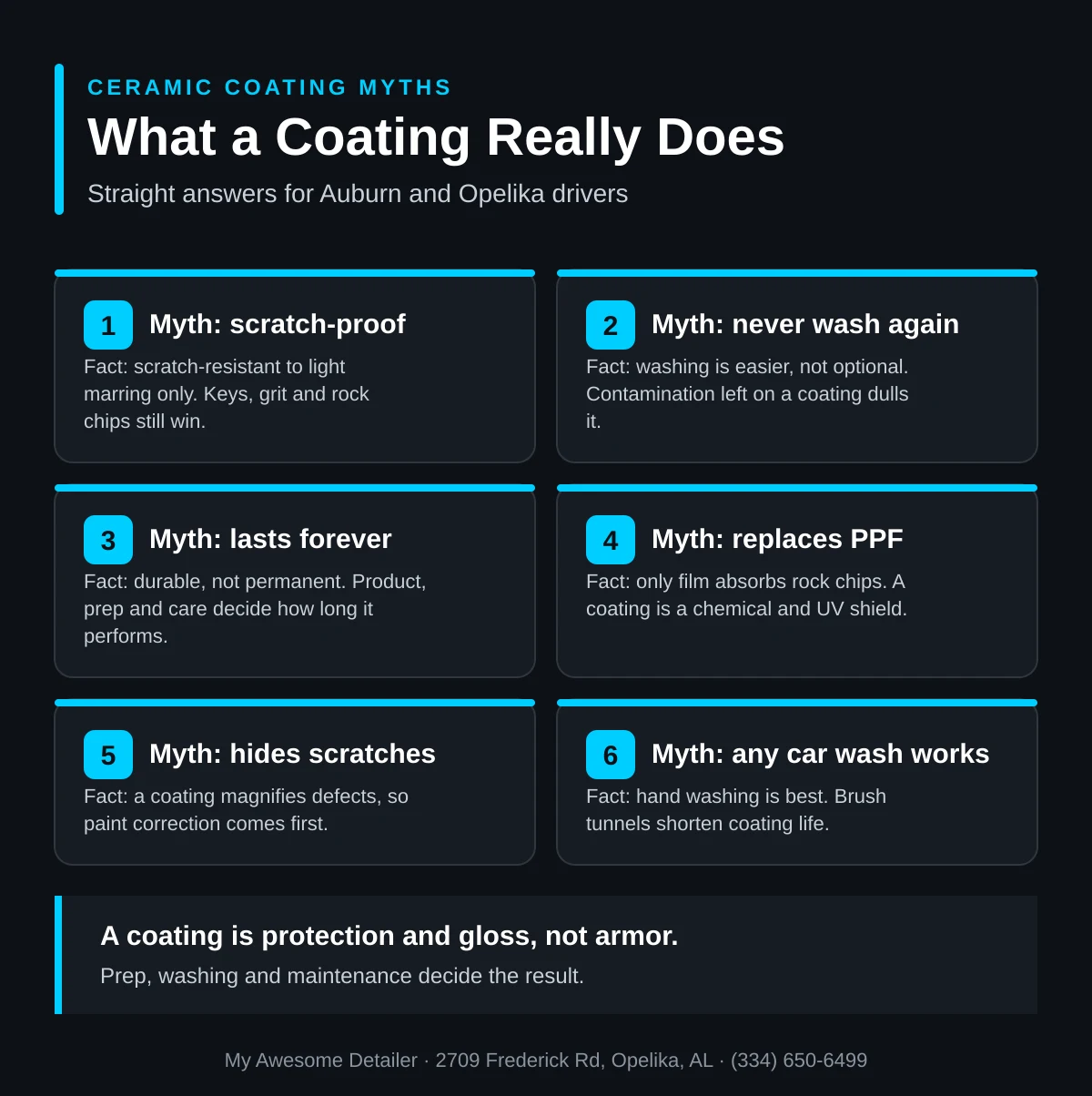
| Scratch-proof | Scratch-resistant for light marring only. Keys, grit and rock chips still win. |
| Never wash again | Washing is easier and faster, but still required. Contamination left on a coating dulls it. |
| Lasts forever | Durable, not permanent. Life depends on product, prep, environment and care. |
| Replaces PPF | Coating handles chemicals, UV and gloss. PPF handles impact. They work together. |
| Fills scratches | Coating magnifies defects. Correction comes first. |
| Expensive wax | A bonded, cured layer that performs for years, versus weeks or months for wax. |
| Any car wash is fine | Hand wash is best. Brush tunnels shorten coating life. |
| Gloss lasts forever by itself | Gloss comes from correction plus maintenance. |
What a coating is genuinely great at in east Alabama
With the myths cleared out, here is the honest case for a coating, because it is a good one:
- Heat and UV: from May through September, dark paint in direct Alabama sun gets very hot. A coating helps slow the oxidation that makes clear coat look chalky and faded. See how Alabama heat damages car paint.
- Bird droppings, love bugs and tree sap: all common in Auburn and Opelika. A coating buys you time to rinse them off before they etch.
- Red clay and road film: they release more easily from a slick surface, which means faster, safer washes. More in Red Clay and Your Car.
- Resale appearance: well-kept paint is one of the first things a buyer notices. We discuss that in ceramic coating and resale value.
How to tell a good coating installer from a bad pitch
Once you know the myths, the red flags are easy to spot. When you are comparing shops around Auburn, Opelika, Phenix City or Columbus, listen for these:
- "It's scratch-proof" or "bulletproof." No coating is. A shop that says so is selling, not informing.
- "Never wash again." See Myth 2.
- No mention of paint correction. If the quote does not describe prep, ask what prep is included.
- Vague terms. Ask what is covered, for how long, and what maintenance keeps it valid. Then read it in writing.
- Pressure to decide on the spot. A good installer is happy to let you read and compare.
My Awesome Detailer is an Owner's Pride Select installer, one of roughly the top 40 shops in the country, and we hold a 4.9-star rating from 200+ reviews. We mention that not to brag but because the point of those standards is exactly this: honest expectations, proper prep, and a coating system installed the way it is meant to be.
Frequently asked questions
Is ceramic coating scratch proof?
No. A ceramic coating is scratch-resistant to light marring, but keys, grit, rock chips and rough towels can still scratch a coated car. A deeper scratch that cuts into the clear coat is still a scratch.
Do I still need to wash my car if it is ceramic coated?
Yes. A coating makes washing easier and faster, but dirt, pollen and contamination still build up, and leaving them on can dull the coating and etch the surface.
Does ceramic coating last forever?
No. A coating is a durable but sacrificial layer. How long it performs depends on the formulation, the prep, how the car is washed and where it is parked.
Can ceramic coating replace paint protection film?
No. A coating protects against chemicals and UV and adds gloss, while PPF physically absorbs rock chips and impacts. Many owners use both, with PPF on high-impact areas and a coating over the top.
Does ceramic coating hide swirl marks and scratches?
No. A coating makes defects more visible, not less. Paint correction should be done before the coating goes on.
Is ceramic coating worth it in Alabama?
For many drivers, yes. Intense sun, heat, pollen, red clay, bugs and bird droppings are hard on paint, and a coating helps with all of them when it is installed and maintained properly.
Can I take a ceramic coated car through an automatic car wash?
You can, but it is not ideal. Brush washes can mar the surface and strong detergents can strip performance. A hand wash with pH-neutral soap is best, and touchless is the better automatic option if you have to.
What to do in the first weeks after a coating
Most of the myths get tested in the first month, so it helps to know what normal looks like. Right after installation the coating is still curing, which is why we give every customer specific instructions at pickup. In general, keep the car dry and out of harsh chemicals during the early cure period, avoid automatic washes entirely at first, and rinse off anything that lands on the paint. If you see light water spotting in the first days, that is usually minerals sitting on a surface that has not fully cured, and it is something to mention to your installer rather than scrub at with a household cleaner.
After the cure window, settle into the routine from Myth 2: gentle hand washes, quick rinses of bird droppings and bugs, and a periodic check-in with the shop. If beading ever looks different than you expect, bring it by. A coating that looks tired is very often a coating that is just dirty or in need of a booster, and a professional can tell the difference in a few minutes.
The bottom line
Ceramic coating is a genuinely useful product, and it does not need myths to sell it. It protects against chemicals and UV, makes washing easier, and keeps paint looking its best for years when installed and maintained properly. It does not stop rock chips, it does not fix scratches, and it does not mean the end of washing your car. Go in with realistic expectations and a shop that preps the paint properly, and a coating will do exactly what it should.
If you are in Auburn, Opelika, Phenix City or anywhere in Lee County and want straight answers about what a coating would do for your car, our shop at 2709 Frederick Road in Opelika is happy to walk you through it. Start with the Service Builder, call (334) 650-6499, or read more on our ceramic coating page.