Quick answer: ceramic coating does not make white paint immune to yellowing, but it meaningfully slows the UV-driven clear coat oxidation that turns white paint dull, chalky, or faintly yellow over time — because the coating's resin layer sits between Alabama's intense sun and your factory clear coat, absorbing and reflecting a significant share of the ultraviolet exposure that causes the discoloration in the first place. Paired with honest prep before coating and a hand-wash-only routine afterward, a properly maintained ceramic coating is the single most effective thing an Auburn or Opelika white-car owner can do to keep factory-white paint looking bright instead of drifting toward a dull, slightly yellow off-white over the next several years.
At My Awesome Detailer in Opelika, white is one of the most common colors we coat for owners across Auburn, Opelika, and the wider Lee County area — from white daily-driven sedans and SUVs to white work trucks that spend all day in the sun. White is popular because it hides dust and shows scratches less than a dark color, and because it tends to run cooler to the touch in summer. What it doesn't hide well is age. Unlike silver or gray paint, which mostly struggles with swirl marks under direct light, white clear coat has a specific failure mode of its own: slow, UV-driven yellowing and chalkiness that creeps in gradually enough that most owners don't notice it until they park next to a newer white car and see the difference side by side. This guide covers why white paint yellows in Alabama's climate specifically, how ceramic coating slows that process, which coating makes sense, how it's priced in Auburn and Opelika, and the maintenance habits that make the biggest difference over the life of the paint.
Why white paint yellows in Alabama's sun
White paint yellows because its clear coat — the transparent, UV-exposed top layer on every modern paint job — is made of a polymer resin that slowly breaks down under prolonged ultraviolet exposure, and on white paint that breakdown shows up as a visible yellow or amber tint because there's no underlying pigment to mask the discoloration the way there is on darker colors. This isn't unique to any one manufacturer or paint brand; it's a basic property of clear coat chemistry that every color shares, but only white (and to a lesser extent other very light colors) reveals it clearly.
Every modern factory paint job is built in layers: primer, base coat (the actual color), and a clear coat on top that provides gloss and UV protection for the color underneath. That clear coat is a polymer resin, and prolonged UV exposure gradually breaks the chemical bonds in that resin in a process called photo-oxidation. On a black or red car, the byproducts of that breakdown — a faint yellowish or hazy cast — get absorbed into the visual noise of the base color and are much harder to notice. On white paint, there's no pigment intensity to hide it, so the exact same chemical process reads as an obvious shift from bright white toward a duller, warmer, slightly yellow tone. Owners sometimes describe it as the paint looking "dirty" even right after a wash, or "aged" in a way a wash and wax doesn't fix — that's oxidized clear coat, not dirt.
- Photo-oxidation — UV breaks down the clear coat's resin at a molecular level; this is the root cause, not surface dirt or wax buildup.
- Chalking — as oxidation progresses, the clear coat can develop a dull, powdery surface texture in addition to the color shift.
- Uneven yellowing — horizontal panels (hood, roof, trunk) that take the most direct overhead sun typically yellow first and worst, since UV dose is highest there.
- Irreversible past a certain point — light oxidation can sometimes be polished out; deep, chalky oxidation that has etched into the clear coat may not be fully restorable.
This is why a five-year-old white car that's never been protected can genuinely look a full shade duller than an identical car that was coated and maintained from day one, even with the same mileage and the same number of washes. It isn't that one owner washed more carefully — it's that one car's clear coat has been absorbing UV damage unprotected the entire time, and the other has had a sacrificial, UV-resistant layer taking that exposure instead.
How ceramic coating slows the yellowing process
A quality ceramic coating adds a hard, UV-resistant resin layer on top of the factory clear coat, and because that layer contains its own UV absorbers and sits directly in the path of the sun, it takes a meaningful share of the ultraviolet exposure that would otherwise reach and break down the factory clear coat underneath — slowing photo-oxidation rather than stopping it outright. No coating, ceramic or otherwise, makes a car's paint permanently immune to sun damage; the honest claim is that it meaningfully extends how long white paint stays bright before yellowing becomes visible.
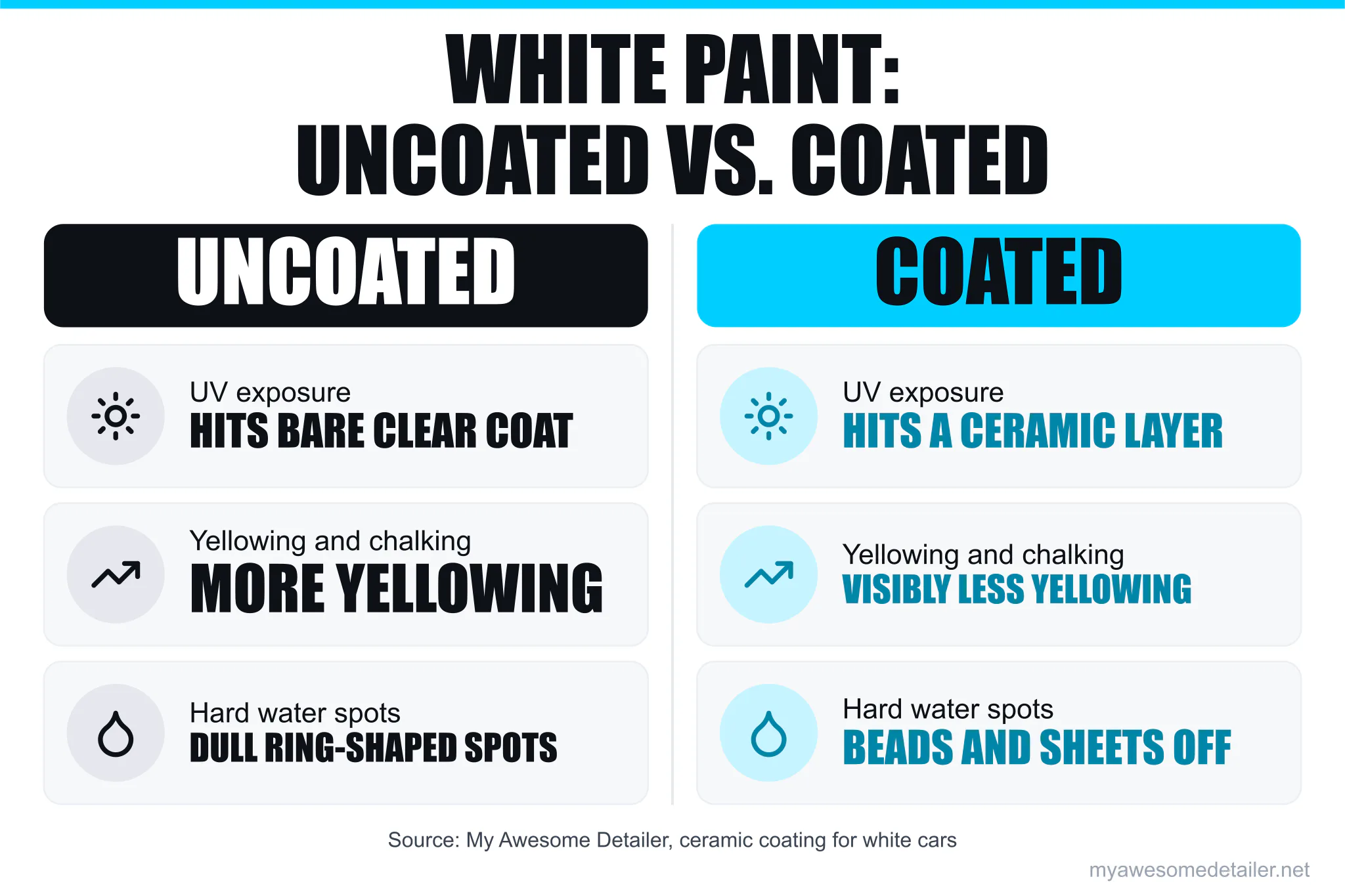
This matters because it sets the right expectation from the start: ceramic coating is not a yellowing "cure," and any installer who claims otherwise is overselling the product. What it genuinely does is shift the UV exposure burden. Instead of Alabama's sun hitting bare factory clear coat every single day for years, it's hitting a sacrificial ceramic layer engineered specifically to resist that kind of breakdown. Over the life of the coating, that difference adds up to visibly less yellowing and less chalking than the same car would show unprotected over the same time period, especially on horizontal panels that see the most direct sun.
The other piece that matters as much as the coating itself is what's underneath it. Ceramic coating is optically clear and doesn't hide existing yellowing or chalking — it locks in whatever condition the clear coat is in at the time of application. A white car with oxidation already set into the clear coat will still show it under the coating, just with more gloss. Our install starts with a strip wash, clay and a one-step polish that brings the gloss up; it is not paint correction, so oxidation and deeper defects already in the clear coat stay. That's why the best time to coat a white car is early, before the yellowing process gets going. For a full walk-through of what install day actually looks like, see our guide to the ceramic coating process, step by step.
See how much sun damage your white paint has already taken on.
A look under good lighting shows what condition your clear coat is in before a coating locks it in.
Which ceramic coating makes the most sense for white paint?
For white cars specifically, what matters most is UV protection that keeps working for years, because the primary job a white car needs a coating to do is resist yellowing under continuous Alabama sun — not just repel water and add gloss. Both of our coatings are built for that; the difference is who maintains it and how you pay.
| Option | The coating | What you pay | Guarantee |
|---|---|---|---|
| Coating Club | Pro-grade, single layer, maintained by us with a ceramic performance maintenance visit every 90 days | A monthly membership | Keeps performing while your membership is active and current |
| Select, For Life | Multi-layer and self-healing, our most potent coating | Paid once, owned outright | For life on that vehicle, plus a $5,000 insurance-backed policy that runs 9 years |
For a white work truck or daily driver that sits outside for most of its life between Auburn and Opelika, the Coating Club is usually the right call — we keep the coating performing with a visit every 90 days, so the UV protection never quietly lapses. For a white car an owner plans to keep for many years, Select, For Life is worth it specifically because UV protection compounds over time — it is paid once and guaranteed for life on that vehicle, so the factory clear coat underneath stays out of the sun's direct path. To compare the two plans, see our complete ceramic coating cost guide for Auburn.
It's worth noting that "white" covers a range of factory finishes with slightly different starting points. A solid, non-metallic white (like a factory Summit White or Oxford White) has no metallic flake to scatter light, so any yellowing or chalking reads very directly against a flat, uniform color — there's nowhere for the discoloration to hide. Pearl whites and tri-coat whites add a translucent pearl layer under the clear coat, which can make early yellowing slightly less obvious at a glance but doesn't change the underlying chemistry — the clear coat on a pearl white car ages the same way. Either way, the approach is the same: honest prep, then a coating with real UV resistance to protect it going forward.
There's also a second, less obvious benefit to coating white paint that's worth mentioning alongside UV resistance: water spotting and mineral deposits show up almost as clearly on white as yellowing does, because both problems create a visible break in an otherwise uniform, flat-white surface. A quality ceramic coating's hydrophobic properties make water sheet and bead off instead of sitting and drying on the panel, which cuts down on the hard-water etching that would otherwise leave dull, ring-shaped spots baked into the clear coat. On a white hood or roof, those etched water spots are just as noticeable as an early yellow tint, and in practice the two problems often show up together on a neglected white car — one from UV, one from standing water — which is part of why a coated white car tends to photograph and show noticeably better in direct sun than an uncoated one of the same age.
Washing and maintenance habits that protect (or speed up) yellowing
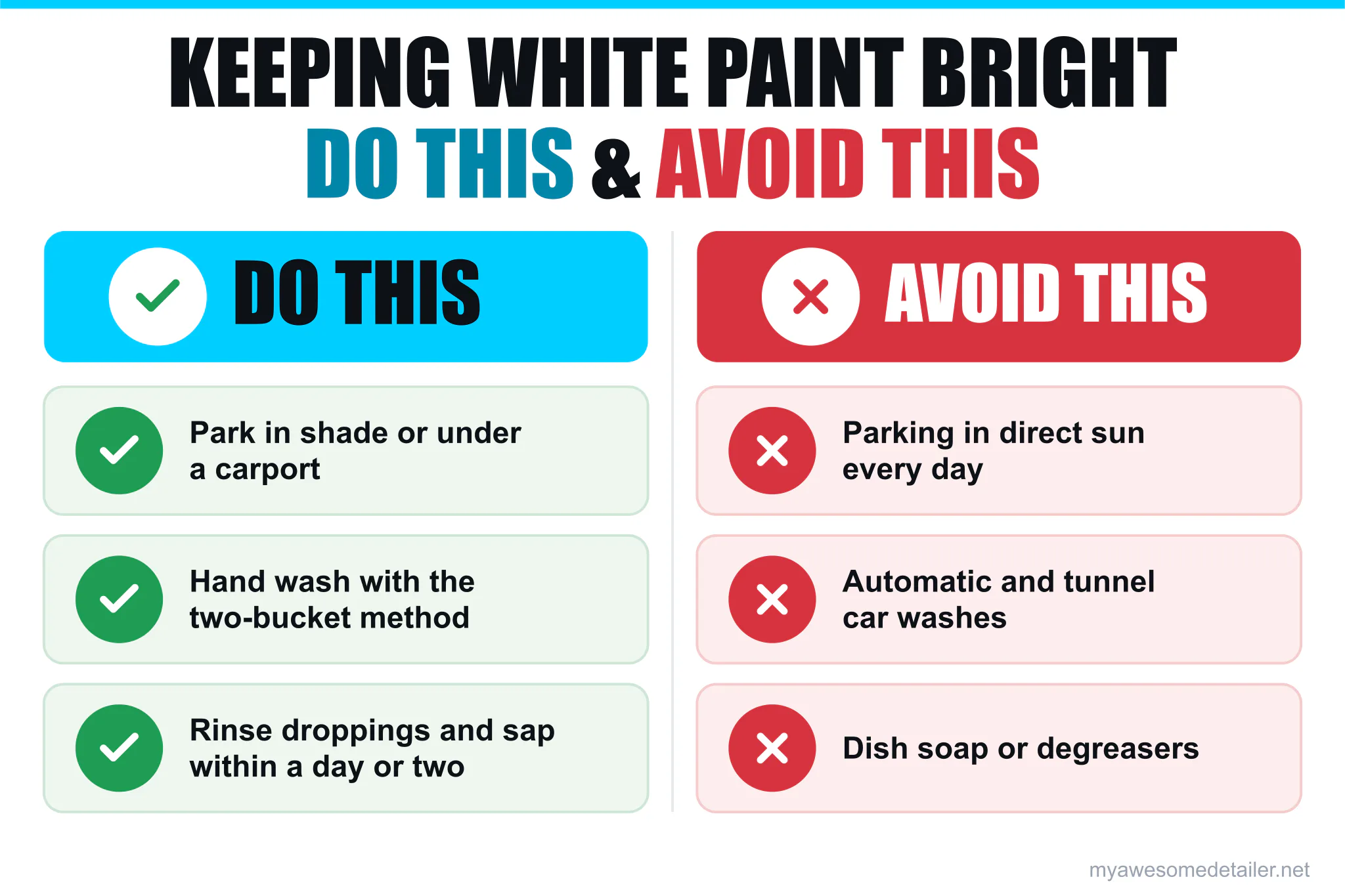
The habits that speed up yellowing on white paint are almost never about the coating itself failing — they're washing and parking choices that either add mechanical damage on top of UV stress or skip the maintenance that keeps a coating's UV resistance performing at its best. None of these mistakes are unique to white cars, but the results show up more clearly on white than on darker colors.
| Habit | Why it matters on white paint | Better alternative |
|---|---|---|
| Parking in direct sun daily with no cover | Maximizes cumulative UV dose on the exact panels that yellow first | Shade, a carport, or a breathable car cover when parked long-term outdoors |
| Automatic/tunnel car washes | Fine scratching from brushes adds haze that compounds with UV dulling, making yellowing look worse than it is | Hand washing with a two-bucket method and a clean microfiber mitt |
| Skipping annual maintenance/inspection | Lets a coating's protective performance quietly decline without the owner noticing until yellowing is visible | An annual decontamination and inspection to catch early oxidation before it spreads |
| Letting bird droppings or tree sap sit | Acidic contaminants etch localized spots that oxidize and yellow faster than the surrounding panel | Rinse or wipe off bird droppings and sap within a day or two, not weeks |
| Using dish soap or degreasers to wash | Strips the coating's protective properties faster than a proper pH-neutral car soap | A dedicated pH-neutral ceramic-safe wash soap |
Sun exposure is the single biggest lever an owner actually controls day to day. A white car that spends eight hours a day in an uncovered parking lot will show yellowing noticeably sooner than an identical coated car that's garaged overnight and parked in shade whenever possible, simply because of the difference in cumulative UV dose over months and years. For owners who can't avoid outdoor daily parking — which describes a lot of commuters and work trucks in the Auburn-Opelika area — the coating is doing more of the protective work, which is exactly why choosing a tier with genuinely strong UV resistance matters more for a white car than it might for a garage-kept vehicle in a different color. We cover the broader set of coating-damaging habits, most of which apply here too, in our guide to five things that ruin your ceramic coating.
Automatic and tunnel washes deserve a specific mention for white cars. The fine scratching those washes introduce doesn't cause yellowing directly, but it does add a hazy, light-scattering texture to the surface that makes existing UV dulling look considerably worse — the two effects stack. A white car that's both lightly oxidized and covered in fine wash-induced scratches looks noticeably duller than a car with just one of those problems on its own. Keeping wash method mechanical damage out of the equation is one of the simplest ways to make sure any yellowing that does eventually show up stays as mild and slow-developing as possible. For more on how wash method affects paint generally, see our comparison of a car wash versus a proper detail.
Alabama's climate and white paint
Lee County's combination of intense summer UV, long sun-exposure hours, high humidity, and heavy spring pollen puts white paint under more sustained stress than it would face in a milder or shorter-summer climate — which is exactly why white cars in Auburn and Opelika tend to show visible yellowing sooner than the same car would in a cooler northern state. Owners who've moved here from a shorter-summer region are often surprised by how much faster the change shows up.
Alabama summers put a white car's roof and hood under direct, high-intensity UV exposure for a large share of daylight hours, month after month, with a summer season that runs longer than in most of the country. That sustained exposure is the core driver of clear coat photo-oxidation, and it's compounded by high humidity, which can accelerate certain oxidation and etching reactions on painted surfaces. Spring pollen season across Lee County (typically March through May) adds another layer: pollen that sits wet against the clear coat for hours at a time, especially if it's wiped off dry rather than rinsed first, contributes fine scratching that compounds with UV dulling the same way automatic-wash scratching does.
Here's the layered defense that actually holds up against all of it on white paint specifically:
None of these stressors are unique to Alabama, but the length and intensity of the sun exposure here, combined with humidity and pollen, means white cars in the Auburn-Opelika corridor genuinely show yellowing sooner than the same car would in a milder climate. Parking in shade when possible and keeping up with hand-wash maintenance go a long way toward slowing that timeline once a coating is on. For a deeper look at how Alabama's heat affects coating longevity across all colors, see our guide to how long ceramic coating lasts in Alabama heat.
What does ceramic coating cost for a white car in Auburn?
At My Awesome Detailer, ceramic coating for a white car is the same as for any vehicle: the Coating Club, a monthly membership, or Select, For Life, paid once and owned outright. The coating is one price for any vehicle, and your free account shows it. Paint correction isn't something we do right now; every install includes a one-step polish, and oxidation already set into the clear coat stays.
| Service | What's included | Price |
|---|---|---|
| Coating Club | Pro-grade single layer, a ceramic performance maintenance visit every 90 days, guaranteed while you're a member | A monthly membership |
| Select, For Life | Multi-layer and self-healing, lifetime performance guarantee, $5,000 insurance-backed policy that runs 9 years | Paid once, owned outright |
There's no size or condition upcharge on the coating: it is one price for any vehicle. For a full breakdown, see our complete ceramic coating cost guide for Auburn.
One question white-car owners ask more than owners of any other color: is it worth coating a car that's already showing moderate yellowing? Usually yes, because the coating slows the damage from here, but be clear on what it won't do: our one-step polish brings the gloss up, and yellowing already set into the clear coat stays. Cars with clear coat failure so advanced it's peeling or has worn through to bare base coat in spots need paint repair, not a coating.
Choosing an installer for white paint
Because yellowing and chalking develop slowly and are easy to overlook in normal daylight, the best way to vet an installer for a white car is to ask specifically how they check for existing UV oxidation before quoting, and to ask what UV-inhibitor performance their coating product is actually rated for — not just how glossy it looks fresh off the bottle. A coating with weak UV resistance can still look great on install day and still fail to protect against yellowing over the following years.
- Ask how they check for existing oxidation and chalking — a proper inspection under good lighting, not a quick glance.
- Ask about the coating product's UV-inhibitor rating — not every ceramic product on the market is formulated the same way for long-term UV resistance.
- Ask exactly what the prep includes — and what it won't fix. Ours is a strip wash, clay and a one-step polish; oxidation already set into the clear coat stays.
- A written, itemized quote — what's included in the prep and which coating plan, not a single vague number.
As a Top 40 ceramic installer nationwide, My Awesome Detailer is upfront on every white-car job about what the prep will and won't change, because coating over existing oxidation locks in that baseline. We walk every white car with the owner before starting, since early chalking and yellowing are often visible under direct outdoor light even when they're hard to see in a shaded driveway or under garage lighting.
It's also worth asking an installer how they handle panel wipe-down before coating, and whether they recommend an annual maintenance visit afterward. On white paint specifically, any leftover polishing oil left in the clear coat can trap a faint haze under the coating that only becomes visible once the car sits in full sun for a few weeks — an easy problem to avoid with a proper isopropyl-based wipe-down, and an easy one to miss if a shop is rushing between jobs. An annual maintenance visit matters more on white than it might seem, too: because gradual yellowing develops slowly enough that owners often stop noticing it day to day, a yearly inspection under good lighting catches early oxidation or coating wear while it's still a quick fix, rather than letting it progress for another few Alabama summers unnoticed.
Keep your white paint bright, not yellowing.
A one-step polish, UV-resistant ceramic, and a maintenance plan built for Alabama sun — at our Opelika studio.
The bottom line for Auburn's white-car owners
White paint doesn't hide its age the way darker or metallic colors do. Where silver and gray owners have to worry about swirl marks under direct light, white owners are managing a slower, cumulative process: UV-driven clear coat oxidation that shows up as yellowing and chalking, worst on the horizontal panels that take the most direct sun. There's no coating on the market that makes a car immune to that process entirely — but a ceramic coating with genuine UV resistance, paired with shaded parking when it's available and hand-wash-only maintenance, is the most effective way to slow it down and keep white paint looking closer to day-one bright for years longer than it otherwise would.
If you're not sure how much UV damage your white car has already taken on, the simplest check costs nothing: park it next to a newer white car of a similar shade in direct daylight and compare. A visible shift toward cream, ivory, or a faint yellow tint — especially on the roof or hood — is early clear coat oxidation, and it's a sign to get the paint protected now. Left unprotected, that same oxidation only deepens with each additional Alabama summer.
As a Top 40 ceramic installer nationwide with a 4.9-star rating across 200+ reviews, My Awesome Detailer coats white vehicles for owners across Auburn, Opelika, and the surrounding Lee County area.
Protect your white paint before another Alabama summer.
See what a UV-resistant ceramic coating can do for your car's finish.