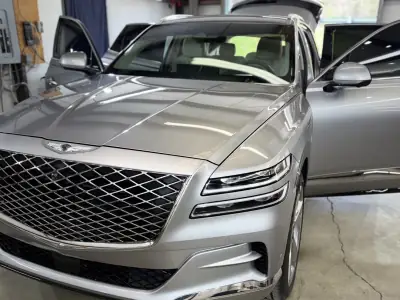
Ceramic coating on a silver or gray car works exactly the same chemically as on any other color, but metallic paint's reflective flake is forgiving of dust and merciless on swirl marks under direct sun, so it pays to know what the prep will and won't change. A silver or gray car can go two weeks between washes and still look clean from ten feet away, then reveal a web of fine scratches the moment it sits in a parking lot at noon. The answer isn't a different coating product. Our install starts with a strip wash, clay and a one-step polish that brings the gloss up; light swirls may soften, but deeper swirls and scratches stay, because paint correction isn't something we do right now. The coating then protects that finish and makes the next swirls far less likely to form.
At My Awesome Detailer in Opelika, silver and gray vehicles are some of the most common cars we coat for owners across Auburn, Opelika, and the wider Lee County area — from Silver Ice Metallic trucks to Nardo Gray-style performance cars to everyday gray crossovers. These colors are popular for a practical reason: they hide road grime, water spots, and everyday dust far better than black or white. That same metallic flake, though, scatters and bounces light in a way that makes swirl marks, holograms, and wash-induced scratching stand out more clearly than on a solid color once the sun hits it at the right angle. This guide covers why silver and gray paint behaves this way, what our ceramic coating prep actually does, which coating makes sense, how it's priced in Auburn and Opelika, and the mistakes that leave metallic paint looking worse than before it was "protected."
Why silver and gray hide dirt but expose every swirl
Silver and gray paints contain metallic aluminum flake suspended in the clear coat, and that flake scatters light in every direction — which is exactly why these colors camouflage dust and water spots at a glance, but turn into a magnifying glass for fine scratches the instant direct or angled light hits the surface. It's a genuine paradox that catches a lot of silver and gray owners off guard: the color that looked the cleanest in the grocery store parking lot is often hiding the most defect-covered clear coat in the row.
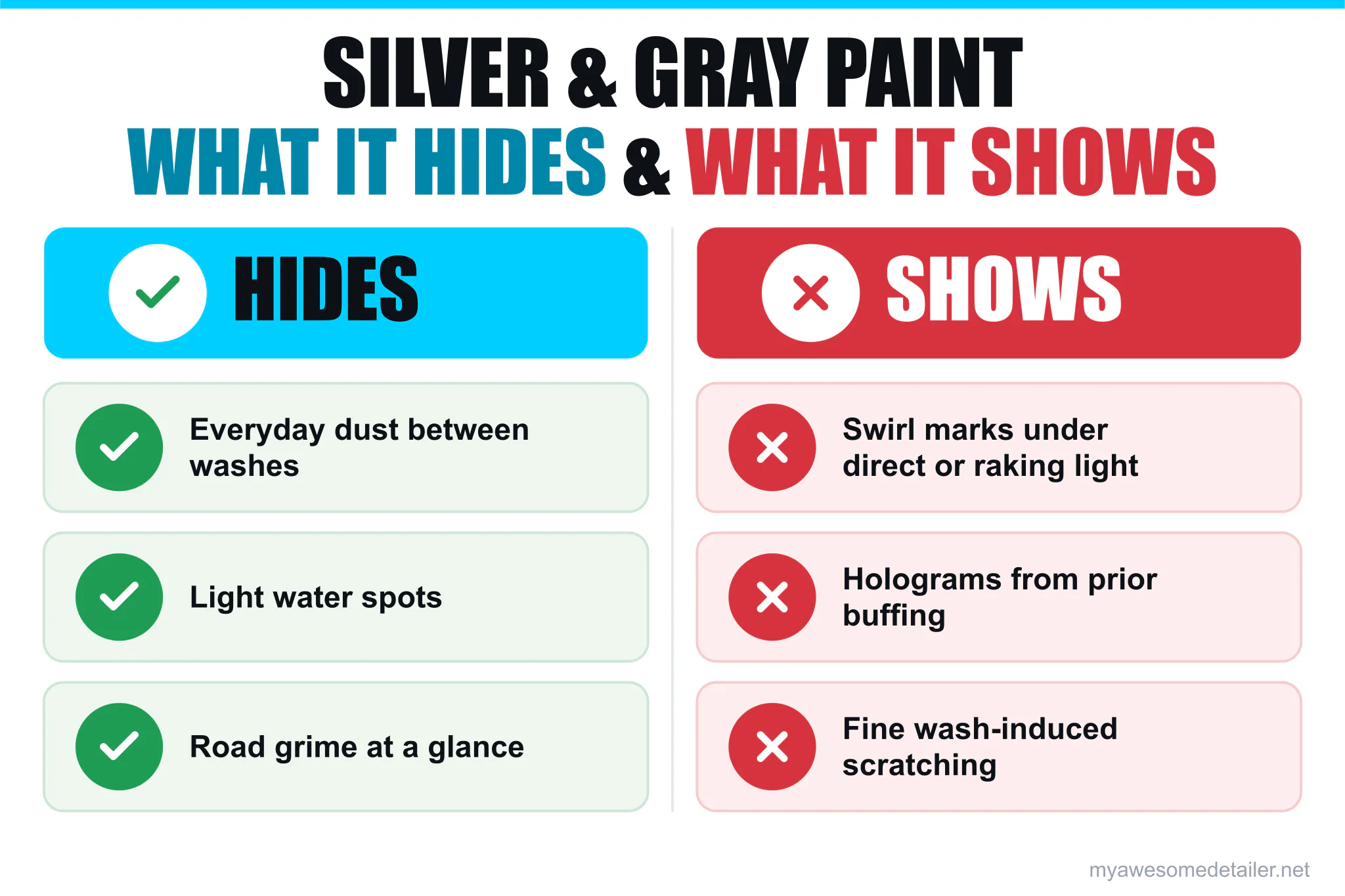
On a solid color like black or deep red, light reflects back to your eye in a fairly uniform way, so any interruption in that reflection — a swirl, a scratch, a hologram from a bad buffing job — reads as an obvious dark or light streak. On silver and gray, the metallic flake is already scattering light in dozens of directions before it even reaches your eye, which is what gives these colors their sparkle and also what hides small amounts of surface dust, light water spotting, and minor road film between washes. The trade-off is that once you catch the paint under raking light — a low sun angle, an overhead garage light, or a phone flashlight held at a shallow angle — that same flake reflects every swirl and micro-scratch back at you in sharp relief, because the scattered light has nothing consistent to bounce off except the damaged clear coat.
- Dust and light water spots — genuinely harder to see on silver/gray between washes than on black or dark colors.
- Swirl marks from washing — much easier to see under direct or raking light than on most solid colors, because the metallic flake amplifies the light-scattering effect of the damage.
- Holograms from prior buffing — a common surprise on used silver/gray cars; they're often invisible in the shade and glaringly obvious in full sun.
- Fine wash-induced scratching — accumulates the same way on any color, but shows up first and worst on metallics.
This is why a silver or gray car that "looks fine" in a shaded driveway can look genuinely rough the first time an owner parks it under a bright showroom light or takes it to a car show. It isn't that the paint got worse overnight — it's that the lighting finally revealed what was already there. This is the exact reason to know what's in your paint before it gets coated, not after.
We hear a version of this surprise regularly from customers bringing in a silver or gray trade-in inspection, a recently purchased used car, or even a two-year-old daily driver: "It looked great when I bought it." In most cases the paint didn't change — the buyer simply never saw it under the right light until it was parked at our Opelika studio under bay lighting built specifically to reveal exactly this kind of defect.
Why prep matters before the coating goes on
A ceramic coating is optically clear and adds depth to whatever is underneath it, which means coating over swirl marks on silver or gray paint doesn't hide them — it locks them in and makes them more visible under the exact bright, direct light where metallic flake already amplifies every defect. This is true on every paint color, but it's the single most common regret we hear from silver and gray owners who expected a coating to hide swirls.
Our prep on a metallic finish is the same as on any car, but the flake makes shortcuts obvious. It begins with a strip wash and clay to pull embedded contamination the paint has picked up from the road, then a one-step polish that brings the gloss up before the coating is applied. It is not paint correction: light swirls may soften, and deeper swirls and scratches stay.
- Strip wash and clay — removes embedded tar and industrial fallout that a normal wash leaves behind.
- One-step polish — brings the gloss up; light swirls may soften, deeper swirls and scratches stay.
- Panel wipe-down — removes polishing oils so the ceramic coating bonds directly to bare, clean clear coat.
We walk every silver or gray car with the owner before starting, because metallic paint often has more visible history than the owner realized — a prior dealership "buff and wax," a run through an automatic wash a few too many times, or light marring from an at-home wash mitt. Pointing that out under proper lighting before we touch a buffer sets honest expectations: the one-step polish brings the gloss up, and deeper swirls and scratches will still be there under the coating.
See what's really under your silver or gray paint.
A look under proper lighting shows what's already in the paint before you commit to a coating.
Which ceramic coating makes sense for silver and gray paint?
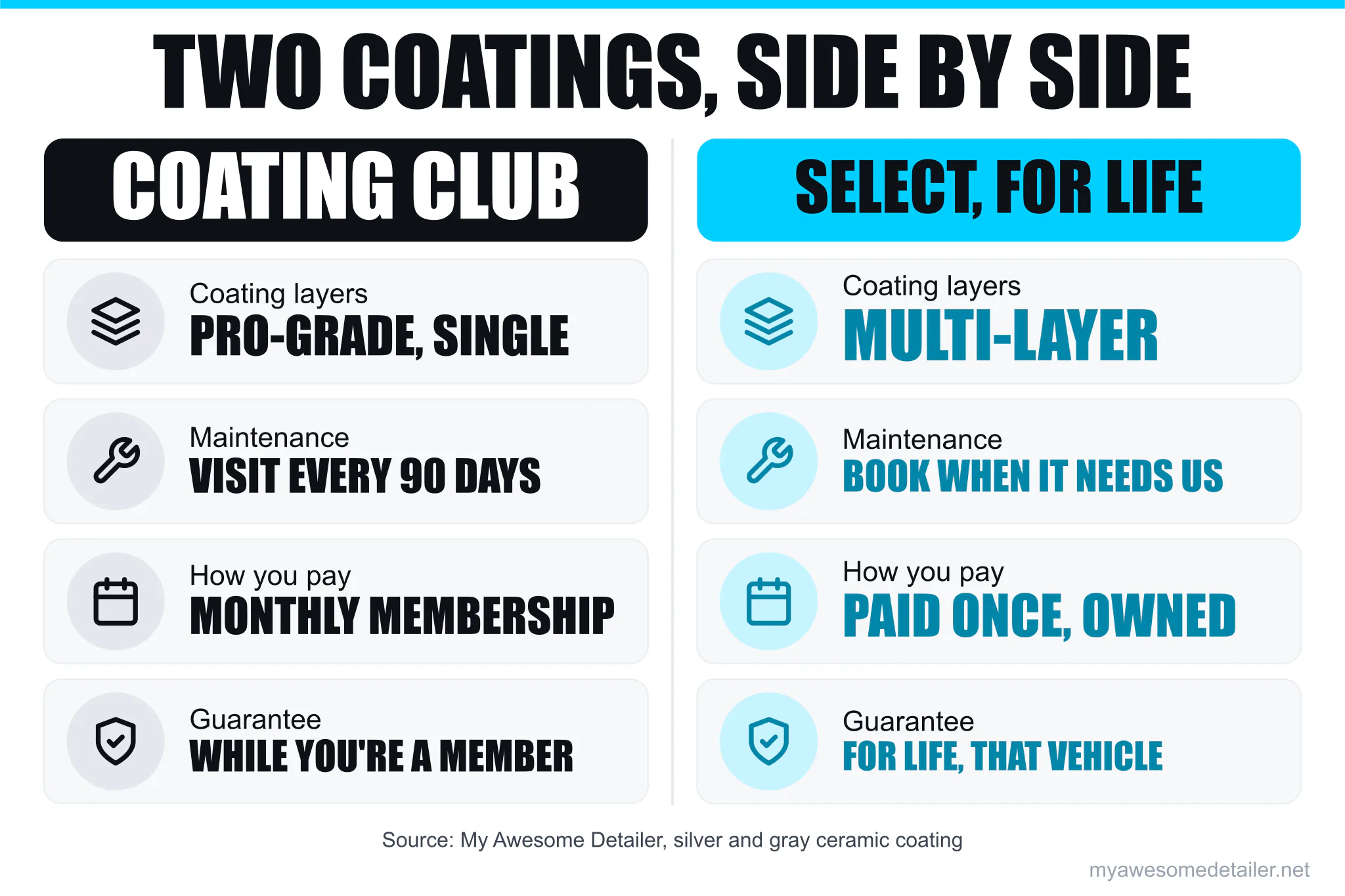
Either of our two coatings protects a silver or gray finish and brings out its depth; the choice comes down to how long you'll keep the car and whether you want it maintained for you. The Coating Club keeps a pro-grade coating performing with a visit every 90 days. Select, For Life is our most potent, multi-layer, self-healing coating, paid once.
| Option | The coating | What you pay | Guarantee |
|---|---|---|---|
| Coating Club | Pro-grade, single layer, maintained by us with a ceramic performance maintenance visit every 90 days | A monthly membership | Keeps performing while your membership is active and current |
| Select, For Life | Multi-layer and self-healing, our most potent coating | Paid once, owned outright | For life on that vehicle, plus a $5,000 insurance-backed policy that runs 9 years |
For a daily-driven gray crossover racking up regular miles between Auburn and Opelika, the Coating Club is usually the sweet spot — we keep the coating performing for you, and you can cancel anytime. For a garage-kept silver sports car or a truck the owner takes to weekend meets and plans to keep, Select, For Life is worth it: paid once and guaranteed for life on that vehicle. For a full walk-through of what happens on install day, see our guide to the ceramic coating process, step by step.
"Silver" and "gray" also cover a wide range of factory finishes, and the coating process is the same across all of them, but the visual payoff varies. Bright, high-flake finishes like Iconic Silver Metallic or Quicksilver Metallic show the biggest jump in perceived depth once polished and coated, because there's more reflective flake to work with. Flatter, low-flake tones like Satin Steel Gray or a modern Nardo Gray-style finish rely less on sparkle and more on a smooth, even reflection — on these, prep quality matters just as much, but the coating's main job is producing a uniform, streak-free sheen rather than maximizing sparkle. Either way, the underlying rule doesn't change: the coating only shows off the paint underneath it.
Common mistakes that leave silver and gray paint looking worse
The most common mistakes on silver and gray paint are expecting a coating to hide swirls, using the wrong wash method afterward, and not addressing water spots quickly — and all three show up faster and more obviously on metallic paint than on solid colors. None of these are coating failures; they're process and aftercare failures that metallic flake simply has less patience for.
| Mistake | Why it happens | Real cost on silver/gray |
|---|---|---|
| Expecting the coating to hide swirls | A coating adds gloss, so owners assume it fills defects | Swirls locked in and amplified under direct light; coating must be stripped to fix properly |
| Automatic/tunnel washing after coating | Convenience; owner assumes the coating makes any wash method safe | Fine scratching accumulates faster and shows up sooner on light metallic flake than on dark colors |
| Letting hard water spots dry on the surface | Skipping a proper dry/rinse after washing or rain | Mineral deposits etch into the clear coat and stand out as dull spots against reflective flake |
| Using dark wax or spray sealants to "fill" swirls | A cheap, temporary fix that looks okay in the shade | Swirls return under direct sun within weeks; doesn't address the underlying clear coat damage |
Automatic and tunnel car washes deserve a specific callout for silver and gray owners, because these colors make the resulting damage so visible. The brushes and abrasive grit picked up in most tunnel washes create fine scratching on any paint, but on a coated silver or gray finish that scratching shows up as a hazy, less-reflective look within a matter of months, well before the coating itself is worn. We cover this comparison in more depth in our guide to car wash versus a proper detail, and the specific chemical and mechanical threats to watch for in our guide on things that ruin your ceramic coating.
How to maintain a coated silver or gray finish long-term
A coated silver or gray car holds its deep look for years with three habits: hand washing on a regular cadence, a prompt rinse after rain or pollen, and regular ceramic performance maintenance visits to catch any early contamination before it bonds to the coating. None of this is complicated, but metallic paint gives an owner less room to skip steps than a solid color does, because the flake shows the results of neglect faster.
Wash cadence matters more on silver and gray than owners often expect. Going too long between washes lets road film, pollen, and light industrial fallout from the Auburn-Opelika corridor build up in layers, and once that film sits on a coated surface through a few hot afternoons, it can bond tightly enough that a routine wash won't fully lift it. A two-week hand-wash cadence during pollen season (typically March through May in Lee County) and a three-to-four-week cadence the rest of the year keeps a coated metallic finish looking the way it did on install day. Two-bucket washing with a pH-neutral soap, a clean microfiber wash mitt, and a proper drying towel or air blower avoids reintroducing fine scratching on the freshly polished finish.
- Hand wash on a regular cadence — every two weeks in pollen season, every three to four weeks otherwise.
- Rinse promptly after rain or heavy pollen — standing water and pollen residue are what etch and dull a coated metallic finish fastest.
- Use pH-neutral soap and a clean microfiber mitt — harsh degreasers and dirty wash media put new swirls into the finish.
- Keep up the ceramic performance maintenance visits — every 90 days on the Coating Club; on Select, For Life, book one whenever it needs us. They catch early bonded contamination before it becomes permanent etching.
- Avoid automatic and tunnel washes entirely — even "soft touch" brushless tunnels use chemicals and drying methods that are harder on a coated surface than a careful hand wash.
Regular maintenance visits are worth calling out specifically for silver and gray owners: because these colors hide grime so well between washes, it's easy to go a full year without noticing early water spot etching or a faint haze developing in direct sun. A ceramic performance maintenance visit catches that early, while it's still a quick fix.
How Alabama's climate affects silver and gray paint specifically
Lee County's intense summer UV, heavy spring pollen, and hard water combine to stress any finish, but on silver and gray paint the visible result is different than on dark colors — instead of fading or dulling, unprotected metallic clear coat tends to show water spot etching and a hazy loss of that deep "wet flake" reflection first. Owners moving to Alabama from a milder climate are often surprised by how quickly this shows up on a metallic finish specifically.
Surface temperatures on a silver or gray hood still climb well into triple digits on an August afternoon in Auburn, and while lighter metallic colors reflect more heat than black paint, the clear coat itself still bakes under that sun exposure. Hard water spotting is a particular issue for these colors: mineral deposits that dry on the surface after a rinse or a summer thunderstorm etch a dull, cloudy ring into the clear coat, and because silver and gray already scatter light heavily, those etched spots break up the reflective flake pattern in a way that's easy to spot even from a few feet away. Spring pollen season adds a second layer — pollen that sits wet against the clear coat for hours, combined with an aggressive wipe-down, contributes to the same fine scratching that shows up first on metallics.
Here's the layered defense that holds up against all of it on a silver or gray finish specifically:
None of these threats are unique to Alabama, but the combination of summer heat, hard water, and a long pollen season means silver and gray owners here see the effects faster than owners in milder climates. Prompt rinsing after a storm and hand washing between visits go a long way toward protecting the investment once the coating is on. For a deeper look at how Alabama's heat specifically affects coating longevity across all colors, see our guide to how long ceramic coating lasts in Alabama heat.
What does ceramic coating cost for a silver or gray car in Auburn?
At My Awesome Detailer, ceramic coating for a silver or gray car is the same as for any vehicle: the Coating Club, a monthly membership, or Select, For Life, paid once and owned outright. The coating is one price for any vehicle, and your free account shows it. Paint correction isn't something we do right now; every install includes a one-step polish, and deeper swirls and scratches stay.
| Service | What's included | Price |
|---|---|---|
| Coating Club | Pro-grade single layer, a ceramic performance maintenance visit every 90 days, guaranteed while you're a member | A monthly membership |
| Select, For Life | Multi-layer and self-healing, lifetime performance guarantee, $5,000 insurance-backed policy that runs 9 years | Paid once, owned outright |
There's no size or condition upcharge on the coating: it is one price for any vehicle. For a full breakdown across all colors and vehicle types, see our complete ceramic coating cost guide for Auburn.
Choosing an installer for silver or gray paint
Because swirls and prep quality show up so clearly on metallic paint under direct light, the best way to vet an installer for a silver or gray car is to ask to see their work on other metallic-colored vehicles specifically, under real outdoor lighting — not glossy after-photos taken in a shaded bay. Dark and matte colors can sometimes mask mediocre prep; silver and gray generally can't.
- Ask to see silver/gray cars they've coated — under outdoor or raking light, not just shaded studio photos.
- Ask exactly what the prep includes — and what it won't fix. Ours is a strip wash, clay and a one-step polish; deeper swirls and scratches stay.
- Ask how they wash-test after coating — a shop that walks you through a proper hand-wash-only aftercare plan is thinking about your specific paint, not just the sale.
- A written, itemized quote — what's included in the prep and which coating plan, not a single vague number.
As a Top 40 ceramic installer nationwide, My Awesome Detailer has built our prep process around exactly this kind of scrutiny, because silver and gray customers in Auburn and Opelika are often the ones who notice a rushed job the fastest.
It's also worth asking how an installer handles the wipe-down step right before coating. On metallic paint, any leftover polishing oil or filler left in the clear coat can make the paint look perfect in the shop's own lighting, only to reveal lingering haze or trapped swirls once the coating cures and the car sits in real sunlight. A shop that uses a dedicated panel-wipe or isopropyl-based prep specifically to strip those oils before coating is protecting against exactly the kind of "looks great at pickup, disappointing a week later" outcome that gives ceramic coating a bad reputation it doesn't deserve.
The bottom line for Auburn's silver and gray owners
Silver and gray paint isn't harder to protect than any other color — it's just more honest about the process behind it. Rushed prep, or a coating applied over swirls you expected it to hide, shows up clearly on metallic flake the first time the car sits in direct sun. Honest prep, a coating plan matched to how the car is driven, and hand-wash-only aftercare: that's the combination that gives silver and gray paint the deep reflection these colors are capable of.
If you're weighing whether a silver or gray car in your driveway right now already has swirls, the simplest test costs nothing: step outside around midday, angle the car so the sun hits a door panel or the hood at a low, raking angle, and look closely. If you see a web of fine, criss-crossing lines rather than a single clean reflection, that's swirl damage the metallic flake has been quietly hiding from you at every other angle. That's also exactly what a coating applied today would lock in for the next several years, so it's worth knowing before you book.
As a Top 40 ceramic installer nationwide with a 4.9-star rating across 200+ reviews, My Awesome Detailer coats metallic finishes for owners across Auburn, Opelika, and the surrounding Lee County area.
Get your silver or gray paint protected.
A one-step polish, ceramic coating, and hand-wash aftercare guidance built for metallic finishes — at our Opelika studio.