Quick answer: Window tint heat rejection and darkness are two different measurements. VLT% tells you how dark a film is (and it's what Alabama law regulates: front side windows must let in more than 32% of light), while IR rejection tells you what share of the sun's infrared energy the film blocks, and no law limits that number. That's why a legal 35% nano-ceramic film with high IR rejection can keep your cabin noticeably cooler than a cheap 5% dyed "limo" tint. When you compare films, read the VLT for legality, the IR% for heat, and the TSER (total solar energy rejected) for the full picture.
Window tint IR percentage explained in one line: it's the comfort number, not the darkness number. Most drivers who walk into our Opelika shop think darker tint automatically means a cooler car. It's an easy assumption to make, since a darker window looks like it's blocking more sun. But the heat you feel on your arm on a July afternoon on US-280 is mostly infrared energy, which you can't see at all. A film can be nearly clear and still block a big share of it, or nearly black and let most of it through.
At My Awesome Detailer LLC, 2709 Frederick Road in Opelika, we install nano-ceramic window film for drivers from Auburn, Opelika, and the rest of Lee County, plus Phenix City and Columbus, GA. This guide covers what IR rejection actually measures, why it's separate from VLT, how TSER ties the numbers together, and how to read a film spec sheet so you don't pay for marketing instead of performance. If you want the darkness side of the story first, start with our window tint percentages and VLT guide for Alabama.
What does window tint heat rejection actually mean?
Window tint heat rejection is the share of the sun's energy a film keeps from passing through your glass into the cabin. Sunlight isn't one thing. It arrives as three bands of energy, and a film handles each band differently:
- Ultraviolet (UV) is a small slice of the sun's energy, but it's the part that burns skin and fades dashboards, leather, and upholstery. Quality films, including the ceramic films we install, block about 99% of UV.
- Visible light is the part your eyes see. Blocking it makes a window look darker. This is what VLT (Visible Light Transmission) measures.
- Infrared (IR) is invisible, and it's the band you feel as heat. Roughly half of the solar energy that reaches the ground is infrared. This is what IR rejection measures.
So "heat rejection" isn't a single number. A spec sheet may list several. The three that matter most are VLT, IR rejection, and TSER (Total Solar Energy Rejected). UV blocking is usually listed too, but almost every decent film today blocks about 99%, so it rarely separates one film from another.
The key point: because so much of the heat load is infrared, a film that targets IR can cut the heat dramatically without blocking much visible light. That's the whole idea behind nano-ceramic film. Ceramic particles are engineered to absorb and reject infrared wavelengths while letting a useful amount of visible light through. Dyed film works the opposite way. It absorbs visible light to look dark, and it does relatively little about infrared.
Window tint IR percentage explained: what IR rejection measures
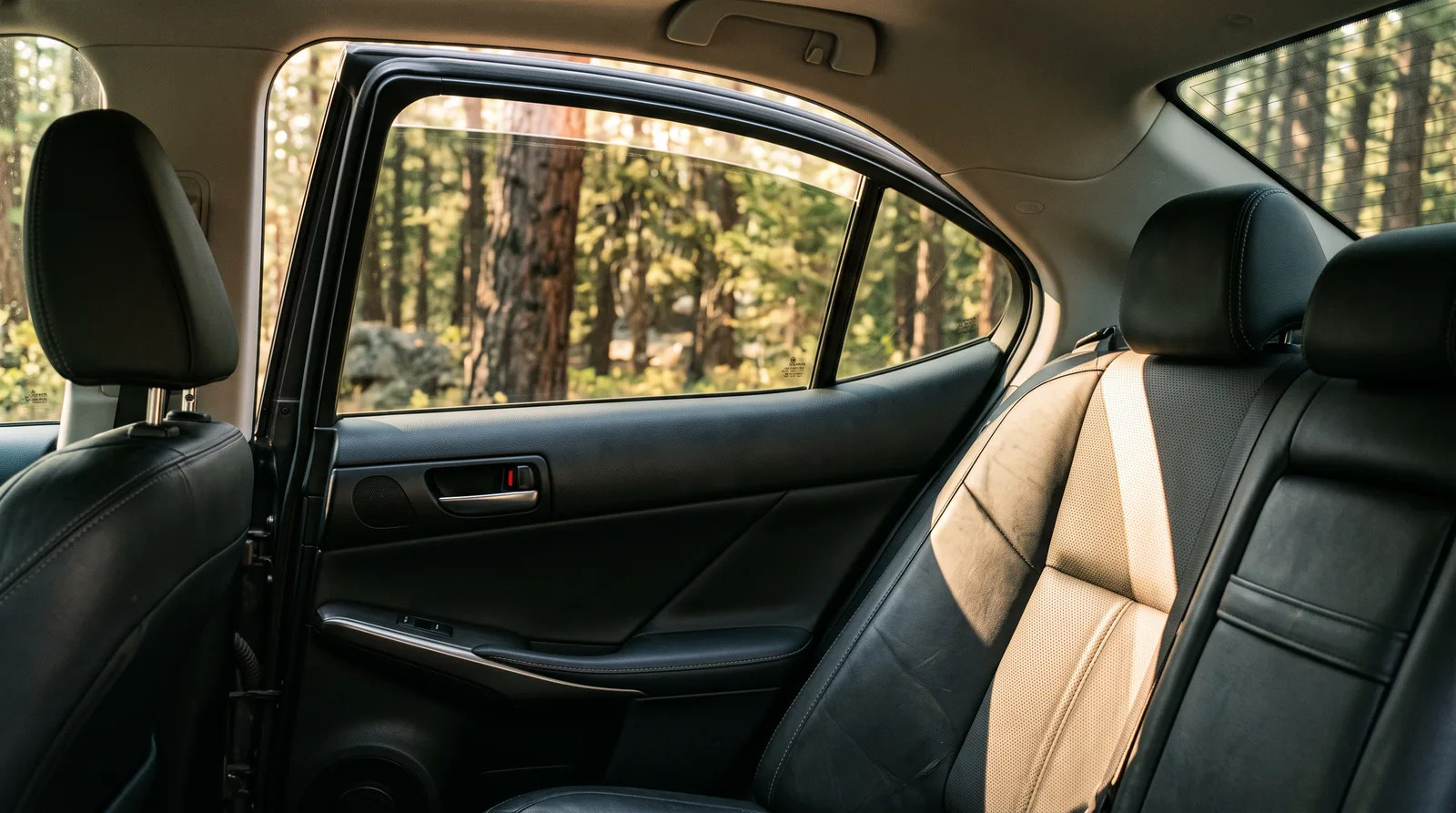
IR rejection is the percentage of infrared energy a film blocks from passing through the glass. If a film is rated at 90% IR rejection, the manufacturer is saying it stops about 90% of the infrared energy it was tested against. The higher the IR%, the less radiant heat reaches your skin, your seats, and your steering wheel.
That sounds simple, and it would be, except for one detail most shoppers never hear about: manufacturers don't all measure IR across the same range of wavelengths.
The wavelength catch
The infrared part of sunlight covers a wide range of wavelengths. Some film brands report IR rejection measured at a single wavelength or a narrow band where their film performs best. Others report it across a much wider band. Both numbers can be technically accurate, yet they aren't comparable. A film advertised at "up to 99% IR rejection" measured at one narrow band may block noticeably less across the full infrared range.
That's why you'll see impressive IR numbers on almost every ceramic film brochure, and why IR% alone shouldn't decide your purchase. Use it to compare films within the same brand and the same test method. Across brands, lean on TSER, which we'll get to below.
What a high IR number does for you
Even with that caveat, a genuinely high IR rejection film makes a difference you can feel in Alabama:
- Less heat on your skin. The driver's side arm and shoulder take the most direct sun on a long drive. High-IR film reduces that "hot through the glass" sensation.
- Cooler surfaces. Seats, the steering wheel, and the dash absorb less radiant energy, so they're not as scorching when you get in after work.
- Less work for your A/C. The cabin heats up more slowly while parked and cools down faster once you're moving. We can't promise a specific temperature drop, because it depends on your vehicle, glass, color, and where you park, but the difference is noticeable on most cars.
VLT vs IR rejection: why one is regulated and one isn't
VLT is regulated because it affects what you and a police officer can see through the glass. IR rejection isn't regulated because blocking invisible infrared doesn't change visibility at all. That single distinction is why a lighter, fully legal film can still be the best heat-rejecting option on the market.
Alabama's tint law is written entirely in terms of light transmission and reflectivity. It says nothing about how much infrared heat a film may block. Here's how the rules break down for 2026 (for the full detail, see our Alabama window tint laws guide):
| Window | Alabama VLT rule (2026) | Is IR rejection limited? |
|---|---|---|
| Windshield | Non-reflective tint above the AS-1 line only | No. A near-clear IR film is the comfort option here |
| Front side windows | Must let in more than 32% of light | No |
| Back side windows | Sedan: more than 32% VLT. SUV/truck/van: any darkness | No |
| Rear window | Sedan: more than 32% VLT. SUV/truck/van: any darkness (dual side mirrors required) | No |
| Reflectivity | Side windows can't be excessively reflective or mirrored | Indirectly. Mirror-style metallized films can fail this |
Look at that right-hand column. On the windows where Alabama limits darkness, it doesn't limit heat rejection. So if your front doors have to stay lighter than 32%, the way to get more heat control there isn't going darker. It's choosing a film with better IR and TSER performance at a legal shade.
This is the same idea we cover in our ceramic tint vs. regular tint comparison: film type matters more than film darkness when it comes to comfort.
Bottom line for Lee County drivers: the law caps how dark your front windows can be. It doesn't cap how cool they can keep you. That's the gap ceramic film fills.
TSER: the number that ties heat rejection together
TSER stands for Total Solar Energy Rejected. It's the percentage of all the sun's energy (UV, visible, and infrared combined) that a film keeps out of the vehicle. If you only compare one number between two films from different brands, make it TSER.
TSER is more honest than IR% for a few reasons:
- It covers the whole solar spectrum, not one hand-picked band of infrared.
- It accounts for visible light too. Visible light carries real energy. Blocking more of it (going darker) adds to total heat rejection, and TSER reflects that.
- It's calculated with standardized methods, so it's easier to compare across product lines than a headline IR claim.
Why darker shades of the same film reject more total heat
Within one film line, the darker shades almost always have a higher TSER than the lighter shades, because they block more visible light on top of the same infrared technology. That doesn't contradict anything above. It just means darkness adds to heat rejection; it isn't the main source of it. A dark dyed film has only darkness working for it. A ceramic film at the same shade has darkness plus infrared rejection. And a ceramic film at a lighter, legal shade can still match or beat a much darker dyed film because its infrared performance carries the load.
Typical ranges by film type
Exact numbers vary by brand, product line, and shade, so always read the specific spec sheet. But here are the general ranges you'll see when you compare film types:
| Film type | Typical IR rejection | Heat performance (TSER) | Fades over time? | Signal interference? |
|---|---|---|---|---|
| Dyed | Low (~15–25%) | Lowest. Comes mostly from darkness | Yes. Can turn purple in a few Alabama summers | No |
| Metallized | Moderate | Moderate. Comes from reflective metal layers | Durable | Often. Can affect phone, GPS, and toll tags |
| Carbon | Good (~40–55%) | Mid-tier | Color-stable | No |
| Nano-ceramic | Highest (up to ~99% in the band the manufacturer tests) | Highest at any given shade | Color-stable for the life of the car | No |
Notice the dyed row: its heat performance mostly comes from blocking visible light. That's why a dark dyed film can feel decent on day one and still leave a black interior baking in an Auburn parking lot. The infrared, which is a big share of the heat, is passing straight through.
Want to see real spec sheets side by side?
We'll show you ceramic and dyed samples on your own glass and walk through the VLT, IR, and TSER numbers for a legal shade that fits how you drive.
How to read a window tint spec sheet
To read a tint spec sheet, check five things in order: VLT for legality, TSER for total heat, IR rejection (and how it was measured) for radiant heat, UV blocking for skin and interior protection, and glare reduction or reflectivity for comfort and compliance. Here's how to work through it without getting lost in marketing language.
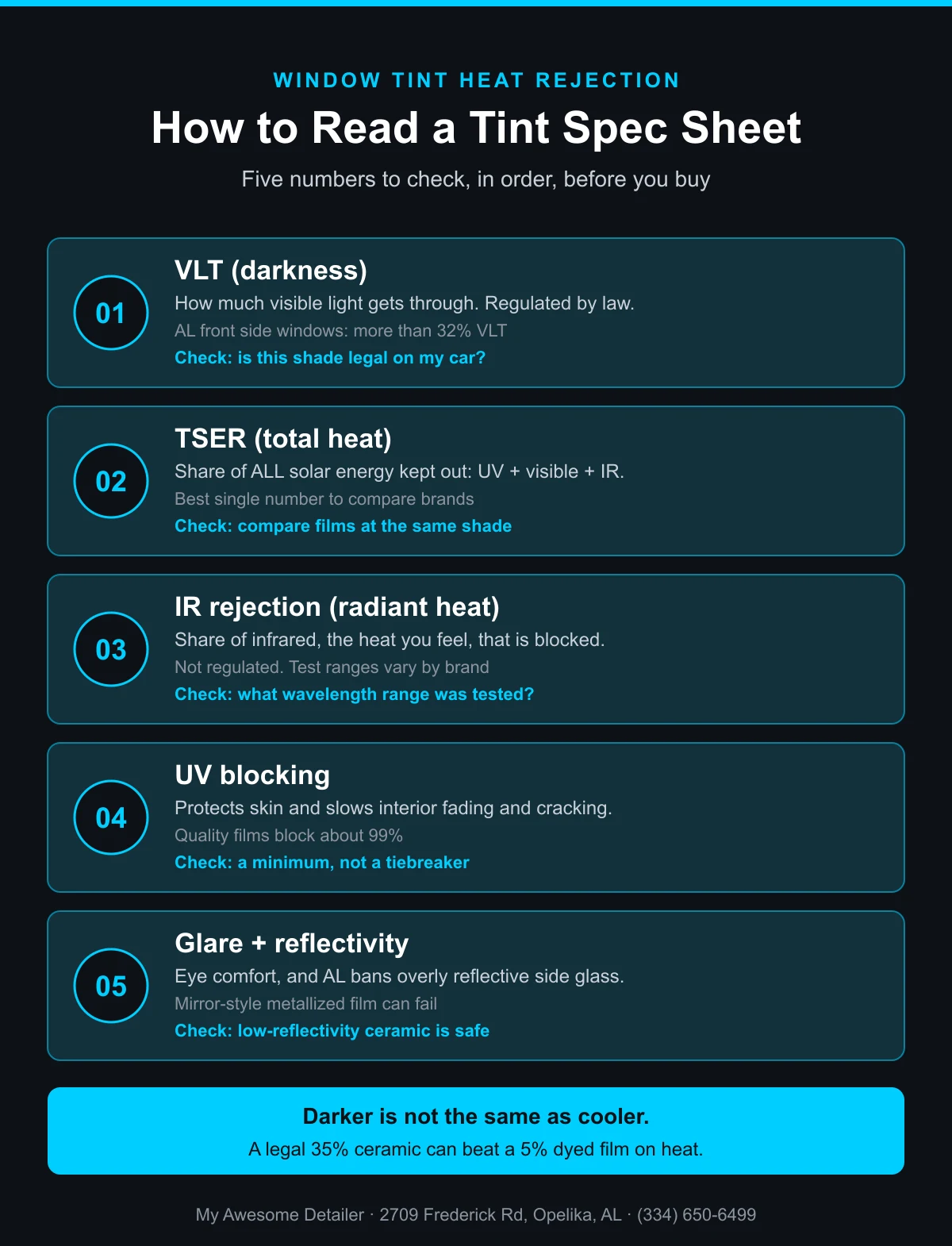
Step 1: Find the VLT and check it against the law
Start here because it rules options in or out. In Alabama, anything going on the front side windows must let in more than 32% of light. Remember that VLT on a spec sheet is the film alone. Your glass has its own slight tint, so the installed (net) VLT reads a bit darker than the film number. That's why we measure net VLT on the car with a meter rather than trusting the box.
Step 2: Find the TSER
This is your best single comparison number between films. Higher TSER means more of the sun's total energy is kept out. Compare TSER between films at the same shade. Comparing a 35% film's TSER to a 5% film's isn't apples to apples, because the darker film gets a boost from blocking visible light.
Step 3: Read the IR rejection, including the fine print
Look for the IR rejection figure and any note about how it was measured: a single wavelength, a narrow range, or the full infrared range. If the sheet says "up to," treat it as a best-case figure. It's still useful for comparing shades within one product line from the same manufacturer.
Step 4: Confirm UV blocking
You want about 99% UV rejection. This protects your skin on long drives and slows fading and cracking on your dash, seats, and door panels. Nearly every quality film meets this, so it's a box to check rather than a reason to choose one film over another.
Step 5: Check glare reduction and reflectivity
Glare reduction tells you how much the film cuts visible glare, which helps on west-facing evening drives. Interior and exterior reflectivity matter for Alabama compliance, since side windows can't be excessively reflective. Ceramic films are generally low-reflectivity, which is one more reason they're a safe pick here.
What a spec sheet won't tell you
A spec sheet can't tell you how well the film will be installed, whether the edges are clean, or what happens if it fails. Those depend on the shop and the warranty. The ceramic film we install carries a lifetime no-fault warranty. You can read the details on our warranty page.
Why a lighter legal tint can still reject serious heat
A lighter legal tint can reject serious heat because most of the heat you feel is infrared, and ceramic film blocks infrared without needing to be dark. This is the core of the whole topic, so here's a side-by-side example that shows how the numbers play out.
The figures below are illustrative, meant to show the relationships rather than quote a specific product. Your actual numbers depend on the film line and shade you choose.
| Example film | VLT (darkness) | IR rejection | Legal on Alabama front doors? | How it feels in the sun |
|---|---|---|---|---|
| Dyed "limo" film | 5% (very dark) | Low | No | Looks blacked out, but radiant heat still comes through the glass |
| Dyed film | 35% | Low | Yes | Some glare relief, little heat relief |
| Carbon film | 35% | Moderate | Yes | A clear step up in comfort |
| Nano-ceramic film | 35% | High | Yes | Noticeably cooler on your skin and seats at a legal shade |
| Clear ceramic film | ~70% (nearly clear) | High | Windshield: talk to us about Alabama's rules first | Cuts radiant heat with almost no visible change |
The 5% dyed film is the one people expect to win, and it's the only one in the table that isn't legal on your front doors. The legal 35% ceramic is the one that actually keeps the driver comfortable. That's the gap between what tint looks like it does and what it measurably does.
Absorption vs. reflection: where the heat goes
Films reject heat in two ways. Reflective (metallized) films bounce some energy back outside, which is why they often look shiny. Absorptive films, including dyed and ceramic, soak up energy in the film and glass. Some of that absorbed heat radiates back toward the outside, and some moves inward.
Ceramic films are designed to absorb infrared and shed much of it to the outside air, especially once the car is moving and air is flowing over the glass. On a parked car in direct sun, the glass itself may feel warm to the touch with ceramic film installed. That's normal. The goal is to keep the radiant heat off you and your interior, not to make the glass cold.
Why the windshield matters for heat
The windshield is the biggest piece of glass on most vehicles, and it's angled to catch a lot of overhead sun. Alabama only allows non-reflective tint above the AS-1 line, so most drivers get a visor strip there. For heat, the strip helps with overhead glare and sun on your forehead and dash. If you want heat control across the full windshield, ask us about a near-clear ceramic option and how it fits Alabama's rules before you decide. We'll tell you plainly what's allowed.
Why IR rejection matters so much in Auburn and Opelika
IR rejection matters more in east Alabama than in most of the country because our long, hot, humid summers and strong sun put a heavy heat load on every piece of glass in your car for months at a time. Here's where our customers notice it most:
- Parking lots with no shade. Work lots, Tiger Town, and game-day parking around Auburn can leave a car sitting in direct sun for hours. A cabin with high-IR film heats up more slowly, and the seats and steering wheel aren't as hot when you get back.
- Commutes on I-85 and US-280. On long drives, the sun sits on one side of the car for a long stretch. The driver's arm and shoulder take that radiant heat, and IR rejection is what reduces it, whatever the shade.
- Kids and pets in the back seat. Rear passengers often sit right next to glass with no visor and no way to move out of the sun. Ceramic film on the rear glass keeps that space more comfortable. Our minivan and family SUV tint guide covers row-by-row choices.
- Dark interiors. Black leather and dark dashboards absorb radiant heat fast. Blocking infrared at the glass protects them from heat and blocking UV slows fading and cracking.
- Lake Martin weekends. Long drives to the lake in midsummer sun are exactly when you want the heat stopped at the glass.
Factory privacy glass isn't the same as IR film
Many SUVs, trucks, and vans come with dark "privacy glass" on the rear windows. It looks tinted, and it does block visible light, but it's generally designed for privacy rather than infrared heat rejection. That's why the back seat of a factory-dark SUV can still get hot. Adding ceramic film over privacy glass adds infrared rejection on top of the darkness that's already there. On the front doors, which usually have lighter factory glass, we'll measure net VLT with the film on to make sure it stays legal.
Does IR rejection fade over time?
It depends on the film type. Dyed film relies on dyes that break down under UV and heat, so it fades, can turn purple, and loses performance over a few Alabama summers. Ceramic film is color-stable. Its ceramic particles don't break down the way dye does, so its heat performance holds up over the life of the film. That's a big part of why ceramic costs more upfront but tends to cost less over time. Our window tint cost guide for Auburn and Opelika breaks down that math.
Common IR marketing traps to watch for
The most common traps are "up to" IR numbers without a test range, comparing IR% across brands as if the tests were the same, and pushing darker film as the answer to heat. Here's what to watch for when you're shopping around:
- "Up to 99% IR rejection" with no context. Ask what wavelength range that number covers. If no one can tell you, use the TSER instead.
- Comparing IR% across brands. Different test methods produce different numbers. A film quoting 90% might outperform another quoting 95% if they were measured differently.
- "Go darker for more heat rejection." Darker adds some total heat rejection, but on the front doors it can push you below Alabama's 32% limit. Better film at a legal shade is the smarter path.
- Calling all ceramic film the same. "Ceramic" covers a wide range of product lines and price points. Ask to see the spec sheet for the exact film and shade going on your car.
- Heat lamp demos with no numbers. A demo can show the idea, but it isn't a spec. Ask for the published VLT, IR, and TSER figures too.
- Ignoring reflectivity. Some high-heat-rejection films get their performance from mirror-like metal layers. Alabama doesn't allow excessively reflective side windows, and metal content can interfere with your phone, GPS, and toll tag.
How we spec heat rejection at My Awesome Detailer
At our Opelika shop, we start with what you want from the tint (cooler cabin, less glare, privacy, or a certain look) and then pick the film and shades that deliver it legally. Here's what that looks like in practice:
- We ask how you drive and park. A daily I-85 commuter, a family hauling kids, and a weekend car that sits in a garage all need different things.
- We show you samples on your own glass so you can see the real shade, not a photo.
- We share the spec sheets and explain the VLT, IR, and TSER numbers in plain English.
- We keep the front doors legal. We measure net VLT and won't install film that puts you below Alabama's limit.
- We install nano-ceramic film that blocks about 99% of UV, rejects infrared heat at the top of the range, stays color-stable, and doesn't interfere with your phone, GPS, or toll tag, backed by a lifetime no-fault warranty.
My Awesome Detailer is a shop-based installer. You bring the car to us at 2709 Frederick Road in Opelika, where film goes on in a clean, controlled indoor bay. That's how we get clean edges and a bubble-free install that lasts. We're rated 4.9★ from 200+ reviews and hold Owner's Pride Select installer status, a distinction shared by roughly 40 shops in the U.S. Learn more about our film options on our window tint page, or read about the team on our about page.
Pairing tint with other protection
Window film protects the glass and the cabin. If you're also thinking about the paint, many customers pair tint with ceramic coating or paint protection film while the car is already at the shop. We'll give you honest advice on what's worth it for your vehicle and what isn't.
Get more heat rejection without going illegal
Bring your car to our Opelika shop and we'll match a legal ceramic shade to the heat, glare, and privacy you're after, with the spec sheet in hand.
The short version
VLT is darkness and it's regulated. IR rejection is infrared heat blocking and it isn't. TSER is the total-energy number that pulls them together. If you remember nothing else from this guide, remember these points:
- Darker doesn't automatically mean cooler. Infrared, a big share of the sun's heat, is invisible, and ceramic film blocks it without needing to be dark.
- Alabama limits front side windows to more than 32% VLT, but it places no limit on IR rejection, so the smart move is better film at a legal shade.
- IR% numbers vary by test method. Use them to compare shades within one brand, and use TSER to compare across brands.
- About 99% UV blocking is standard on quality film. It's a minimum to check, not something that separates good films from great ones.
- Dyed film fades and loses performance in Alabama heat. Nano-ceramic film stays color-stable and keeps working.
If you're comparing quotes or spec sheets and want a second opinion, call us at (334) 650-6499 or request a free quote. We'll walk through the numbers with you, even if you're still shopping around.