Quick answer: A car interior smells bad because something organic or chemical is sitting in the fabric, carpet, foam, or vents and giving off odor every time the cabin heats up. The usual culprits are mildew from damp carpet, pet accidents, cigarette smoke residue, spilled food or milk, and a dirty AC system. Air fresheners only mask the smell for a day or two. Professional detailing fixes it by finding the source, pulling it out with hot-water extraction, breaking it down with enzyme cleaner, and, for stubborn cases, treating the sealed cabin with ozone. In Auburn and Opelika, final pricing depends on the vehicle and how deep the smell goes.
You get in the car after a hot Alabama afternoon and it hits you: that sour, musty, or stale smell that wasn't there last month. You've tried the little cardboard tree, a spray, maybe a bowl of baking soda. It helps for a day, and then the smell is back, sometimes stronger than before.
That's not bad luck, and it's not your imagination. A smell that keeps coming back is a smell with a source, and as long as the source is still in the car, no fragrance will win. This guide explains where interior odors come from, why Lee County's heat and humidity make them worse, why air fresheners fail, what a professional odor treatment really involves, and what you can do yourself first.
It's written by My Awesome Detailer LLC, a shop-based detailer at 2709 Frederick Road in Opelika, serving Auburn, Opelika, and the rest of Lee County. We're rated 4.9 stars from more than 200 reviews and we're an Owner's Pride Select installer, one of roughly the top 40 shops in the U.S. for that program. Every car comes to our studio and is worked on indoors, which matters a lot for odor work, as you'll see below.
Why does my car interior smell bad?
Every bad car smell comes down to the same thing: odor molecules released by something that shouldn't be there. Bacteria, mold, and mildew produce them as they feed on moisture and organic matter. Smoke, spilled drinks, and body oils leave residues that slowly off-gas. The cabin is a small, sealed space, so even a modest source gets concentrated, and fabric, foam, and headliner material are very good at soaking it up and holding on.
Here are the most common sources we see, roughly in the order people ask about them:
- Mildew and mold from damp carpet, wet floor mats, a leaky door seal, a clogged sunroof drain, or a spill that never fully dried.
- Pet odor from hair, dander, drool, and accidents worked into seat fabric and carpet.
- Cigarette and vape smoke residue on the headliner, soft surfaces, and inside the vents.
- Food and drink such as milk, fast food, and sugary drinks that soaked into upholstery or slid under a seat.
- A dirty AC system where moisture and debris around the evaporator grow a musty film that blows into the cabin.
- Gym bags, kids, and everyday life: sweat, sunscreen, spilled snacks, and sports gear left in a closed car.
Most cars have more than one of these going on at once, which is why a single spray rarely solves it.
Why Alabama makes it worse
Lee County's humidity regularly sits above 70% for much of the year, and a parked car in summer sun can climb well above outdoor temperature. Heat speeds up the release of odor compounds, and humidity gives mildew exactly what it needs. A small spill or a damp floor mat that would dry out in a dry climate can turn musty here within days. If a smell seems to get worse on hot days, or shows up the moment you turn on the AC, that's a strong clue that moisture is involved.
Why air fresheners don't fix it
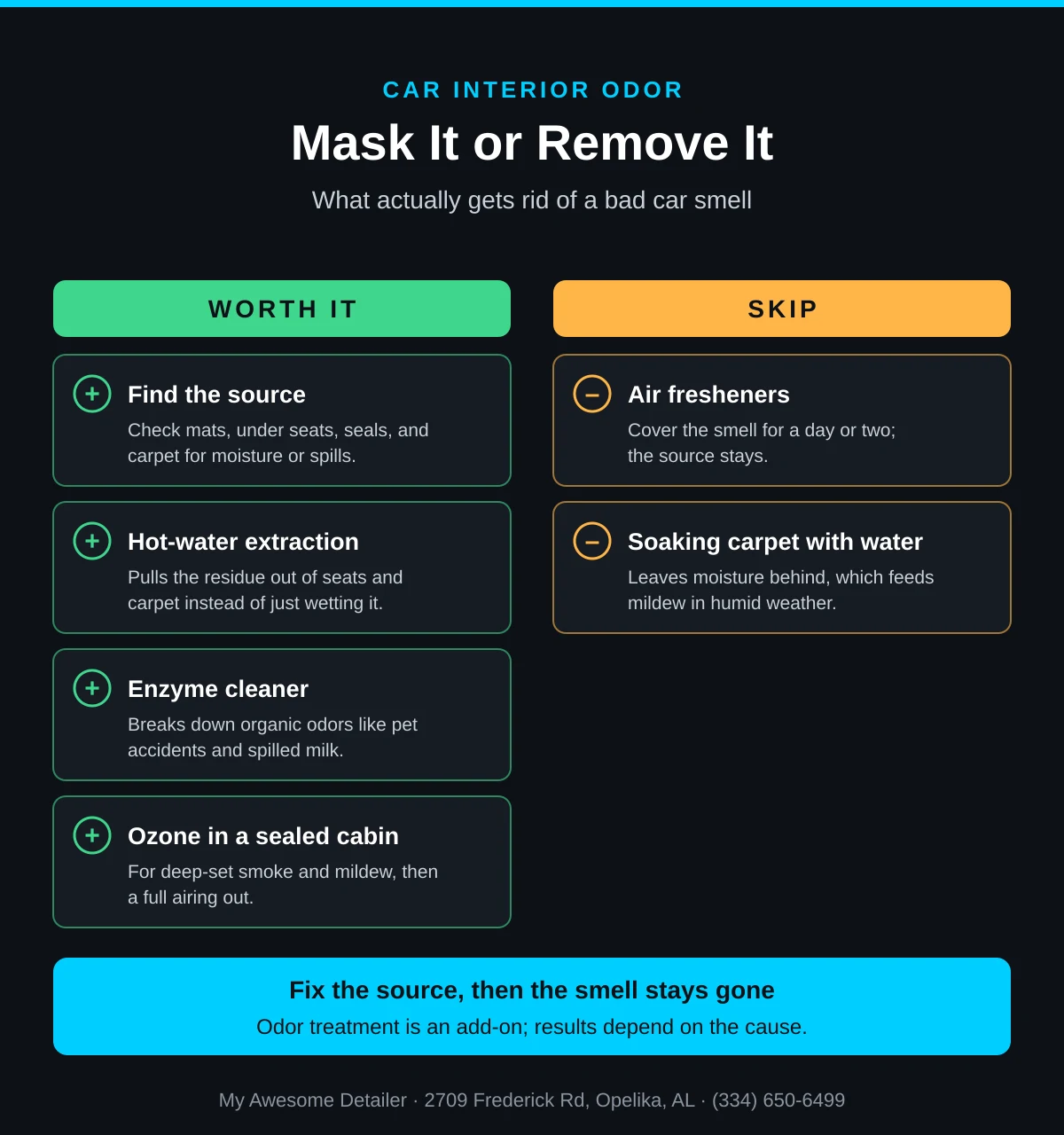
An air freshener adds a stronger smell on top of the bad one. It doesn't remove anything. Some products also coat your nose so you notice the odor less for a while. Neither touches the bacteria, mildew, or residue creating the smell, so the moment the fragrance fades, the source is still there and still active.
There's a second problem: heat. When the cabin bakes in summer, the fragrance burns off faster, and the underlying odor gets released faster too. You end up in a cycle of buying more product and wondering why the car never smells clean.
| Approach | What it does | Does it remove the source? | How long it lasts |
|---|---|---|---|
| Air freshener or spray | Covers the smell with fragrance | No | Hours to a couple of days |
| Baking soda or charcoal bags | Absorbs some airborne odor | No, and it can't reach deep into foam | Mild help for light smells |
| DIY carpet cleaner or shop vacuum | Cleans the surface | Partly, but often leaves moisture behind | Varies; can make mildew worse if it stays damp |
| Professional extraction and enzyme treatment | Pulls contamination out and breaks down organic matter | Yes | Permanent if the moisture or source is fixed |
| Ozone treatment (add-on) | Oxidizes odor molecules throughout the sealed cabin and vents | Yes, for deep-set smoke and mildew | Permanent if the source is gone |
The big five odor sources, and what actually fixes each
1. Mildew and musty smells
Mildew is the number one complaint we hear in this area. It needs moisture, so the first job is always finding where the water came from. Common sources are a floor mat that stayed wet, a spill under the seat, a door or window seal that lets rain in, a sunroof drain that backs up, or a heater core or AC drain issue. If the moisture source isn't fixed, the smell comes back no matter how well the carpet is cleaned.
Once the source is dealt with, the fix is a combination of steam to sanitize, hot-water extraction to pull the dirty moisture out of the carpet, careful drying, and, for stubborn cases, ozone. Over-wetting is the classic DIY mistake: pouring water into carpet without strong extraction leaves it damp underneath, which is exactly how you create a musty smell in the first place.
2. Pet odor
Pet smell has two parts: hair and dander, and whatever got into the fabric. Hair is removed mechanically with rubber tools, pet-hair brushes, and compressed air before extraction. Urine, drool, and vomit are biological, which is where enzyme cleaners come in. Enzymes break down the organic matter itself, so the smell doesn't return when the fabric dries. Ordinary soap or fragrance can't do that, and some cleaners can even set the stain and odor deeper.
3. Cigarette and vape smoke
Smoke is stubborn because the residue gets everywhere: the headliner, seat foam, carpet, door panels, and the inside of the vents. Wiping the surfaces helps, but the smell lives in soft materials and air pathways you can't reach by hand. This is the case where extraction, steam on the hard surfaces, and an ozone cycle in a sealed cabin work together. Heavy smoke can take more than one cycle.
4. Food, milk, and spilled drinks
Sugary and dairy spills are the worst, because bacteria feed on them. A forgotten fast-food bag or a milk spill under a seat can sour into a smell that seems to come from nowhere. The fix is locating the actual spot (often under or between seats), extracting it, and treating it with enzyme cleaner. Spraying air freshener over the area just adds a layer on top of the spoil.
5. The AC system
If the smell only shows up when the fan or AC is running, the vents or evaporator area may be harboring a musty film. A thorough interior cleaning of the vents and a sealed-cabin treatment can help with the cabin side of this. If the odor clearly comes from deep inside the AC system itself, a mechanic or HVAC specialist may need to look at the evaporator or drain. We'd rather tell you that up front than sell you a treatment that won't last.
A smell you can't shake?
Tell us what you're smelling and when it shows up. We'll tell you honestly what it takes to treat it.
How professionals remove car odors, step by step
A good odor job is a process, not a product. Here's how it goes in a shop setting, in the order that makes the difference.
Step 1: Find the source
Before any treatment, a detailer inspects the car: lifting mats, checking under and between seats, feeling carpet for dampness, looking at seals, and checking the headliner and trunk. Treating a car without finding the source is how you end up with a smell that returns in a week.
Step 2: Remove the loose material
A full vacuum, pet-hair removal, and clearing out trash and debris come first. Less material means less odor and a cleaner base for the next steps.
Step 3: Steam and clean the hard surfaces
Steam lifts grime out of vents, seams, buttons, cupholders, and door pockets, and it sanitizes as it cleans. It uses little water, so surfaces dry fast, which is useful in our humidity.
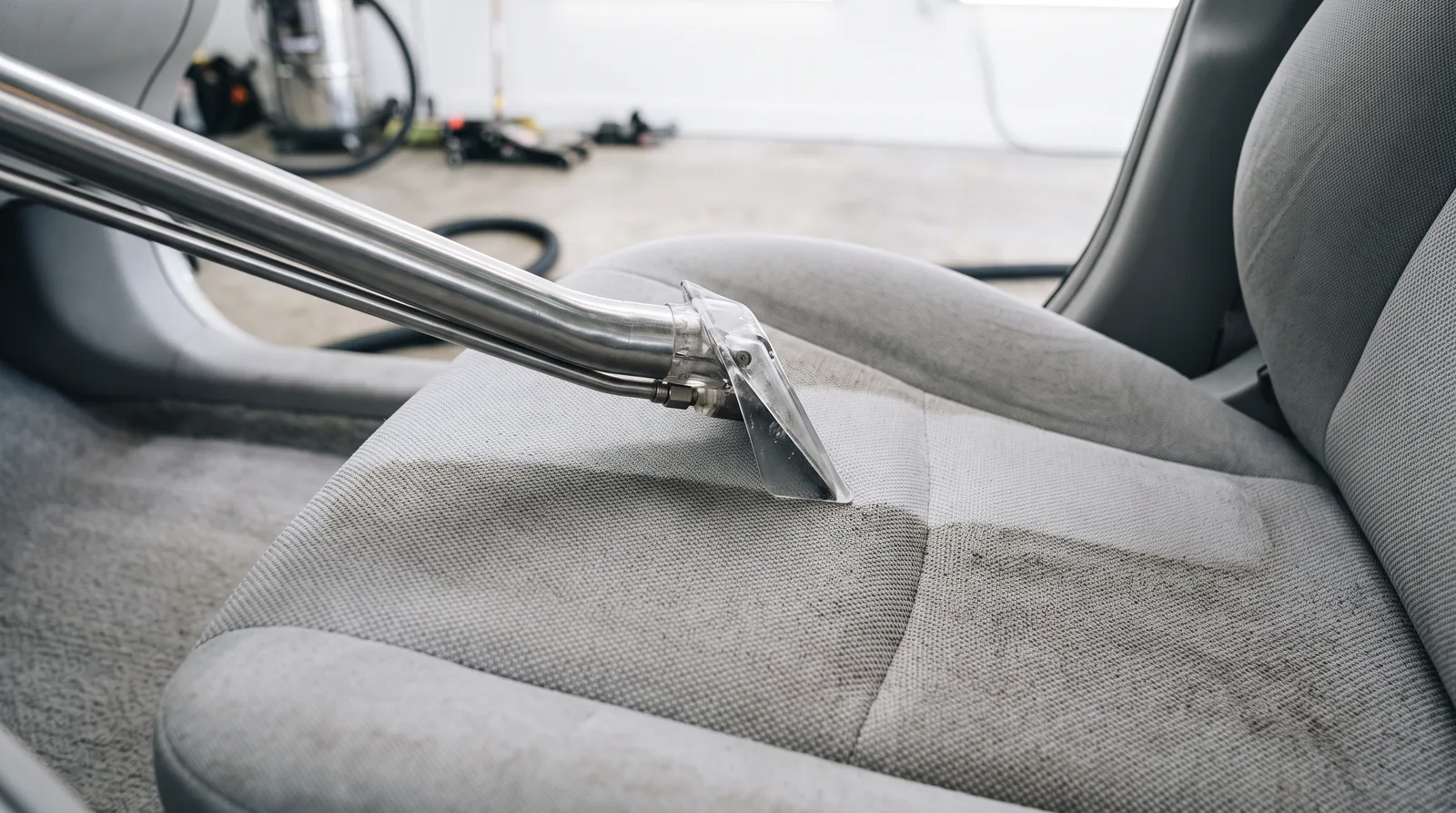
Step 4: Shampoo and hot-water extraction
A professional extractor injects cleaning solution into seats and carpet, agitates the fibers, then pulls the dirty solution and most of the moisture back out. The extraction step is the key. It physically removes the residue that is generating the smell instead of just wetting it.
Step 5: Enzyme treatment for organic odors
For pet accidents, spoiled food, vomit, and similar sources, enzyme cleaner breaks the organic matter down at a molecular level. It works best when applied after extraction, then allowed to do its job.
Step 6: Ozone for deep-set smoke and mildew (when needed)
An ozone generator floods the sealed, empty cabin with ozone (O₃), which oxidizes odor molecules everywhere air reaches, including inside the vents and the headliner. Ozone is a strong oxidizer, so the treatment is done in a sealed, unoccupied vehicle and the car is thoroughly aired out afterward. That's one reason this is a job for a professional shop, not a gadget left running in a driveway.
Step 7: Dry, air out, and check
The car is dried properly and aired out, then checked. We want a cabin that smells neutral, not perfumed.
| Odor source | Main treatment | Ozone needed? | Typical difficulty |
|---|---|---|---|
| Light musty smell from a damp mat | Dry out, steam, extraction | Usually not | Low |
| Pet urine or accident | Extraction plus enzyme cleaner | Sometimes | Medium |
| Spoiled food or milk | Locate, extract, enzyme | Sometimes | Medium |
| Established mildew in carpet | Fix moisture, steam, extraction | Often | Medium to high |
| Cigarette or vape smoke | Full interior detail, extraction, steam | Usually | High; may need more than one cycle |
What you can do before you book a detail
Some quick steps can help, or at least help you figure out what you're dealing with:
- Take out the floor mats and check underneath them and the carpet for dampness. Dry them in the sun.
- Look under and between the seats with a flashlight for food, wrappers, or spills.
- Remove trash and gym gear and don't leave wet items in the car.
- Check the trunk and spare tire well for moisture and old spills.
- Note when it smells worst. Hot days, rainy days, or when the AC runs are all clues worth telling your detailer.
- Replace the cabin air filter if it's overdue. A dirty filter can add a musty smell, and it's a quick, inexpensive fix.
- Park with the windows cracked or in a garage when you can, and let the car air out after wet days.
What not to do
Don't soak the carpet with water and a household cleaner. Don't spray strong fragrance over a wet spot. And don't buy an ozone generator to run in the car yourself: ozone must be used correctly and the cabin aired out before anyone gets in.
What a professional odor treatment looks like at our shop
At My Awesome Detailer, odor work starts inside the interior detail. A full interior detail includes a thorough vacuum, steam cleaning, and shampoo and hot-water extraction of seats and carpets, along with cleaning of all the surfaces. Odor treatment, meaning enzyme or ozone, is an add-on for cases where the source needs more than a standard clean. We want to be straightforward: odor treatment isn't included in our interior packages and we don't guarantee that every smell can be fully removed, since results depend on what caused it and how long it has been in the car. We'll tell you what we find and what we recommend before any work begins.
For a deeper look at what goes into the cleaning itself, see our guide to interior car detailing in Auburn, and our service page for auto detailing in Opelika. If you're not sure what happens when you drop off a car, here is what to expect.
Prices for odor add-ons depend on the vehicle, how severe the smell is, and how many treatments it takes. As a rough guide, specialty add-ons like ozone deodorizing or heavy stain work typically run about $50–$150 on top of the base interior detail, and your final price depends on your vehicle and its condition.
Why a shop matters for odor work
Odor treatment needs a controlled indoor space: stable temperature, good airflow for drying, and a place to run a sealed cycle safely. Our studio on Frederick Road is built for that. Drying is a bigger part of getting rid of smell than most people expect, because damp fabric just starts the mildew cycle over again.
How to keep the smell from coming back
Once the source is gone, a few habits keep it that way:
- Dry spills right away. Blot, don't rub, and let the area air dry fully.
- Use all-weather mats or dry your mats after wet days.
- Don't leave food or wet gear in the car overnight, especially in summer.
- Run the fan on dry for a minute or two before you shut the car off, so the AC system can dry out.
- Keep up with interior cleaning. Regular upkeep is far cheaper than treating a built-up smell. Our guide on car wash vs. detailing explains why a drive-through wash never touches the interior.
- Fix leaks early. A bad door seal or clogged drain is the root cause of many mildew cases.
If you're buying or selling a used car, smell matters to the value. Our post on detailing before selling your car covers what buyers notice first.
Ready for a car that smells like nothing?
Bring it to our Opelika shop and we'll find the source and treat it properly.
How to tell what kind of smell you have
You can often narrow down the cause with your nose and a little timing. The smell itself is a clue, and so is when it appears. Here's a simple way to read it.
| What it smells like | Likely cause | Clue to look for |
|---|---|---|
| Musty, like a damp basement | Mildew in carpet, mats, or the AC system | Worse after rain or when the fan runs; carpet feels cool or damp |
| Sour or rotten | Spilled milk, food, or a drink soaked into fabric | Strongest on hot days; often localized under a seat |
| Sharp, like ammonia | Pet urine or similar biological accident | Stain or stiff patch on a seat or carpet |
| Stale and smoky | Cigarette or vape residue in soft surfaces and vents | Lingers on the headliner; yellow film on glass |
| Dusty or dirty-sock smell from the vents | Dirty cabin filter or evaporator area | Only when the fan or AC starts |
| Chemical or sweet | Possibly a coolant or fluid leak | Have a mechanic check it; this is not a detailing problem |
That last row matters. A sweet, chemical smell, or any smell of fuel or burning, can point to a mechanical problem, and no cleaning will fix it. If you smell fuel, exhaust, or burning, get the car checked before you do anything else.
Smells in a used car you just bought
Buying a used car in the Auburn and Opelika area often means inheriting the last owner's habits. A previous smoker, a dog that rode in the back seat, or a car that sat with a window cracked through a rainy season can all leave a smell that isn't obvious on a short test drive, especially when the dealer has sprayed the cabin with fragrance.
A few things worth doing before or just after you buy:
- Test drive with the AC on and the windows up, and sniff the vents.
- Pull up the floor mats and press the carpet to check for dampness.
- Check the trunk floor and spare tire well for moisture or a musty smell.
- Be skeptical of a car that smells strongly of fragrance. It may be hiding something.
If you end up with a car that smells like its past, a thorough interior detail with extraction is the right first step. It resets the cabin, and then you can decide whether a deeper odor treatment is worth adding.
Common myths about car odors
"A new air freshener will fix it."
It will cover it, briefly. The source keeps producing smell underneath.
"Baking soda and coffee grounds will pull it out."
They can absorb a little airborne odor, which is useful for a mild smell. They don't reach into foam, headliner, or vents, and they don't remove residue.
"If I clean the surface, the smell will go away."
Only if the source is on the surface. Most odors live in padding and fabric below it, which is why extraction matters.
"Leaving the windows down will air it out."
Airing out helps a light smell, but it also lets in rain and humidity. In Alabama, an open window on a wet day can create the mildew problem you were trying to avoid.
"Ozone is dangerous and shops shouldn't use it."
Ozone is a strong oxidizer and needs to be handled with care, which is exactly why it's done in a sealed, unoccupied car by someone who knows the process, with proper airing out afterward. Used correctly, it's a standard tool for smoke and mildew.
Is it worth treating the smell, or should you live with it?
A smell is more than an annoyance. A musty cabin usually means moisture is sitting in your carpet, which can break down padding and make the problem harder to fix the longer you wait. Pet and food odors get deeper into foam over time. A smoky or musty car also loses resale and trade-in value, because buyers notice smell in the first thirty seconds.
If the smell is light and recent, try the home steps above first. If it has lasted more than a couple of weeks, keeps returning, or is tied to smoke, pets, or a known spill, a professional treatment will usually cost less than repeated rounds of products that don't work.
Frequently asked questions
The questions below are the ones we hear most often from Auburn and Opelika drivers. You'll also find them marked up as FAQs at the bottom of the page.
How do I get a smell out of my car?
Find the source first, then remove it: dry out any moisture, vacuum, extract the fabric and carpet, treat organic spills with an enzyme cleaner, and use ozone in a sealed cabin for deep-set smoke or mildew. Fragrance alone won't do it.
Why does my car smell musty when I turn on the AC?
Moisture and debris around the AC system can grow a musty film that blows into the cabin. A dirty cabin air filter can contribute too. Replace the filter, clean the vents, and if it persists, have the AC system inspected.
Does ozone really remove odors?
Yes, ozone oxidizes odor molecules, including inside vents and the headliner, but it works best after the source has been cleaned and extracted. It must be done in a sealed, empty car and aired out before driving.
Can a professional detail get cigarette smell out of a car?
In most cases it can reduce it dramatically, using deep cleaning, extraction, steam, and ozone. Heavy, long-term smoke may need more than one cycle, and no shop can promise a perfect result in every car.
Why does my car smell worse in summer?
Heat releases odor compounds faster and humidity feeds mildew, so a car that seems fine in winter can smell sour on a hot, humid Alabama day.
Is odor treatment included in an interior detail?
At My Awesome Detailer, odor treatment is a separate add-on and isn't included in our interior packages. We'll tell you what we find and recommend what makes sense.
How long does it take to treat a smelly car?
A standard interior detail takes several hours, and odor treatment adds time for the ozone cycle and airing out. Heavily affected cars can take longer. We'll give you a pickup time at drop-off.
Questions about a specific smell? Call (334) 650-6499 or visit us at 2709 Frederick Road in Opelika, or send us a message. We serve Auburn, Opelika, and the Lee County area, including drivers from Phenix City and Columbus, GA.