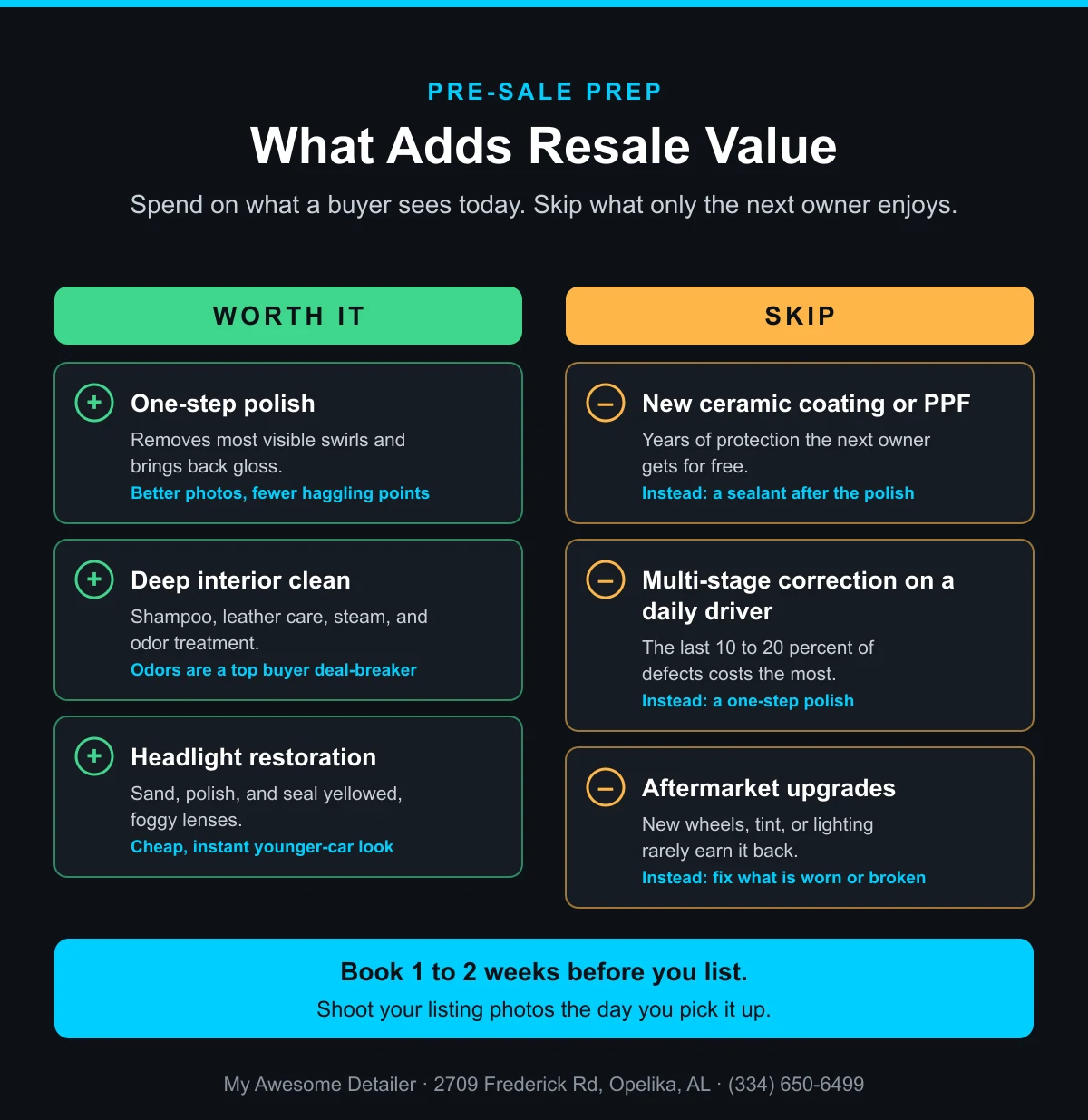
Quick answer: Yes, a professional detail before selling usually pays for itself, and light paint correction often does too. The prep that moves an appraisal is the stuff a buyer sees in the first 60 seconds: swirl-free, glossy paint in photos and in person, a deep-cleaned interior with no odors, and clear headlights. In the Auburn and Opelika area, that prep typically runs about $500 to $950 for a full detail plus a one-step polish, depending on size and condition. What usually isn't worth it right before a sale is a long-term protection product like a full ceramic coating or paint protection film on a car you're about to hand over.
Whether you're listing a car on Facebook Marketplace, trading it in at a dealership on Pepperell Parkway, or selling to a neighbor in Auburn, the same thing happens: someone looks at your car and quietly decides how much it's worth before they ever check the mileage. Paint that looks dull and scratched, a cabin that smells like old fries and dog, and foggy yellow headlights all tell that person "this car has been neglected," and they adjust their number down to match.
This guide is about getting ahead of that judgment without wasting money. At My Awesome Detailer LLC, 2709 Frederick Road in Opelika, we prep cars for sale and trade-in for drivers from Auburn, Opelika, and the rest of Lee County. Below we'll cover what buyers and appraisers actually react to, which services give you the best return before a sale, what to skip, how the timing works, and how to decide between a simple detail and paint correction. If you want the full pricing picture for correction specifically, see our paint correction cost guide for Auburn.
Does detailing increase resale value?
Detailing doesn't change what your car is. It won't lower the mileage, fix a transmission, or erase an accident from a history report. What it changes is how the car is perceived, and perception drives a big part of what people are willing to pay for a used car.
Here's why that matters so much:
- Condition is a pricing input. Pricing guides, dealer appraisal tools, and private buyers all sort used cars by condition, usually something like fair, good, very good, and excellent. Two identical cars with the same miles can land in different condition tiers based largely on cosmetics. A clean, glossy car with a fresh interior reads as "well kept." The same car with swirls, stains, and a smell reads as "used hard."
- Buyers use flaws as negotiating leverage. Every visible problem is a reason to ask for money off. Scratches, a stained seat, and hazy headlights each become a talking point. A clean car gives a buyer fewer reasons to haggle.
- Appraisers estimate reconditioning. When you trade in, the dealer mentally subtracts what it will cost them to make the car front-line ready. If they see a car that already needs very little, there's less to subtract.
- Photos sell the showing. For a private sale, your listing photos decide whether anyone shows up at all. Glossy paint and a clean cabin photograph dramatically better than dull, swirled paint and a cluttered interior.
So the honest answer to "does detailing increase resale value" is: detailing doesn't add value that wasn't there, but it stops you from losing value you'd otherwise give away to a buyer's first impression. For most cars, that protected value is worth more than the cost of the detail.
What a detail can't do
It's worth being clear about the limits, so you spend money in the right places. A detail or paint correction won't fix:
- Mechanical issues, warning lights, or overdue maintenance
- Dents, cracked bumpers, or collision damage
- Scratches that have gone through the clear coat into the color or primer
- Torn upholstery, cracked dashboards, or broken trim
- A history report showing an accident or title issue
If your car has a major mechanical problem, a detail won't hide it, and you shouldn't try to. A clean car with an honest disclosure sells better than a shiny car with a surprise.
What actually moves the needle on a sale or trade-in appraisal
Not every service has the same payoff. The prep work that pays best before a sale is the work that targets what buyers notice first and what shows up most in photos. In our experience at the shop, these are the big four.
1. Swirl-free, glossy paint
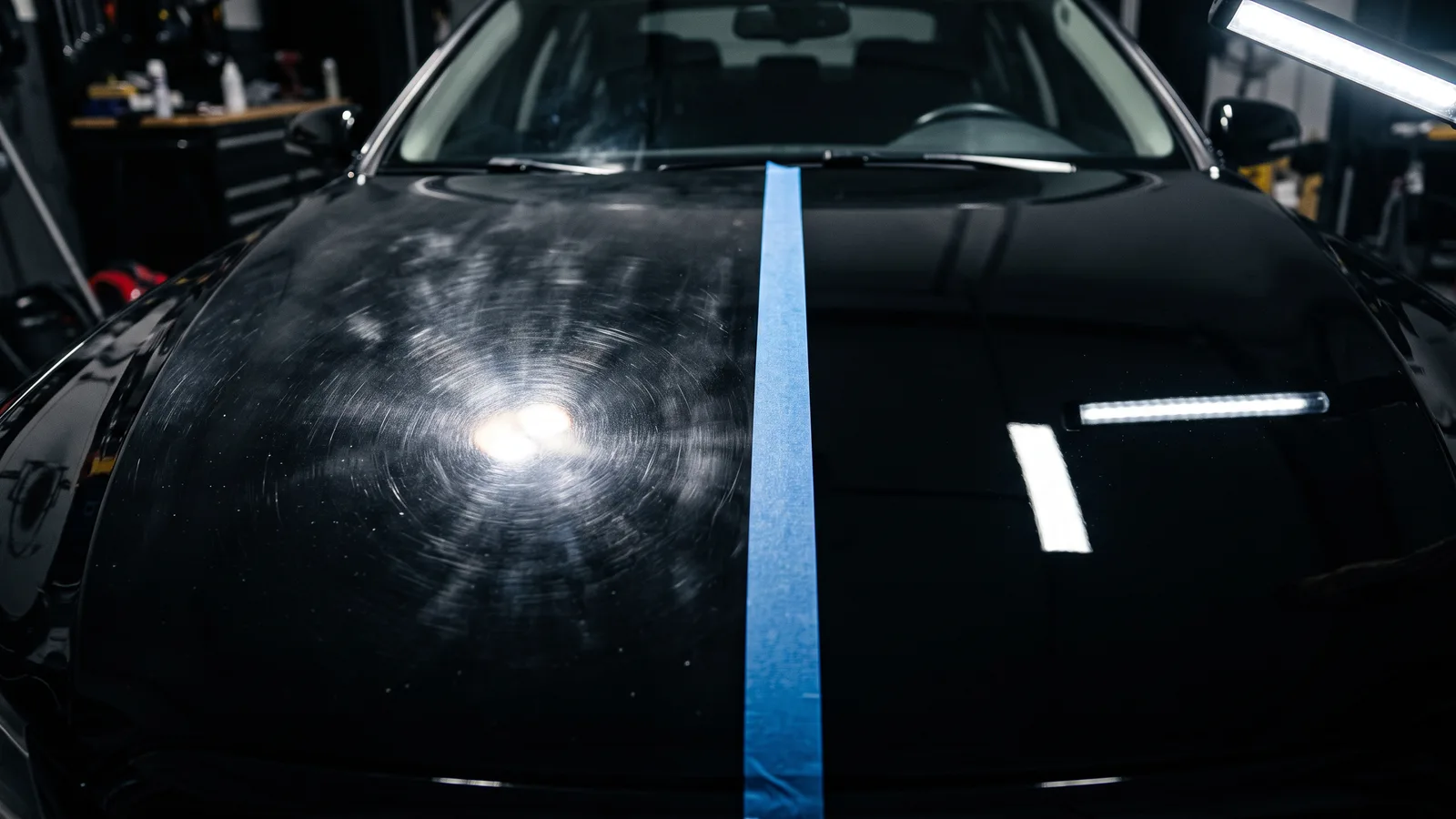
Paint is the largest surface on the car and the first thing anyone sees. On a sunny Alabama afternoon, or under the bright lights of a dealership lot, swirl marks show up as a web of fine circular scratches around every light reflection. On darker colors especially, those swirls make paint look gray, tired, and older than it is.
Most swirls come from years of automatic car washes, dry towels, and dirty wash mitts. They sit in the clear coat, which means a machine polish can usually remove most or all of them. That's what paint correction is: leveling the clear coat until the scratches are gone. Our guide on how paint correction works explains the process step by step.
For a car you're selling, the payoff is twofold:
- Photos: Corrected paint reflects light cleanly, so the car looks deep and glossy in listing pictures instead of hazy.
- In-person inspection: When a buyer or appraiser walks around the car, they see sharp reflections instead of scratches. Fewer visible flaws means fewer reasons to knock down the price.
2. A deep interior clean
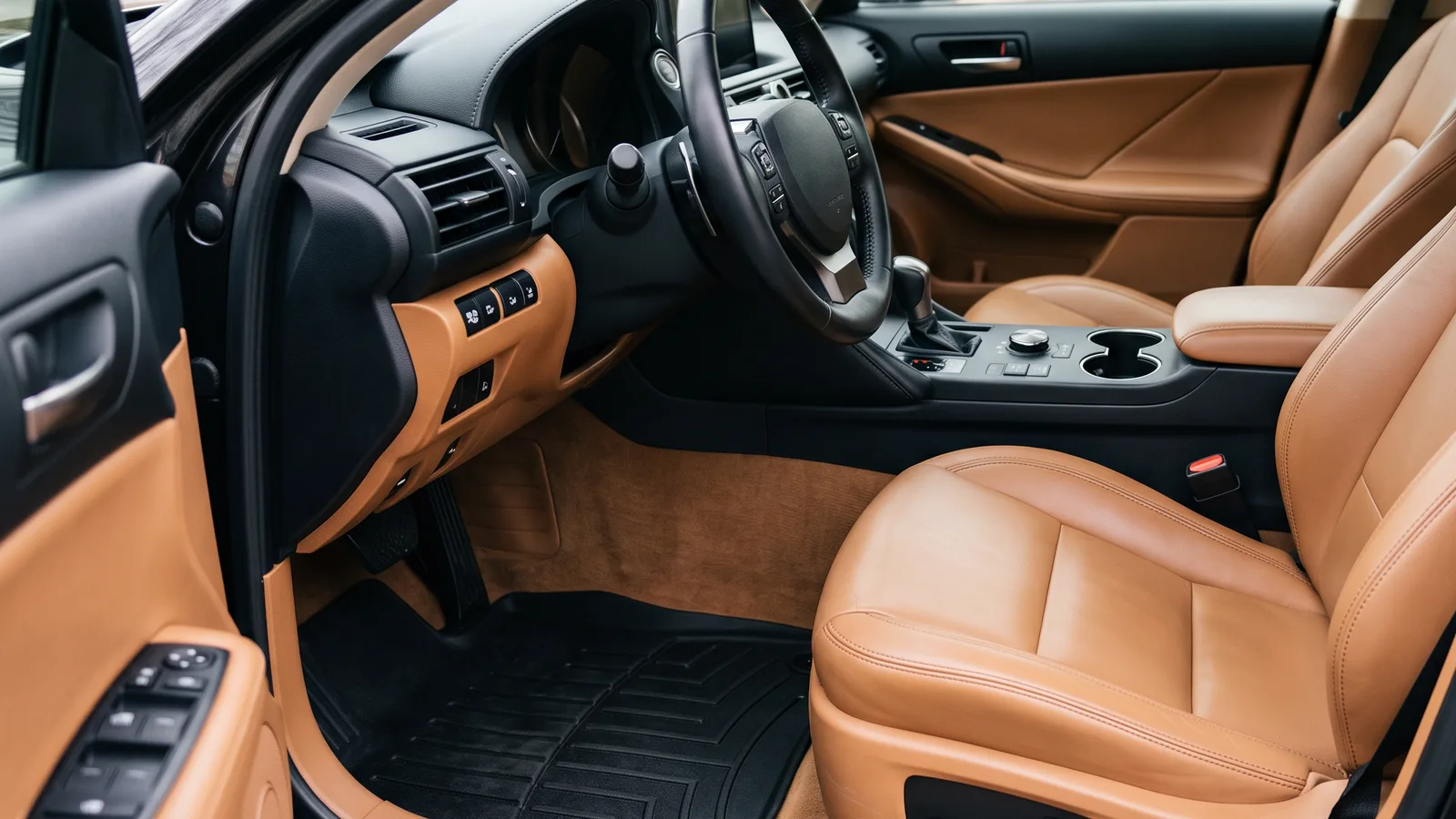
If paint is the first impression, the interior is the one that lasts. A buyer spends the whole test drive sitting in your car. They notice stains on the seats, crumbs in the seat tracks, sticky cupholders, dusty vents, and especially smells. Odors from pets, smoke, food, or mildew are some of the biggest value killers in a used car, because buyers assume they'll never get them out.
A proper interior detail covers far more than a vacuum. It typically includes shampooing carpets and cloth seats, cleaning and conditioning leather, steaming vents and crevices, cleaning every hard surface, cleaning the glass inside, and treating odors at the source. Our interior car detailing guide goes deeper into what's involved.
For a sale, the interior matters even more than usual because it's where a buyer forms their opinion of how the car was treated. A spotless cabin quietly says "the owner took care of this car," and buyers tend to extend that assumption to the parts of the car they can't see.
3. Headlight clarity
Yellowed, foggy headlights age a car by years. In the Alabama sun, polycarbonate lenses oxidize fast once the factory UV coating breaks down, and many cars over five or six years old have at least some haze. Buyers notice it instantly, and appraisers note it because cloudy lenses also reduce how far the lights throw at night.
Headlight restoration is one of the cheapest, highest-impact things you can do before a sale. A professional restoration sands off the oxidized layer, polishes the lens clear, and seals it. Our headlight restoration guide covers the process and typical costs, which usually run about $80 to $180 for a pair in our area. Clear headlights make the whole front of the car look younger, and they show up well in photos.
4. The details buyers notice without realizing it
These smaller items add up to the overall "this car is clean" feeling:
- Wheels and tires: Brake dust caked on wheels looks neglected. Clean wheels and dressed (not greasy) tires frame the car well in photos.
- Glass: Streak-free windows inside and out, plus clean mirrors.
- Door jambs: Buyers open the doors. Grimy jambs are a giveaway that a car was only "washed" for the sale.
- Engine bay: A gentle, careful engine bay cleaning makes the car look maintained when the hood goes up. It shouldn't be shiny and dripping with dressing, which can look like someone is hiding a leak.
- Trunk or cargo area: Empty, vacuumed, and smelling clean.
What's not worth paying for right before a sale
Some services are excellent for a car you're keeping and poor value for a car you're about to sell. The general rule: if a product's main benefit is long-term protection, the person who benefits is the next owner, and buyers usually won't pay you extra for it.
Full ceramic coating on a car you're letting go
We install ceramic coatings every week, and for a car you plan to keep, we think they're one of the best investments you can make in Alabama's sun and pollen. But a full ceramic coating is built to protect paint for years. If you're selling next month, you'd be paying for years of protection that the next owner gets for free, and most private buyers don't know how to value it.
There are exceptions. If a car already has a documented coating from when you bought it, that history can help, and we cover that in our article on ceramic coating and resale value. But adding a new full coating in the weeks before a sale usually isn't a smart use of money. A quality sealant applied after the polish gives you the same "fresh off the lot" gloss and water beading for the photos and the showing at a fraction of the cost.
Paint protection film right before selling
The same logic applies to paint protection film. PPF is a great long-term investment for a car you'll drive for years. On a car you're selling soon, it's mostly a gift to the next owner. Skip it unless you're keeping the car.
Multi-stage correction on an average daily driver
A full multi-stage paint correction is designed to remove as much damage as possible, usually for enthusiasts, show cars, or before a coating. On a typical commuter you're selling, a one-step polish usually removes most of the visible swirls and brings back the gloss at a much lower cost. The last 10 to 20 percent of defect removal is where correction gets expensive, and buyers rarely notice the difference between "great" and "flawless."
Cosmetic upgrades the buyer didn't ask for
New aftermarket wheels, window tint, custom lighting, or a new stereo rarely get their money back at sale time. Tint can make a car more comfortable in Alabama's heat, and you can read about that on our window tint page, but if the car doesn't already have it, adding it right before selling usually isn't worth it. Some upgrades can even narrow your pool of buyers.
Detail only vs. detail plus paint correction: which one does your car need?
Not every car needs paint correction before a sale. Some just need a thorough detail. Here's how to decide.
| Your car's condition | Recommended pre-sale prep | Typical Auburn–Opelika range* | Why it pays |
|---|---|---|---|
| Paint looks glossy, only light dirt, interior just lived-in | Full detail (interior + exterior, decon, sealant) | About $250–$500 | Removes the "used" look and gives clean photos |
| Visible swirls in sunlight, paint looks dull or hazy | Full detail + one-step polish | Detail plus about $250–$450 for the polish | Brings back gloss; the biggest visual jump for the money |
| Heavy swirls, water spots, oxidation on a higher-value car | Full detail + two-step correction | Detail plus about $450–$800 for the correction | Worth it when the car's value is high enough that condition tier matters more |
| Foggy or yellow headlights | Headlight restoration add-on | About $80–$180 per pair | Cheap, instant "younger car" effect |
| Stains, pet hair, or odors | Interior detail with odor treatment / extraction | About $150–$300, plus about $50–$150 for heavy add-ons | Odors and stains are among the biggest deal-breakers for buyers |
| Selling soon, considering a full ceramic coating or PPF | Usually skip; use a sealant instead | Not recommended right before a sale | The next owner gets most of the long-term benefit |
*Typical local ranges, not quotes. Final pricing depends on your vehicle's size, paint condition, and how much work it needs. We'll give you a range after we see the car.
A simple test you can do at home
Wash your car, dry it, and park it in direct sun around midday. Stand a few feet back and look at the reflection of the sun in the hood and doors. If you see a spiderweb of fine circular scratches around the reflection, your car has swirls, and a one-step polish will likely make a noticeable difference. If the reflection looks clean and sharp, a detail alone may be all you need. Our list of signs your car needs paint correction walks through more checks.
You can also run your fingertips (inside a thin plastic sandwich bag) across the clean paint. If it feels gritty or rough, the paint has bonded contamination that a clay bar treatment will remove as part of a proper exterior detail.
When deep scratches are the problem
If you have a few deeper scratches, from keys, branches, or shopping carts, check whether your fingernail catches in them. If it does, the scratch may be through the clear coat, and correction can only soften it. In that case, touch-up paint or a body shop may be the right fix. Our article on scratch repair: correction vs. touch-up helps you sort out which is which. For a sale, it's often fine to leave a single deeper scratch and disclose it. A buyer forgives one honest scratch far more easily than a whole car of swirls.
Selling or trading in soon?
Bring the car to our Opelika shop and we'll tell you honestly which prep will actually pay off, and which won't.
Private sale vs. trade-in: does prep matter for both?
It matters for both, but in slightly different ways.
Private sale
In a private sale, prep matters the most. You're competing against every other similar car listed in Auburn, Opelika, Phenix City, and Columbus. Buyers scroll through dozens of listings, and the ones with bright, glossy photos and clean interiors get the clicks and the calls. Then, when the buyer shows up, the car has to match the photos.
A private buyer is also more emotional than a dealer. A car that looks and smells fresh feels like a better car, and that feeling makes people less likely to haggle hard. For a private sale, we usually recommend the full combination: full detail, a one-step polish if there are visible swirls, and headlight restoration if the lenses are hazy.
Trade-in
Dealers are less emotional, but they're still human, and they still estimate reconditioning costs. A trade-in that rolls onto the lot clean, glossy, and odor-free sends a clear message that the car has been cared for, and it gives the appraiser fewer line items to deduct.
That said, dealers can recondition a car cheaper than you can, so the math is tighter. For a trade-in, focus on the cheapest high-impact items: a thorough interior clean (especially odors), a good exterior wash and decon, and headlight restoration. Full paint correction on a trade-in makes the most sense on newer or higher-value vehicles where the condition grade has more dollars attached.
Selling to a dealer outright or to an online buyer
Online car buyers and dealers who make instant offers often use photos and a checklist of condition questions. Clean photos and an interior with no stains or odors help you honestly answer those questions in the most favorable way. If they inspect the car in person, the same rules as a trade-in apply.
Timing: when to detail before you list
Timing matters more than most sellers think. Here's what we recommend:
- Book about one to two weeks before you plan to list. That gives time for any paint correction and detail work, and lets you photograph the car while it's at its best.
- Take listing photos right after pickup. The car will never look better than the day it leaves the shop. Shoot in open shade or early morning or late afternoon light, which shows gloss without harsh glare.
- Keep it clean until it sells. Park in a garage if you can, and avoid automatic car washes, which can put swirls right back in. A gentle hand wash or rinseless wash keeps it photo-ready.
- Do a quick touch-up before showings. A quick wipe-down of the interior, a dust of the dash, and a vacuum of the floor mats before each buyer arrives keeps the first impression strong.
In Alabama, timing around pollen season matters too. In spring, a freshly detailed car can be coated in yellow pine pollen within a day. If you're listing in March or April, plan to rinse the car right before photos and showings.
A pre-sale checklist you can follow
Here's the full prep checklist we'd recommend for most cars before a sale, in order of impact.
Highest impact
- Deep interior clean: shampoo carpets and seats, clean and condition leather, steam vents and crevices, clean glass inside
- Odor treatment if there's any smell from pets, smoke, food, or mildew
- Exterior wash, iron decon, and clay bar treatment
- One-step polish to remove swirls and restore gloss (if swirls are visible)
- Headlight restoration (if lenses are yellow or foggy)
Medium impact
- Clean wheels, wheel barrels, and tires; apply a satin tire dressing
- Clean door jambs, trunk jambs, and fuel door
- Gentle engine bay cleaning
- Sealant or quality wax after the polish for gloss and water beading
- Restore faded black plastic trim
Low cost, worth doing yourself
- Remove all personal items, chargers, air fresheners, and stickers
- Gather service records, both keys, and the owner's manual
- Replace burned-out bulbs and worn wiper blades
- Top off fluids and check tire pressure
- Fix any dashboard warning lights or disclose them
Paperwork matters more than people think. A neat folder of oil change receipts and service records tells a buyer the same thing a clean car does: someone cared about this vehicle.
Why Alabama cars especially benefit from pre-sale paint work
Cars in Lee County live a hard life cosmetically. Long summers of intense UV exposure dry out trim and fade paint. Spring pollen and summer love bugs etch the clear coat if they sit. Red clay dust gets everywhere. Bird droppings and tree sap bake onto hot paint in the sun. And many cars here get washed at automatic tunnel washes that add swirls month after month.
That combination means a lot of Auburn and Opelika cars look older than their actual age by the time they're sold. The good news is that much of that damage lives in the top layer of the clear coat, so a polish can bring back a surprising amount of gloss. We see three- and four-year-old cars that look tired in the sun and come out of a one-step polish looking close to new.
Interiors suffer too. Heat bakes odors into fabric, sunscreen and sweat stain leather, and spilled drinks cook into carpets. A deep interior clean reverses much of that, and it's often the most noticeable change to a buyer.
How to work out whether pre-sale prep is worth it for your car
There's no single number that tells you how much detailing will add to your sale price, and anyone who promises a specific dollar figure is guessing. But you can make a sensible decision with a simple framework.
Step 1: Look at the gap between condition tiers
Look up your car's value on a pricing guide at two condition levels, such as "good" and "very good" or "very good" and "excellent." The gap between those numbers is roughly what's at stake when a buyer decides how your car looks. On many cars, that gap is larger than the cost of a detail and polish.
Step 2: Be honest about what's holding your car back
If the main things dragging your car down are cosmetic, such as swirls, a dirty interior, and yellow headlights, prep can realistically move it up a tier. If it's mechanical issues, body damage, or high mileage, cosmetic prep will still help it sell faster, but it won't change the tier.
Step 3: Match the prep to the car's value
On a lower-value car, keep it simple: a full detail and headlight restoration. On a mid-value car, add a one-step polish if there are swirls. On a newer, higher-value car, a two-step correction can make sense, because buyers of those cars inspect paint more closely and the dollar gap between condition tiers is bigger.
Step 4: Factor in time and hassle
A clean, great-looking car also tends to sell faster. Fewer weeks of listings, fewer no-shows, and fewer lowball messages are worth something, especially if you're carrying a payment or insurance on a car you're trying to move.
What pre-sale prep looks like at My Awesome Detailer
Here's what the process looks like when you bring a car to our Opelika shop to prep it for sale or trade-in:
- Walk-around and goals. We look at the car with you, talk about whether you're selling privately or trading in, and point out what's worth fixing and what isn't. If a service won't pay for itself on your car, we'll tell you.
- Interior deep clean. Vacuum, shampoo or extraction, leather cleaning and conditioning, steam cleaning of vents and crevices, glass, and odor treatment if needed.
- Exterior wash and decon. Hand wash, iron removal, tar removal, and clay to get the paint truly clean.
- Paint correction if it makes sense. Usually a one-step polish on a daily driver, a two-step on a higher-value car with heavier defects.
- Headlights, trim, and wheels. Restore the lenses, bring back faded trim, and clean wheels and tires.
- Protection for the photos. A sealant adds gloss and water beading without paying for years of protection you won't keep.
All of the work is done inside our shop at 2709 Frederick Road, where we have the lighting and controlled space correction requires. Our team holds Owner's Pride Select installer status, a designation held by roughly the top 40 shops in the U.S., and we're rated 4.9 stars from more than 200 reviews. You can learn more about our team or browse our auto detailing services.
If you decide to keep the car after all
It happens more often than you'd think. Someone brings a car in to get it ready to sell, sees it come out looking close to new, and decides to keep it. If that's you, the polish you already paid for is the perfect base for a long-term protection product. A ceramic coating can go right on top of corrected paint and keep it looking that way for years. At that point, the protection is for you, not the next owner, and that's when it makes sense.
Common mistakes sellers make
Using a tunnel wash the day before listing
A quick trip through an automatic wash right before photos can add fresh swirls and leave water spots. A careful hand wash is safer.
Covering up odors with heavy air fresheners
Buyers notice strong fragrances and often assume they're hiding something. Removing odors at the source is better than masking them.
Shiny, greasy dressings everywhere
Glossy, wet-look dressing on the dashboard, tires, and engine bay can look cheap and sling onto paint. A clean, satin finish looks more natural and more "cared for."
Using a glaze to fake gloss
Filler glazes can hide swirls for a few days, but they wash out. If the buyer comes back after a week, or a dealer washes the car before appraising it, the swirls are back. Real correction stays.
Spending on long-term protection
As covered above, full coatings and film right before a sale mostly benefit the next owner. Spend on what the buyer sees today.
Forgetting the photos
Paying for a detail and then taking listing photos in a dark garage or at noon in harsh sun wastes much of the effect. Take good photos on the day you pick the car up.
The bottom line
Detailing and paint correction before selling aren't about tricking anyone. They're about presenting your car as the well-kept vehicle it actually is, instead of letting a few years of swirls, dust, and haze talk a buyer down. For most cars, the best return comes from a deep interior clean, a one-step polish if swirls are visible, and clear headlights. What usually isn't worth it is buying years of protection for a car you're about to hand to someone else.
Get your car sale-ready in Opelika
We prep cars for sale and trade-in for drivers across Auburn, Opelika, and Lee County. Tell us about your car and we'll recommend only what pays off.