Quick answer: Your car needs paint correction, not just a wash, when the problem is in the clear coat instead of on it. The five signs are: spiderweb swirls that show up in direct sun, a dull or hazy finish that stays dull after a proper wash, water spots that won't wipe off, holograms or buffer trails from a bad past detail, and fine scratches you can see but can't catch with a fingernail. If a wash and a clay bar don't fix it, machine polishing usually will. In the Auburn-Opelika area that typically costs about $250 to $450 for a one-step polish and $450 to $1,500 or more for heavier correction, and final pricing depends on the vehicle.
Most people find out their paint is damaged the same way. They wash the car, pull it out of the shade, and the sun hits the hood. Suddenly there's a web of fine circles all over the paint. The car is clean, and it still doesn't look good.
That moment is the line between washing and paint correction. A wash removes what's sitting on the paint: dust, pollen, bugs, road film. Paint correction removes what's been cut into the paint: swirls, haze, etched spots, and light scratches. No soap, spray wax, or tunnel wash can reach that second category, because there's nothing to wash off. The damage is the surface itself.
At My Awesome Detailer LLC, 2709 Frederick Road in Opelika, we look at paint every day for drivers from Auburn, Opelika, and the rest of Lee County. This guide is the checklist we'd walk you through in person: the five signs that mean correction, how to check your own car in about ten minutes, the common false alarms that only need a wash or decon, and what correction can and can't fix. If you already know you need it and want the cost details, our paint correction cost guide for Auburn goes deeper on pricing.
Wash vs. paint correction: what's actually different
A wash cleans the surface. Paint correction reshapes it. That one sentence explains why so many people keep washing a car that never looks better.
Modern factory paint is built in layers. There's primer on the metal, a thin color coat (the base coat) on top of that, and then a clear coat over everything. The clear coat is what you're actually looking at and touching. It's what gives paint its gloss and depth, and it's what takes the abuse: wash mitts, automatic brushes, towels, sun, bird droppings, and hard water.
The clear coat is thin. On most cars it's measured in microns, about the thickness of a sheet of printer paper or less. When light hits a perfectly flat clear coat, it reflects straight back and you see a crisp, mirror-like reflection. When the clear coat is covered in thousands of tiny scratches, light scatters in every direction. That scattered light is what you see as swirls, haze, and dullness.
What a wash can do
- Remove loose dirt, dust, pollen, and road film
- Remove fresh bug splatter and bird droppings before they etch
- Restore the look of paint that's simply dirty
- Add a temporary layer of gloss if you use a wax or sealant afterward
What paint correction does
- Uses a machine polisher, pads, and abrasive compounds or polishes to level a microscopically thin layer of clear coat
- Removes swirls, light scratches, holograms, and water spot etching by taking the surface down to the bottom of the defect
- Restores a flat surface, so light reflects cleanly again and the gloss and color depth come back
- Makes a permanent change, not a filler that washes away in a few weeks
That last point matters. Some "polishes" at the auto parts store are mostly fillers and glazes. They hide swirls by filling them in, and the swirls come back after a few washes. True correction removes the defect. That's also why it has to be done carefully. You only have so much clear coat, and the goal is to remove as little as necessary.
If you're still sorting out the difference between a wash and a full detail, our guide to car wash vs. detailing in Auburn breaks down what each service includes.
The 5 signs your car needs paint correction (at a glance)
Here's the short version of the checklist. Each sign gets its own section below, with how to check for it and what fixes it.
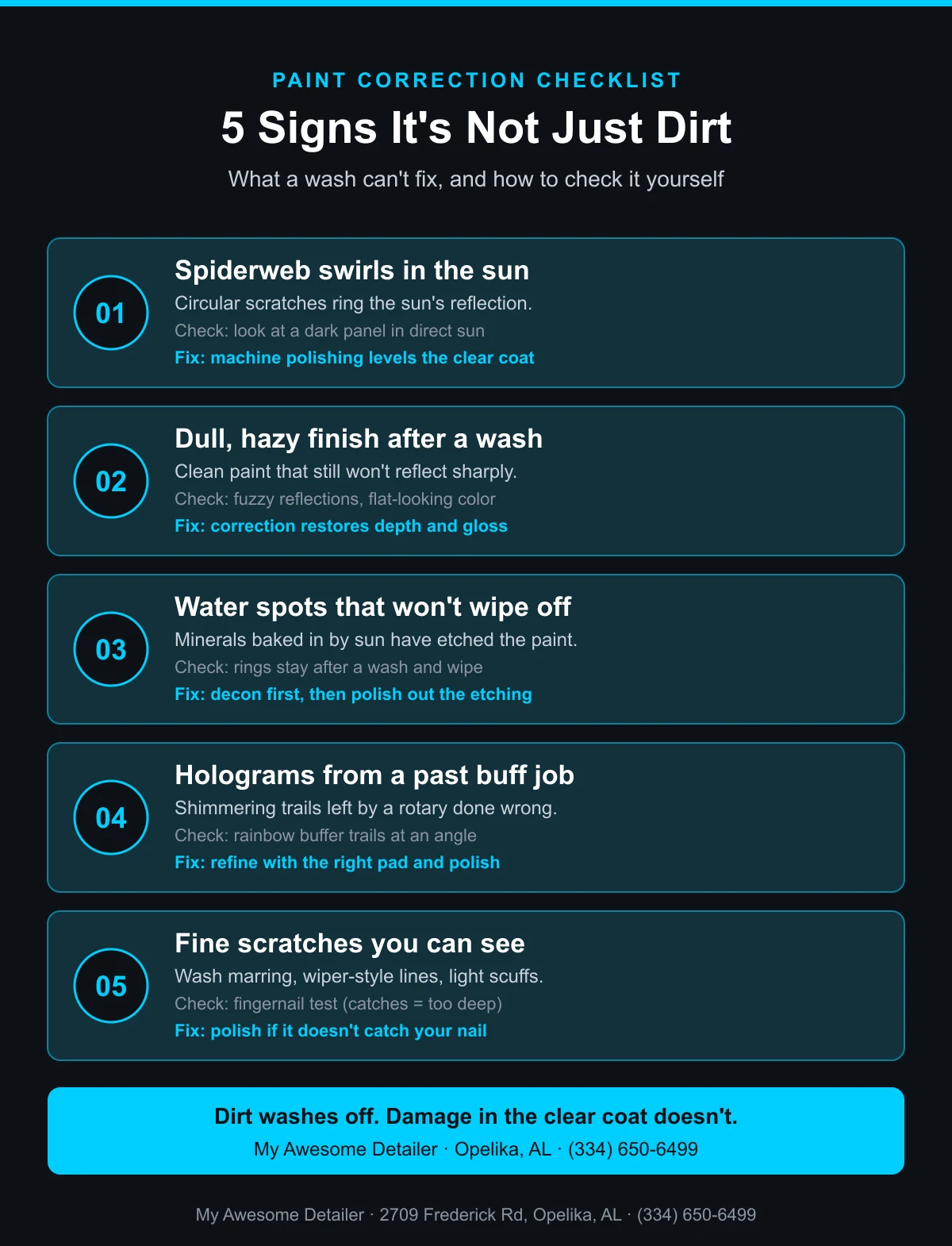
- Spiderweb swirls that circle the sun's reflection or a light
- A dull, hazy finish that stays flat even when the car is clean
- Water spots that won't wipe off because they've etched into the clear coat
- Holograms or buffer trails left behind by a bad past polish job
- Fine scratches you can see but can't catch with a fingernail
One of these on its own, on one panel, might only need a spot repair. Two or more across the car is a strong sign the whole vehicle would benefit from correction.
Sign 1: Spiderweb swirls in the sun
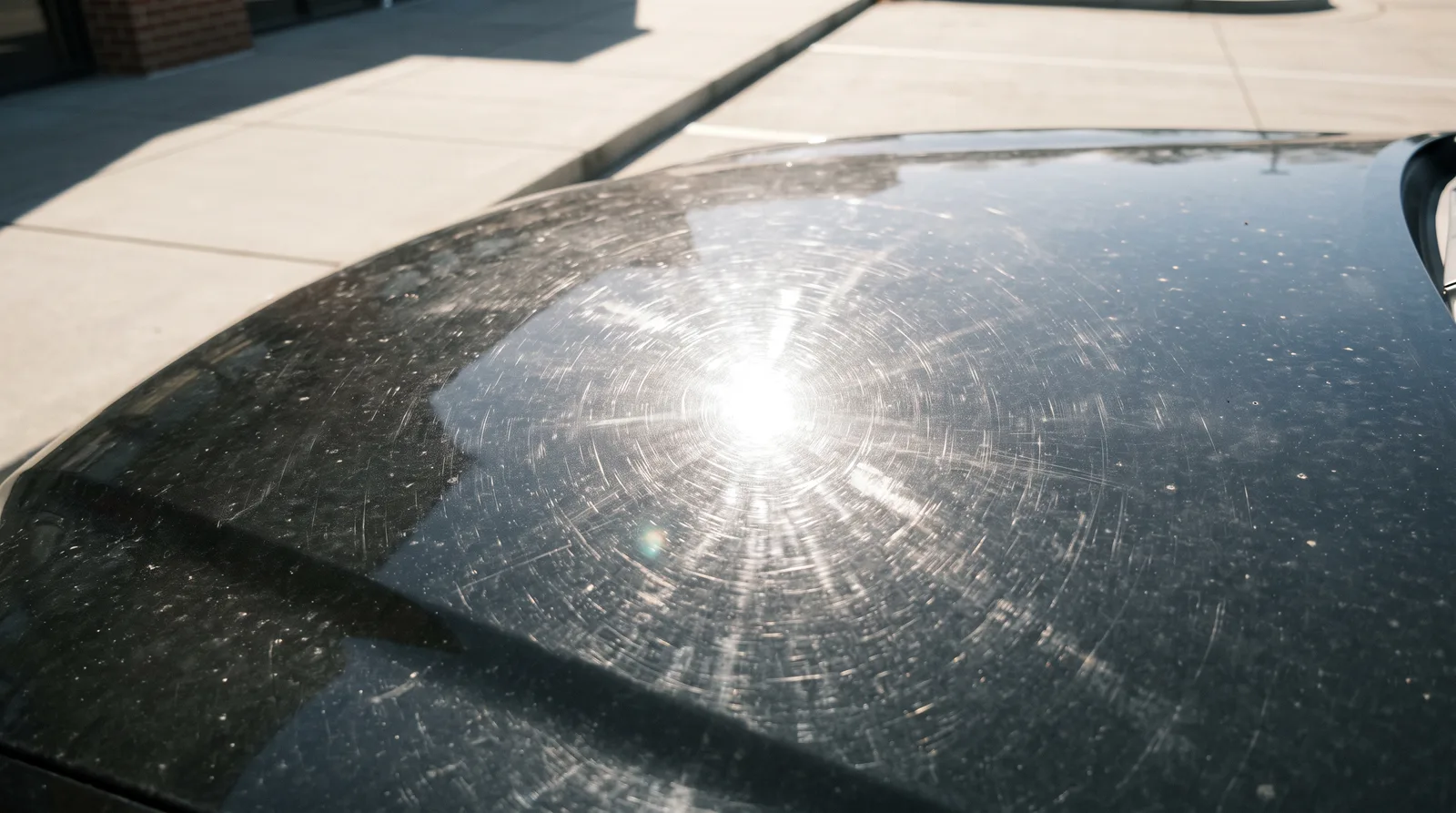
Swirl marks are the most common reason people end up needing paint correction. They're fine, shallow scratches in the clear coat, usually in a circular or random pattern. In the shade they're almost invisible. Under direct sun or a single bright light, they line up around the reflection and look like a spiderweb.
Where swirls come from
- Automatic car washes with brushes or cloth strips. The material drags grit from the car before you across your paint.
- Washing with one bucket, or a dirty mitt. Every pass rubs the dirt you just picked up back into the paint.
- Drying with a bath towel or a chamois dragged across a surface that still has grit on it.
- Dry-wiping dust or pollen with a quick detailer and a shop rag. Lee County pollen season makes this one tempting every spring.
- Brushing up against the car with bags, jackets, or a dog's paws.
How to check
Wash and dry the car, then park it in full sun. Stand so the sun's reflection is on the hood or roof, and look at the area right around the bright spot. At night, a single LED flashlight held at an angle works too. Dark colors (black, dark blue, dark gray, deep red) show swirls the most, but silver and white cars have them too. They just hide them better.
What fixes it
Light, even swirling usually responds well to a one-step polish. Heavier swirling, especially on soft black paint, often needs a two-step correction: a cutting compound to remove the defects, then a finishing polish to refine the surface back to full gloss.
Sign 2: A dull, hazy finish that won't shine after a wash
If your car is clean and still looks flat, the problem isn't dirt. Healthy paint has depth. You can see a sharp reflection of trees, buildings, or clouds in it. Dull paint gives you a blurry, washed-out reflection, and the color looks lighter or chalkier than it should.
What causes the haze
- Dense micro-marring. Thousands of tiny scratches packed close together don't read as individual swirls. They read as an overall haze.
- Early oxidation. Years of Alabama sun break down the top of the clear coat. Red, black, and older single-stage paints show it first, but any color can fade.
- Old, failed wax or sealant buildup that has gone cloudy. This one is actually a false alarm, covered below.
How to check
After a wash, look straight down at the hood or roof and try to read the reflection of something with straight lines, like a power line, a gutter, or the edge of a building. On good paint, the lines are crisp. On hazy paint, they're fuzzy and soft at the edges. Compare a heavily used panel (the hood, the roof, the trunk lid) to a protected area like the inside of a door jamb. If the jamb looks noticeably richer, the outside paint has lost gloss.
What fixes it
Mild haze often clears up with a one-step polish. Real oxidation, where the paint looks chalky or leaves color on a towel, usually needs a heavier compound first. If the clear coat is actually peeling or flaking, that's clear coat failure, and polishing won't fix it. We cover that in the "what correction can't fix" section below.
Sign 3: Water spots that won't wipe off
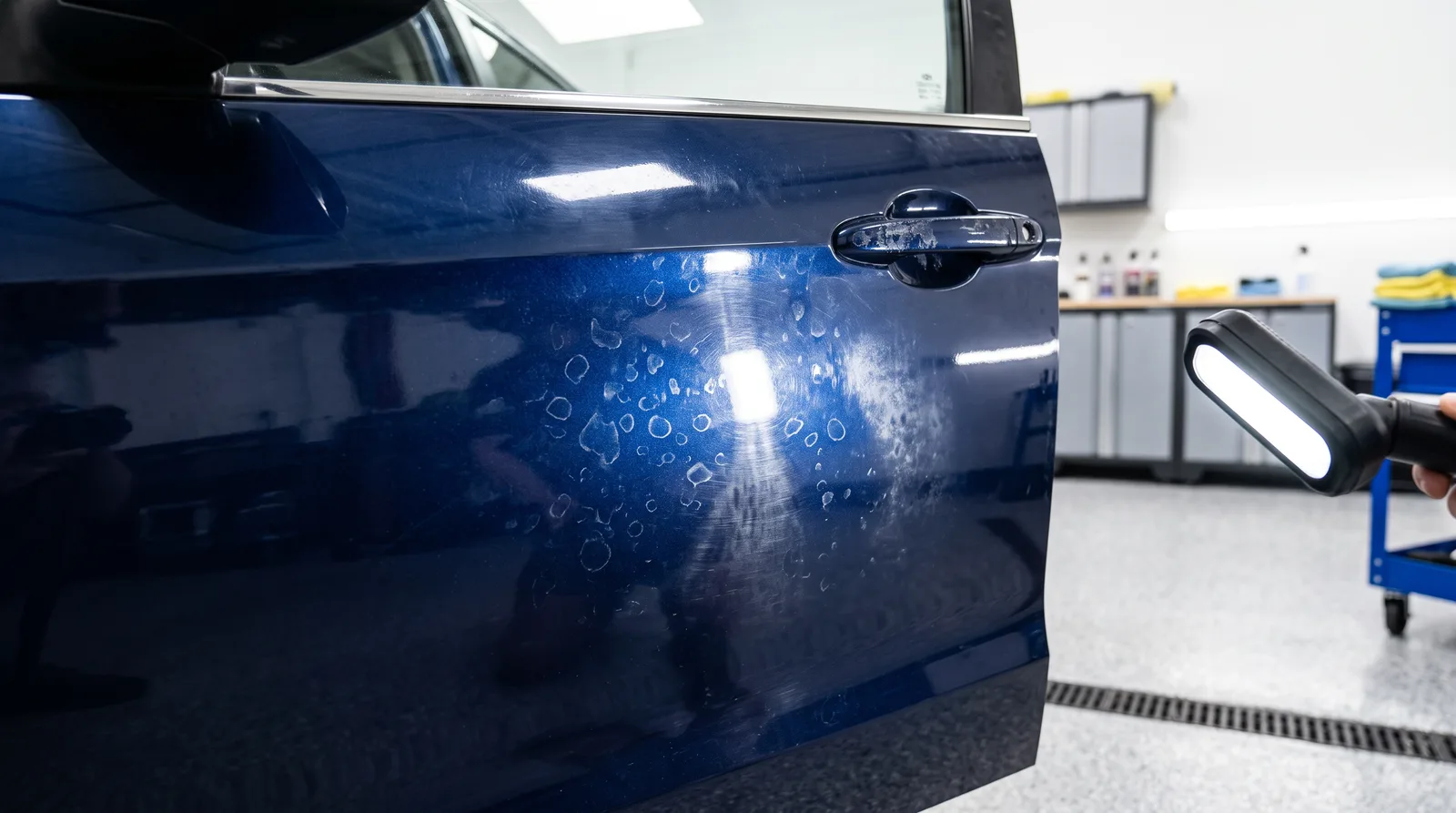
Water spots start as mineral deposits sitting on the paint. Left too long in the sun, they etch into it. Once that happens, no amount of washing will remove them.
When water evaporates, it leaves behind whatever was dissolved in it: calcium, magnesium, and other minerals. Sprinkler overspray, well water, and water left to dry in the sun after a wash are common sources around Auburn and Opelika. On a hot black panel in July, a drop of water can dry in minutes, and the heat bakes those minerals into the clear coat. Acid rain and bird droppings cause similar etching.
The three stages of water spots
| Stage | What it looks like | Does a wash remove it? | Usual fix |
|---|---|---|---|
| Type 1: Surface deposits | White, chalky spots sitting on top of the paint | Often, or a quick detailer does | Proper wash and dry |
| Type 2: Bonded minerals | Spots that feel slightly rough and survive a wash | No | Chemical decontamination (water spot remover) and clay |
| Type 3: Etched spots | Ring-shaped craters visible at an angle, even after decon | No | Paint correction (polishing) |
How to check
Wash the car and dry it completely. If you can still see spots, wipe one with a dedicated water spot remover or a 50/50 mix of distilled water and white vinegar on a microfiber, then rinse. If the spot is gone, it was bonded minerals. If you still see a ring or a faint crater at an angle, the spot has etched into the clear coat and needs correction.
What fixes it
Light etching usually polishes out in a one-step or two-step correction. Deep etching may only partially remove without taking off too much clear coat. A good detailer will tell you where that line is before they start.
Not sure if it's dirt or damage?
Bring the car to our Opelika shop. We'll look at the paint under proper lighting and tell you honestly whether it needs a wash, a decon, or correction.
Sign 4: Holograms and buffer trails from a bad past detail
Holograms are a sign that someone polished the car before, but did it wrong. They look like shimmering, rainbow-colored trails or ghostly swirls that seem to move as you walk around the car. They're most visible on dark paint in direct sun.
Where holograms come from
- A rotary buffer used with the wrong pad, compound, or technique. Rotary polishers are powerful and can leave their own marring pattern if the finishing step is skipped.
- A "cut only" job. Someone used an aggressive compound to remove defects but never refined the surface with a finishing polish.
- Rushed dealership prep. New cars are often buffed quickly before delivery to remove lot scratches, and it isn't always done carefully.
How to check
Look at the hood or roof in direct sun and slowly walk from one side of the car to the other. Regular swirls tend to circle the sun's reflection. Holograms look like tight, wavy, rainbow trails that follow the path a buffer took across the panel.
What fixes it
Holograms are usually shallow, so they generally come out with a careful refining polish using a dual-action polisher and the right pad. The fix is the finishing step the last person skipped. It's also a good reminder to ask any shop how they finish their correction, not just how they cut.
Sign 5: Fine scratches you can see but can't feel
The fingernail test is the fastest way to tell if a scratch can be polished out. Run your fingernail gently across the scratch, not along it. If your nail glides over it without catching, the scratch is very likely inside the clear coat, and paint correction can usually remove it or make it far less visible. If your nail catches, the scratch probably goes deeper than the clear coat, and polishing alone won't remove it.
Common scratches that polish out
- Light wash marring and straight-line scratches from towels
- Fingernail scratches around door handles
- Light scuffs from bags, keys, or a bike leaning on the car
- Faint branch scratches from a narrow drive or a parking spot under shrubs
- Light paint transfer from another car's bumper (often removed with polish alone)
Scratches that need more than polish
- Anything that catches your nail clearly
- Scratches showing white, gray primer, or bare metal
- Rock chips (correction doesn't fill missing paint)
- Key scratches that cut deep into the color coat
Our guide to car scratch repair: paint correction vs. touch-up vs. respray covers exactly where that line falls and what each repair involves.
False alarms: when your car just needs a wash or a decon
Not every rough, dull, or spotty finish needs a machine polisher. A good detailer will rule out the simple stuff first, because correcting paint that only needed a decontamination wash wastes clear coat and money.
| What you notice | Likely cause | Wash fixes it? | Needs correction? |
|---|---|---|---|
| Paint feels rough or gritty after a wash | Bonded contamination (rail dust, overspray, tree sap mist) | No, but a clay bar or iron remover does | Not by itself |
| Tiny orange or rust-colored specks on light paint | Embedded iron particles from brake dust or rail dust | No, but an iron remover does | Not by itself |
| Cloudy, streaky film that smears when wiped | Old wax, sealant, or spray product buildup | A strong wash or panel prep usually does | Usually not |
| Yellow-green dusty coating in spring | Pollen | Yes | No |
| Fresh bug splatter or bird droppings | Contamination sitting on the paint | Yes, if removed quickly | Only if it has etched |
| Circular swirls visible in sun on clean paint | Marring in the clear coat | No | Yes |
| Rings that remain after decon | Etched water spots | No | Yes |
The plastic bag test
Put your hand inside a thin plastic sandwich bag and lightly glide it across a clean, dry panel. The bag amplifies what your fingers feel. If the paint feels like fine sandpaper, it has bonded contamination that a clay bar or clay mitt will remove. That roughness isn't a scratch, and it doesn't need polishing. It does need to come off before any correction, though, because polishing over contamination drags it across the paint.
Why a decon comes first anyway
Every correction we do starts with a thorough wash, an iron decontamination, and a clay treatment. That way we're looking at the actual paint, not a layer of grime, when we decide how much correction the car needs. Sometimes that prep alone transforms the car. When it doesn't, it shows exactly what's left to correct.
One-step, two-step, or multi-stage: how much correction you need
Paint correction isn't one service. It's a range, matched to how deep the damage goes. The goal is always to remove the defects while taking off as little clear coat as possible.
| Correction level | Best for | Typical defect removal | Typical price range (Auburn-Opelika)* |
|---|---|---|---|
| One-step polish (enhancement) | Light swirls, mild haze, a newer car that's lost some gloss | Roughly 50% to 70% of light defects, big gloss boost | About $250 to $450 |
| Two-step correction | Moderate swirls, light scratches, water spot etching, holograms | Roughly 80% to 90% of moderate defects | About $450 to $800 |
| Multi-stage correction | Heavy swirling, neglected or oxidized paint, older dark cars | Roughly 85% to 95%+ of heavy defects | About $800 to $1,500+ |
*Ranges only. Final pricing depends on the vehicle's size, paint hardness, and condition, and is set after an in-person inspection.
How we decide which level
We inspect the paint under bright, color-accurate lighting, then polish a small test spot. The test spot shows how the paint responds: some factory clears are hard and slow to correct, others are soft and mar easily. That test is what turns a guess into a recommendation. It also shows whether the result you want is realistic without removing too much clear coat.
"Perfect" vs. "great"
For most daily drivers, a well-done one-step or two-step correction makes the car look dramatically better, and the remaining defects are hard to spot without an inspection light. Chasing every last mark costs more clear coat and more time. We'll tell you where the point of diminishing returns is for your car.
Why Alabama paint shows these signs faster
Paint in the Auburn-Opelika area works harder than paint in milder climates. A few local factors speed up every sign on this list.
- Long, intense UV season. Strong sun most of the year breaks down unprotected clear coat and speeds up oxidation, especially on horizontal panels like the hood, roof, and trunk.
- Heat that bakes contaminants in. Summer surface temperatures on dark paint can get hot enough to dry water and droppings in minutes. Bird droppings, bug splatter, and tree sap etch much faster in that heat.
- Spring pollen. Lee County's yellow pollen coats cars for weeks. Wiping it off dry is one of the fastest ways to put fine scratches in the paint.
- Sprinklers and summer storms. Water left to dry on hot paint is how etched water spots start.
- Love bug season. Their remains are acidic and can etch paint if they sit. Our post on protecting paint from bird droppings, sap, and love bugs covers that in detail.
- Red clay and gravel roads. Fine grit that gets rubbed in during a wash causes marring.
None of this means your paint is doomed. It means a wash routine that works in a milder climate can wear Alabama paint down quicker, and that protection after correction matters more here.
What paint correction can't fix
Honest expectations matter. Correction is powerful, but it has limits. If any of these describe your car, we'll tell you before we start.
- Scratches through the clear coat. If the scratch shows white, gray, or bare metal, it needs touch-up, a paint-fill repair, or a body shop. Polishing can soften the edges and make it less visible, but it can't add paint back.
- Rock chips. Chips are missing paint. They need touch-up, and preventing new ones is what paint protection film is for.
- Clear coat failure. When the clear coat is peeling, flaking, or turning white and patchy, there's not enough left to polish. That panel needs a respray.
- Dents and dings. These need paintless dent repair or body work, not polishing.
- Very deep etching. Some severe water spot or bird dropping etching can be reduced but not fully removed without taking off too much clear coat.
- Thin, previously over-polished paint. Cars that have been heavily buffed many times may not have much clear coat left to work with. A careful shop checks for this before polishing.
After correction: protect the result
Corrected paint is the best your car will look, and also the most worth protecting. The same washing habits and weather that caused the damage will start it again if nothing changes.
Protection options
| Option | What it does | Typical lifespan | Best for |
|---|---|---|---|
| Wax | Adds gloss and short-term water beading | Weeks to a couple of months | Drivers who enjoy frequent hands-on care |
| Paint sealant | Synthetic protection, longer than wax | A few months | A budget step up from wax |
| Ceramic coating | Hard, slick, chemical-resistant layer bonded to the clear coat; makes washing easier and resists etching | Multiple years, depending on the coating and care | Locking in a fresh correction for the long term |
| Paint protection film (PPF) | Clear urethane film that absorbs rock chips and scratches; many films self-heal light marring | Many years | High-impact areas like the front end, or the whole car |
Ceramic coating and correction go together naturally. A coating needs a clean, corrected surface to bond to, and it locks in the gloss you just paid for. You can see how that fits into the full process in our step-by-step ceramic coating process, and learn more about our ceramic coating service. Correction is part of our auto detailing lineup.
Wash habits that keep swirls from coming back
- Use the two-bucket method (one soapy, one rinse) with a grit guard
- Use a clean microfiber wash mitt, and a separate one for lower panels and wheels
- Pre-rinse thoroughly, or foam first, to lift grit before touching the paint
- Dry with a plush microfiber drying towel or a blower, never a bath towel
- Don't dry-wipe pollen or dust; rinse it off
- Skip brush-style automatic washes
- Wash in the shade, and don't let water dry on hot paint
- Remove bird droppings and bugs as soon as you see them
If your car is already coated, our ceramic coating maintenance guide covers the wash routine that keeps it performing.
What to expect when you bring your car in
Paint correction is done inside our shop, not in a driveway. Polishing needs consistent lighting, a clean, dust-controlled space, and controlled temperatures. Direct sun and wind make paint and products hard to work with, and they hide defects while you're polishing.
- Inspection. We look at the paint with you under proper lighting and point out what's dirt, what's contamination, and what's damage.
- Recommendation. Based on the paint and your goals, we recommend a correction level and protection options, with a price range up front.
- Wash and decon. A full wash, iron removal, and clay treatment so we're working on clean, smooth paint.
- Taping and test spot. Trim, rubber, and sensitive edges are taped. A test spot confirms the pad and polish combination.
- Correction. Panel by panel, one or more polishing steps depending on the level you chose.
- Panel wipe and inspection. Polishing oils are removed so we can see the true result and catch anything that needs another pass.
- Protection. Sealant, ceramic coating, or PPF, based on what you chose.
A one-step polish is often a one-day job. Heavier, multi-stage correction, especially combined with a ceramic coating, can take longer. We'll give you a timeline with your quote, and you'll know exactly when to pick it up from our Opelika shop.
Quick self-check: does your car need paint correction?
Answer these after a proper wash, with the car in direct sun or under a single bright light:
- Do you see circular swirls around the sun's reflection? Likely correction.
- Does the clean paint look flat or blurry compared to the door jambs? Likely correction.
- Do spots remain after a wash and a water spot remover? Likely correction.
- Do you see rainbow trails that move as you walk around the car? Likely correction (holograms).
- Do you see fine scratches that your fingernail doesn't catch? Likely correction.
- Does the paint feel rough in a plastic bag but look fine? Decon and clay first.
- Does your nail catch, or do you see primer or metal? Touch-up or body work, not polish alone.
Two or more "likely correction" answers usually means the whole car would look noticeably better after it. One isolated spot may only need a small spot repair.
Ready to get the gloss back?
Paint correction is done inside our shop at 2709 Frederick Road in Opelika. Tell us about the car and we'll set up an inspection.
Paint that looks dull or swirled is not a lost cause. In most cases the gloss is still there, under a layer of tiny scratches. Washing won't reach it, but careful correction will. Whether you drive a daily commuter on I-85 or a weekend car that sits in Auburn on game days, a professional inspection will tell you which of these five signs you have and what it takes to fix them.