
Quick answer: When you drop off your car for detailing, expect a short walk-around inspection with the detailer, a clear quote and pickup time before any work starts, and then a hands-on process that usually takes about 1 to 6 hours depending on the package and the car's condition. Take your valuables and personal items out beforehand, mention any problem spots, and plan to look the car over with the detailer at pickup. In the Auburn and Opelika area, typical detailing prices run from about $75 to $150 for a maintenance detail up to about $250 to $500+ for a full detail, and the final price depends on your vehicle's size and condition.
If you have never had a car professionally detailed, the first appointment can feel a little uncertain. You're handing over your keys and one of the most expensive things you own. You may wonder how long it will take, whether you should clean it out first, what happens if they find something wrong, and how you'll know the job was done right.
Those are good questions, and a good shop should answer every one of them before you hand over the keys. This guide walks through a first time detailing appointment from start to finish: what to do before you arrive, what happens at drop-off, how long each package takes, how communication works during the job, and what to check when you pick the car up.
It is written from the perspective of My Awesome Detailer LLC, a detailing shop at 2709 Frederick Road in Opelika, serving Auburn, Opelika, and the rest of Lee County. We are rated 4.9 stars from more than 200 reviews, and we are an Owner's Pride Select installer, one of roughly the top 40 shops in the U.S. for that program. We're a shop-based detailer: every car is brought to our studio and worked on indoors. Most of what follows applies to any reputable shop, though, so you'll know what to expect wherever you book.
Before your appointment: how to prepare your car
You don't need to clean your car before a detail. That's the whole point. But a few minutes of preparation makes the appointment smoother, protects your belongings, and helps the detailer spend time where it matters.
Take out personal items and valuables
This is the single most useful thing you can do. Before dropping your car off for a detail, remove:
- Valuables: cash, jewelry, sunglasses, garage door openers you care about, and anything you'd hate to misplace.
- Electronics: laptops, tablets, chargers, dash cams you plan to take with you, and loose cables.
- Paperwork: mail, receipts, and documents you don't want handled. Your registration and insurance card can stay in the glovebox if that's where you keep them.
- Child seats if you're comfortable removing and reinstalling them. If not, tell the detailer. Car seats are often left in place unless you ask for the seat and the area under it to be cleaned.
- Trunk and cargo items: sports gear, tools, strollers, grocery bags, and anything stored under the cargo floor.
Why it matters: a detailer needs to reach every pocket, cupholder, seat track, and storage bin. When those are full, either the detailer has to move your things around (which most people would rather avoid) or those areas can't be cleaned well. Clearing the car out means more time cleaning and less time sorting.
Note the problem spots you care about
Think about what bothers you most about the car right now. A coffee stain on the passenger seat. A smell you can't track down. Dog hair worked into the cargo carpet. Hazy headlights. Water spots on the glass. Tree sap on the hood. Make a short list, even just in your head, so you can point to each one at drop-off.
Detailers can see dirt, but they can't always tell which issue matters most to you. A stain that has been there for three years might be a top priority for you and an afterthought on a generic checklist. Saying it out loud at the walk-around gets it on the plan.
Tell the shop about anything unusual
Let the shop know ahead of time if any of these apply:
- The car has an existing ceramic coating, paint protection film, or a vinyl wrap. Each of those changes which products and methods should be used on the paint.
- There is aftermarket window tint, especially if it's new, since fresh film needs time to cure.
- There's a known mechanical or electrical quirk: a sticky door handle, a window that doesn't roll back up, a warning light, a battery that's been weak.
- There are pet, smoke, or mildew odors you want treated. Odor work takes extra time and can change the price.
- Something on the car is fragile or recently repaired, like fresh paint from a body shop.
Check the gas and the keys
Arrive with a reasonable amount of fuel or charge, since the car may be moved in and out of a bay a couple of times. Bring the key you'll leave with the shop, and keep your house key and any other keys on a separate ring if you can. If you have a valet key or a key card, that works too, as long as it unlocks every door, the trunk, and the glovebox.
Don't wash it right before
Some first-timers run the car through a car wash before a detailing appointment because they're embarrassed by the dirt. You don't need to. An automatic wash won't remove what a detailer removes, and brushes can add the very scratches you'd later pay to have corrected. If you want to understand why the two are so different, our guide to car wash vs. detailing breaks it down.
At drop-off: the walk-around inspection
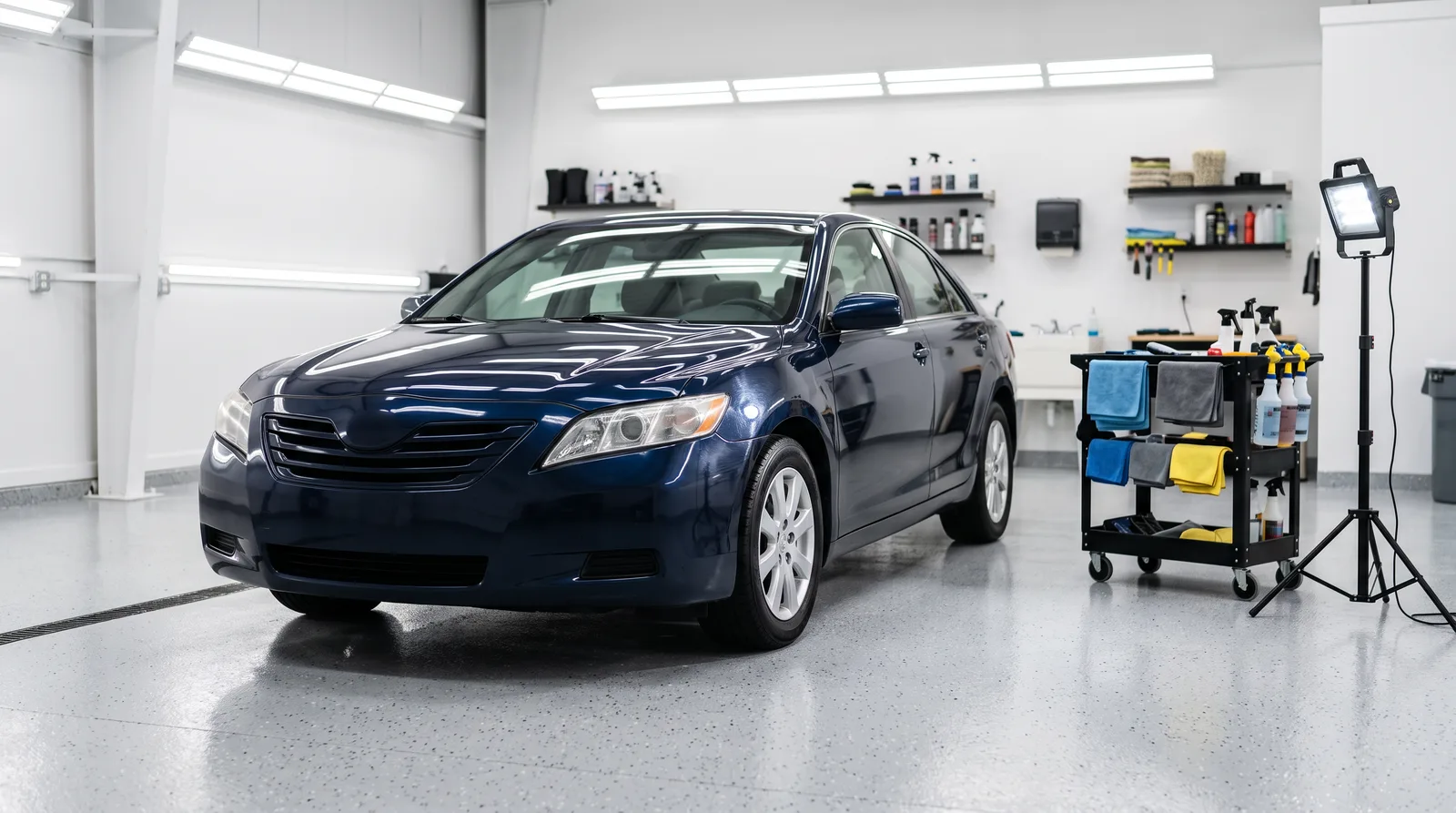
The appointment really starts with the walk-around. This is the part first-time customers tend not to expect, and it's one of the best signs of a professional shop.
What the detailer looks at
With you there, the detailer walks around the car and through the interior. A careful intake usually covers:
- Existing paint damage: chips, deep scratches, door dings, scuffed bumpers, clear coat failure, and areas that have been repainted.
- Swirl marks and haze: often easier to see under a bright inspection light than in daylight. These are fine scratches in the clear coat, usually from washing.
- Wheels and tires: curb rash on rims, brake dust buildup, and tire condition.
- Glass: rock chips, cracks, and water spotting.
- Interior condition: stains, tears, cracked leather, worn bolsters, burns, sticky residue, and odors.
- Anything loose or broken: trim pieces, clips, mirror caps, or panels that are already loose.
Many shops photograph existing damage at intake. That isn't about distrust. It protects both sides: you know the shop saw the chip on the hood before work started, and the shop has a record of the car's condition when it arrived.
Setting expectations honestly
The walk-around is also where a good detailer tells you what a detail can and can't do. This part matters, because it's where most disappointment comes from when it's skipped.
- Stains: most come out, but some, like old ink, dye transfer from jeans, bleach marks, or stains that have set for years, may only lighten.
- Scratches: a wash and wax won't remove scratches. Light swirls can be reduced by polishing, which is paint correction, a separate service. A scratch you can catch with a fingernail is usually too deep to polish out completely.
- Odors: many can be eliminated, but heavy smoke or mildew sometimes needs more than one treatment.
- Worn materials: cleaning can't repair cracked leather or faded plastic. It can make them look much better and slow further wear.
Hearing this up front is a good thing. A shop that promises everything will come out perfectly before it has even looked closely is setting you up to be let down.
Choosing a package and getting a quote
Once the detailer has seen the car, you'll settle on a package and any add-ons. You should leave the counter knowing three things: what work will be done, what it will cost (or the range it will fall in), and when the car will be ready. If something might change the price, like heavy pet hair or a stain that needs extra treatment, a good shop tells you that before starting, not on the invoice.
Prices vary by vehicle size, condition, and package. As a general guide for the Auburn-Opelika area, based on typical local ranges and not a quote:
| Package | What it typically covers | Typical time at the shop | Typical local price range |
|---|---|---|---|
| Maintenance / express detail | Hand wash, wheels and tires, light interior vacuum and wipe-down, glass | About 1 to 2 hours | About $75 to $150 |
| Interior detail | Full vacuum, carpet and seat shampoo or extraction, steam cleaning, leather care, vents, interior glass | About 2 to 4 hours | About $150 to $300 |
| Exterior detail | Foam and hand wash, wheels and wells, decontamination, clay bar, sealant, tire dressing | About 2 to 3 hours | About $150 to $300 |
| Full detail | Complete interior and exterior, decontamination, gloss enhancement, protection | About 4 to 6 hours | About $250 to $500+ |
| Large SUV, truck, or 3-row | Any package, with more surface area and seating | Add about 1 to 2 hours | Add about $50 to $150+ |
For a deeper look at what each tier includes, see our guide to auto detailing packages and costs, or go straight to our auto detailing page.
First detail? We'll walk you through it.
Tell us about your car and what bothers you most about it, and we'll recommend the right package before you bring it to the shop.
How long does a car detailing appointment take?
This is the question almost every first-time customer asks, and the honest answer is: it depends on the package and how much the car needs. A professional detail is hands-on work, so time scales with surface area and condition.
Typical time by package
- Maintenance detail: roughly 1 to 2 hours. Some people wait for this one; most still drop off.
- Interior or exterior only: roughly 2 to 4 hours. Plan on being without the car for a good part of the morning or afternoon.
- Full detail: roughly 4 to 6 hours of hands-on work. Plan to drop the car off in the morning and pick it up later the same day.
- Full detail plus extras: heavy pet hair, odor treatment, or engine bay cleaning can push past that. Ask at drop-off.
- Paint correction or ceramic coating: these are bigger services that often take one to several days, partly because coatings need cure time. They're usually booked separately from a standard detail.
What makes a detail take longer
Two cars of the same size can take very different amounts of time. The biggest factors are:
- Pet hair. Dog hair weaves itself into carpet and cloth and has to be pulled out, not just vacuumed.
- Sand and red clay. Lee County's red clay stains carpet and packs into wheel wells and door jambs. Beach sand from a Gulf Shores trip ends up in every seam. Our post on red clay and your car covers why it's so stubborn.
- Kids' car messes. Crushed snacks in seat tracks, juice in cupholders, and sticky residue on every surface a small hand can reach.
- Time since the last detail. A car detailed every few months cleans up faster than one that hasn't been touched in years.
- Exterior contamination. Tree sap, love bugs, tar, and hard water spots each need their own treatment.
Should you wait at the shop or drop it off?
For anything beyond a quick maintenance detail, dropping off is usually the better choice. A full detail is most of a working day, and the detailer can focus on the car without working around a waiting customer. Many people in Auburn and Opelika arrange a ride to work or to campus, or have a family member follow them to the shop. Ask when you book what time to drop off and when to expect a call that it's ready.
What happens while your car is being detailed
Once the paperwork is done and you've left, the car goes into the bay. Here's what a full detail typically looks like from the inside, so you know where those hours go.
The usual order of work
Most professional detailers work top to bottom and dirtiest to cleanest, so clean areas don't get re-contaminated:
- Interior strip-out. Floor mats come out, trash is removed, and the cabin is dry-vacuumed and air-blown to push dust out of vents, seams, and crevices.
- Interior deep cleaning. Carpets and cloth seats are shampooed or hot-water extracted, leather is cleaned and conditioned, hard plastics and door panels are cleaned, and steam is used on vents, cupholders, and stubborn grime. Our interior car detailing guide goes deeper on this part.
- Wheels, tires, and wheel wells. These are the dirtiest parts of the exterior, so they're cleaned before the paint to avoid spraying grime onto clean panels.
- Exterior wash. Pre-rinse, foam pre-soak, and a careful hand wash using techniques designed to keep new scratches off the paint.
- Decontamination. Iron remover and a clay bar or clay mitt pull bonded contamination out of the clear coat so the paint feels smooth.
- Protection. A sealant or similar protection is applied, depending on the package, and tires and trim are dressed.
- Glass and final details. Interior and exterior glass, door jambs, and a final inspection under good lighting.
Why the shop environment matters
Working indoors under controlled lighting is one of the biggest advantages of bringing a car to a shop. Good lighting shows the detailer what's really on the paint. Shade keeps Alabama sun from drying soap and cleaners on the panels before they can be rinsed, which causes spotting. And the car isn't sitting in the open where pollen, dust, or a sudden summer storm can land on it halfway through. If you're weighing your options, our post on shop detailing vs. mobile detailing explains the trade-offs. My Awesome Detailer works only in the shop, which is why everything in this guide assumes a drop-off.
Communication during the job
Most details go exactly as planned, and you'll simply get a call or text when the car is ready. But sometimes a detailer finds something mid-job worth telling you about:
- A stain is fighting back and would need extra time or a different treatment.
- Pet hair or sand is much heavier than it looked at intake.
- Something new turns up under the dirt, like a scratch hidden by a layer of grime or a tear in the seat under a seat cover.
A professional shop reaches out before doing extra work that would change the price. You should never be surprised by an add-on you didn't approve. If you're hard to reach during the day, tell the shop the best way to contact you and whether there's a limit you're comfortable approving without a call.
Pickup: the final walk-through and quality check
When the car is done, you'll be told it's ready. Don't just grab the keys and go. The pickup walk-through is your chance to see the work, ask questions, and catch anything that was missed while you're still at the shop.
What to check before you drive away
Look at the car in good light, ideally with the detailer next to you. Check:
- The spots you pointed out at drop-off. These matter most. Were they handled, or improved as much as was realistic?
- Glass from inside and out. Look for streaks, especially on the inside of the windshield, which is the hardest piece of glass in any car to clean.
- Door jambs and the trunk opening. These are easy to rush and easy to check.
- Seat tracks, cupholders, and console bins. Signs of a careful interior detail.
- Wheels and tire dressing. Clean barrels and faces, with dressing that isn't slung onto the paint.
- Paint feel and gloss. After decontamination the paint should feel smooth and look clear, not hazy.
If something isn't right, say so then. Any reputable shop would rather fix a missed spot while you're standing there than hear about it in a review later.
Things that are normal after a detail
A few things surprise first-time customers but are completely normal:
- Carpets and cloth seats may feel slightly damp after extraction. Leave the windows cracked in a shaded spot or run the A/C for the first drive, and they'll dry.
- A clean, neutral smell from the cleaners used. It should fade within a day or two.
- Seats and mirrors may be adjusted. The detailer has to move seats to reach underneath. Check your seat, mirrors, and steering wheel before you pull out.
- Some water may drip from mirrors and trim for the first few minutes of driving, since water hides in mirror housings and panel gaps.
- Old damage looks more noticeable. Once the dirt is gone, chips and scratches that were hidden can stand out more. That's not new damage, and it's one reason the intake inspection and photos matter.
Ask about next steps
The pickup walk-through is also a good time to ask the detailer two questions: how often your car should be detailed given how you use it, and whether any protection makes sense. If the detailer noticed swirl marks, faded headlights, or paint that is starting to dull, they can explain options like paint correction, ceramic coating, or paint protection film. There's no pressure to decide that day. It's simply useful information for planning.
First time detailing appointment timeline
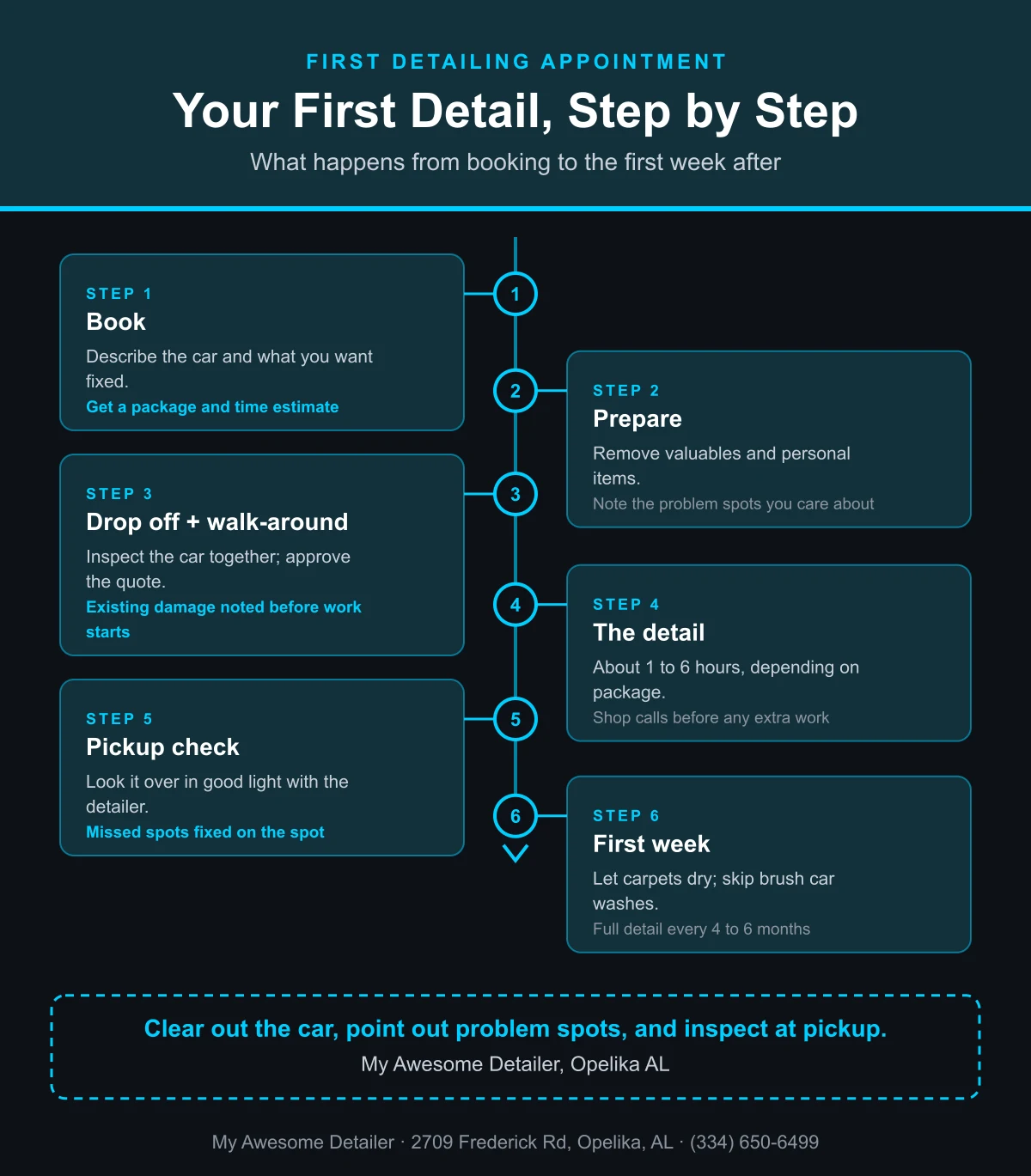
Here's the whole first visit at a glance, from booking to the first week afterward.
| Stage | When | What you do | What the shop does |
|---|---|---|---|
| Book | A few days to a week ahead | Describe the car, its condition, and what you want fixed | Recommends a package and gives a time estimate |
| Prepare | The night before | Remove valuables and personal items; note problem spots | Schedules the bay and time for your car |
| Drop off | Usually morning | Walk around the car with the detailer; approve the quote | Inspects, notes existing damage, confirms pickup time |
| Detail | About 1 to 6 hours, by package | Stay reachable by phone or text | Cleans interior and exterior; calls before any extra work |
| Pick up | Same day for most packages | Do a walk-through in good light; ask questions | Shows the work; fixes anything missed on the spot |
| Aftercare | The first week | Let carpets dry; avoid automatic brush washes | Answers follow-up questions; suggests a maintenance schedule |
Common first-timer questions (and honest answers)
Do I need to clean my car before a detail?
No. Remove personal items and valuables so every area can be reached, and throw out obvious trash if you like, but don't vacuum or wash it first. That's the detailer's job, and it's what you're paying for.
Will the detailer go through my things?
A professional detailer cleans storage areas, not the contents of your bags or papers. That's exactly why it's best to take personal items out ahead of time. Anything left in the car, like registration papers in the glovebox, is typically moved only as far as needed to clean and then put back.
Is it okay to leave my car seat installed?
Yes, but tell the detailer at drop-off. Some parents prefer to remove the seat so the vehicle seat underneath can be cleaned, then reinstall it themselves. Others leave it in place. Either is fine, as long as everyone knows the plan.
What if my car is really bad?
Detailers see heavily soiled cars every week: work trucks, family SUVs after a long road trip, cars with years of dog hair, and cars that have been sitting. There's nothing to be embarrassed about. The only thing that changes is time and possibly price, which is why the condition is assessed at the walk-around and discussed before work starts.
Is it rude to inspect the car at pickup?
Not at all. A good detailer expects it and usually invites it. Looking the car over together is part of a professional handoff.
Should I tip?
Tipping is up to you and is never required. Many customers tip when the work exceeds their expectations, especially on a heavily soiled car. A detailed online review is also very much appreciated by any local shop.
After the detail: keeping your car clean longer
The first week after a detail is when you can keep that just-detailed feeling going the longest. A few habits help, especially with Alabama heat, pollen, and red clay working against you.
The first few days
- Let carpets and seats dry fully. Crack the windows in a garage or shaded spot.
- Avoid automatic car washes with brushes, which can put fine scratches back into freshly cleaned paint.
- Remove bird droppings, tree sap, and love bugs promptly. In Alabama summer heat, these can etch the clear coat surprisingly fast.
Ongoing habits
- Use floor mats, especially all-weather mats during the rainy season and pollen season.
- Keep a small trash bag in the car so wrappers and receipts don't pile up.
- Wash the car by hand, or with a touchless wash between details, every couple of weeks.
- Park in shade or a garage when you can to slow sun damage to the paint, dashboard, and leather.
How often to book a detail
For most daily drivers in Auburn and Opelika, a full detail every 4 to 6 months with lighter maintenance in between keeps a car in good shape. Cars that carry pets, kids, or job-site dirt may need it more often. If you want the exterior to stay cleaner between visits, protection such as ceramic coating makes washing easier and helps the paint shed dirt and water. Our post on ceramic coating maintenance explains how that works over time.
What makes a good detailing shop: red flags and green flags
Knowing what to expect also helps you tell a professional shop from one that's cutting corners. Here's what to look for during your first visit.
| Green flags | Red flags |
|---|---|
| Walks around the car with you at drop-off | Takes the keys without looking at the car |
| Notes and photographs existing damage | Doesn't mention existing chips, scratches, or stains |
| Gives a clear quote or price range before starting | Price is vague until the invoice |
| Explains what can and can't be fixed | Promises every stain and scratch will disappear |
| Calls before adding work that changes the price | Adds charges without asking |
| Works indoors in a clean, well-lit shop | Works in direct sun with no controlled lighting |
| Invites you to inspect at pickup | Rushes you out the door |
| Strong, recent reviews that mention specific details | Few reviews, or only vague ones |
At My Awesome Detailer, the walk-around, the clear quote, the call before any extra work, and the pickup walk-through are standard on every car. You can read more about our shop or see the full list of services we offer.
What to expect when you drop off your car for detailing: the bottom line
A first detailing appointment is simpler than it seems. Clear out your personal items, think about the spots that bother you most, and show up ready for a short walk-around. You'll leave knowing what will be done, what it will cost, and when it'll be ready. Expect a full detail to take most of a day, expect a call if anything changes, and plan to look the car over with the detailer at pickup.
Once you've been through it once, every visit after that is easy. And if you have questions before you book, ask. A good shop is happy to explain its process before you ever hand over the keys.
Book your first detail in Opelika
Bring your car to our shop at 2709 Frederick Road. We'll walk around it with you, give you a clear quote, and call you when it's ready.