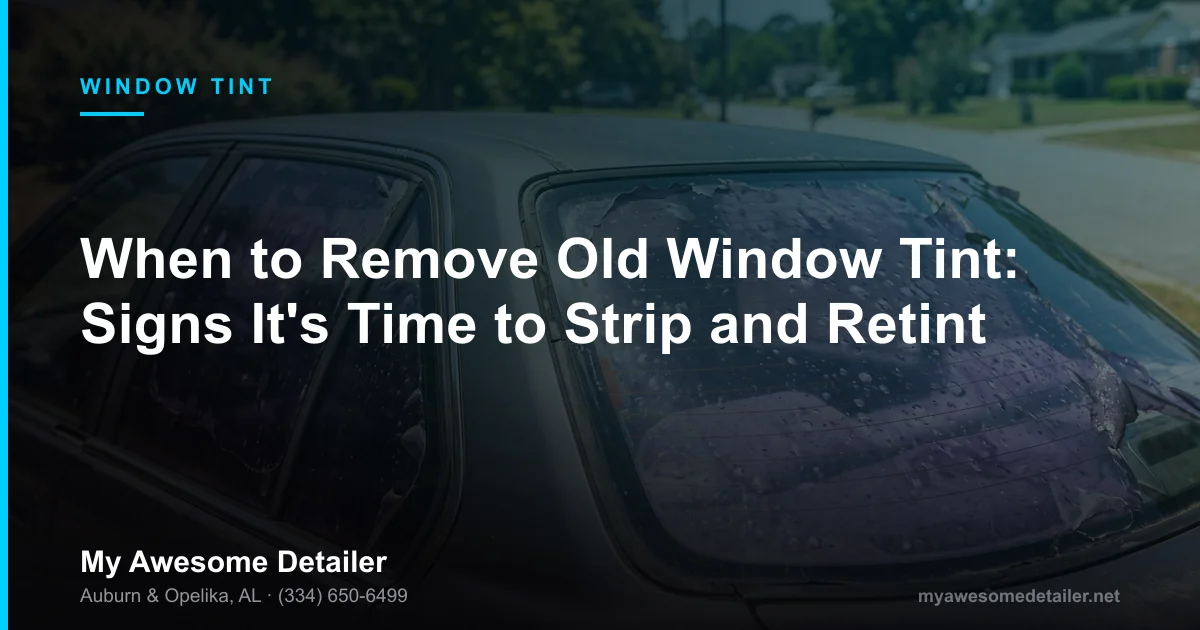
Quick answer: Remove and replace old window tint when it turns purple, bubbles or peels after the first few weeks of curing, looks hazy or distorted (especially at night), is scratched or creased, or no longer keeps your car cool. None of those problems can be repaired; the film has to be stripped and the glass retinted. In Auburn and Opelika, professional window tint removal typically runs about $25–$50 per window, quoted together with new film, and a full strip-and-retint is usually finished the same day.
Old tint rarely fails overnight. It fades a shade at a time, a bubble shows up in one corner, an edge lifts a little more every summer, and one evening you notice you're squinting through the rear glass to find the car behind you. Because the decline is slow, most drivers wait far longer than they should. The question we hear most at our Opelika shop isn't "how do I remove my tint?" It's "is it bad enough yet?"
At My Awesome Detailer LLC, 2709 Frederick Road in Opelika, we strip failing film and install new nano-ceramic tint for drivers from Auburn, Opelika, and the rest of Lee County, plus Phenix City and Columbus, GA. This guide is the diagnostic side of the job: the six signs that old window tint has reached the end, how to tell which ones are urgent, why DIY window tint removal so often damages rear defroster lines, and what a professional strip-and-retint actually involves. If your film is bubbling and you want to know why it happened, our guide to why window tint bubbles or peels covers the causes in depth.
When should you remove old window tint?
You should remove old window tint as soon as it shows a failure that affects how you see out of the car, or a failure that will only get worse. Tint is a thin polyester film held to the glass by an adhesive layer. Once the dye, the adhesive, or the film itself starts breaking down, there is no product or trick that reverses it. The only fix is to take the film off and start over.
That makes the decision simpler than it looks. You aren't choosing between "repair" and "replace." You're choosing between "replace now" and "replace later," and the cost of later goes up in two ways. First, older and more sun-baked film bonds harder to the glass and tends to come off in small brittle pieces, which takes more labor to strip. Second, the longer degraded film stays on, the longer you're driving with reduced visibility and reduced heat and UV protection.
Here's the short version of what to look for. Each sign gets its own section below.
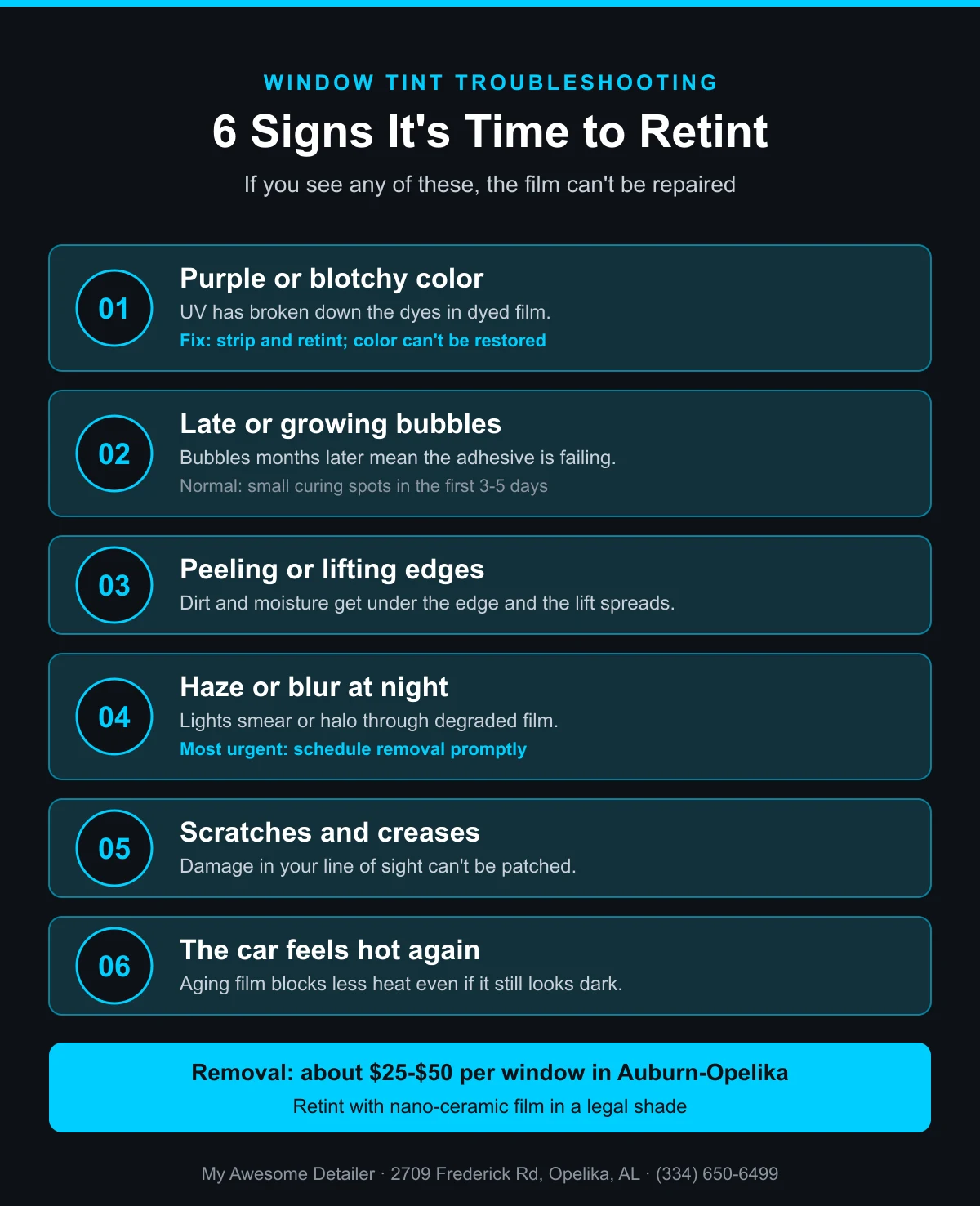
6 signs it's time to strip and retint
Walk around your car in daylight, then sit in it at night with the dome light off. Most of these signs are obvious once you know what you're looking for.
1. The tint has turned purple or blotchy
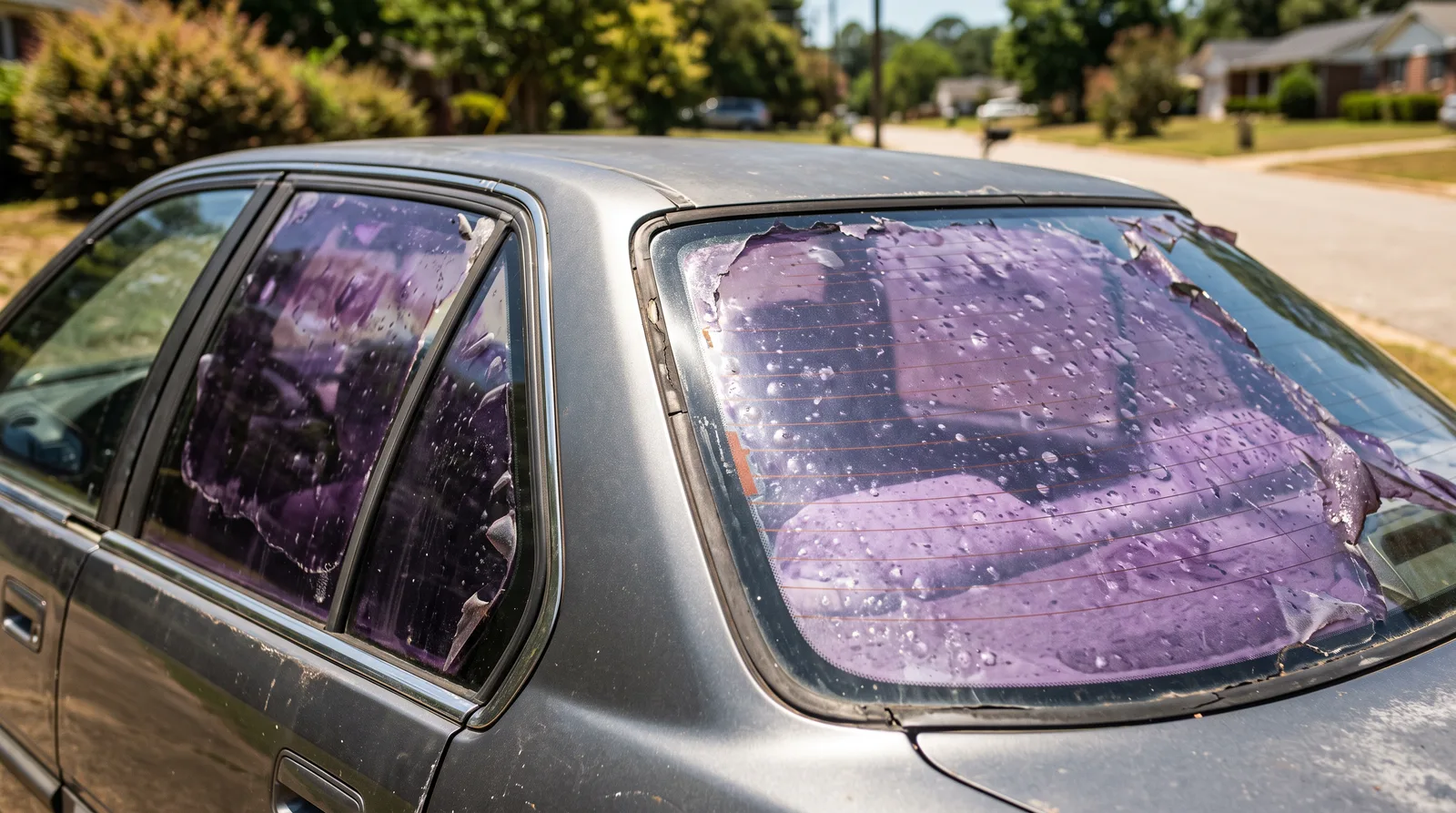
Purple tint is the most recognizable sign of failure, and it almost always means the car has dyed film. Dyed tint gets its color from layers of dye. Ultraviolet light breaks those dyes down over time, and they don't break down evenly. The colors that fade first leave the remaining color shifted toward purple, and the change is often patchy, darker in some areas and lighter in others.
Purple is more than a cosmetic problem. Once the dye has broken down, the film is also doing much less of the job you paid for. It's blocking less heat and less glare than it did when it was new. Alabama's long, strong-sun summers speed this up; our guide to how long window tint lasts in Alabama puts typical dyed film at roughly 2–5 years before it fades, bubbles, or turns purple.
Can purple tint be fixed? No. There's no way to restore the dye. Purple tint has to be removed and replaced.
2. Bubbles that appear late or keep spreading
Not every bubble is a failure. New tint is installed with a slip solution, and small hazy spots or water pockets are normal for the first several days while the film cures. Our tint aftercare guide explains the timeline: most film cures in 3–5 days, and it can stretch toward two weeks in cooler or more humid weather.
The bubbles that matter are the ones that show up months or years later, or the ones that grow. Late bubbles mean the adhesive is letting go. Heat makes the trapped air or gas expand, which pushes the film further from the glass, which lets more heat in behind it. On a car that sits in an Opelika parking lot every afternoon, that cycle repeats daily through the summer. Small late bubbles rarely stay small.
Pressing or pinning bubbles flat doesn't fix the cause. The adhesive under them has failed, and the film will lift again, often taking a creased or cloudy patch with it.
3. Peeling or lifting edges
Failing tint usually lets go at the edges first. The top edge of a roll-down window takes the most abuse because it slides past the rubber seal every time the window moves. Rear glass edges take heat from the sun and the defroster. Once an edge starts lifting, dirt and moisture get under it, the adhesive can't re-bond, and the lift creeps inward.
A lifted edge also catches. A seatbelt buckle, a bag strap, or a window seal can grab it and tear a bigger section loose. If you see an edge peeling on one window, check the others; film of the same age on the same car usually fails on the same schedule.
4. Haze, distortion, or poor visibility at night
This is the sign people notice last and the one that matters most. Degraded film can develop a milky haze, a fine crackle pattern, or a wavy distortion that bends straight lines. During the day you may barely notice it. At night, it's a different story: headlights behind you scatter into a glow, the edges of other cars blur, and backing out of a dark driveway gets harder.
Try this simple check. After dark, sit in the driver's seat with the interior lights off and look through each window at a lit sign or a streetlight. On healthy film, the light source should look crisp. If it smears, halos, or looks like you're seeing it through wax paper, the film is compromising your visibility, and it's time to schedule removal no matter how it looks in daylight.
Very dark film that has also degraded is the worst combination. A shade that was manageable at night when it was new can become genuinely unsafe once haze and scratches are added on top. Our article on window tint, driving safety, and glare goes deeper on night driving and shade choice.
5. Scratches, creases, nicks, or tears
Window film has a hard-coat on the inside surface, but it's still softer than glass. Years of rolling windows up and down over a gritty seal, kids' car seats, pet claws, ice scrapers, and the wrong cleaning towels all leave marks. A few light scratches you can only see at certain angles aren't urgent. Scratches across your line of sight, creases, and nicks that are starting to lift are.
Damaged film can't be patched invisibly. A single window can be stripped and redone on its own, but on older film the new piece may not match the shade or color of the faded windows around it, which is one reason many owners choose to redo the whole car at once.
6. The car feels hot again
Sometimes the film looks acceptable but the cabin doesn't feel the way it used to. The steering wheel and seats get hot faster, the AC takes longer to catch up, and your forearm burns on the drive home down US-280. Dyed and lower-grade films lose performance as they age. Even when the color still looks dark, the dye that was absorbing heat may be largely gone.
This sign is easier to judge if you know what the film was supposed to do. Darkness and heat rejection are separate measurements, and our guide to window tint heat rejection and IR% explains why a dark film can still let a lot of heat through.
How urgent is it? A quick diagnostic table
Not every sign means "book this week." Use this table to sort what you're seeing into what can wait and what can't.
| What you see | What it usually means | Urgency | What to do |
|---|---|---|---|
| Small hazy spots or water pockets in the first 1–2 weeks | Normal curing of new film | None | Leave windows up 3–5 days and wait it out |
| Slight even fading, no bubbles | Film aging; still bonded | Low | Monitor; plan replacement before it worsens |
| Purple or blotchy color | Dyed film breaking down; heat and glare control reduced | Medium | Strip and retint; cannot be restored |
| Bubbles that appear late or keep growing | Adhesive failure | Medium to high | Strip and retint; pressing bubbles flat won't last |
| Peeling or lifting edges | Adhesive failure spreading from the edge | Medium to high | Strip and retint before larger sections tear |
| Scratches or creases in your line of sight | Physical damage to the film | Medium to high | Redo the affected window or the full car |
| Haze, halos, or distortion at night | Film degradation affecting visibility | High | Schedule removal promptly |
| Front side windows darker than 32% VLT | Film is too dark for Alabama law | High | Replace with a legal shade |
If you're unsure which row you're in, a quick look in person settles it. We can tell curing from failing, check whether the adhesive is letting go, and meter the shade with a VLT meter in a few minutes.
Not sure if your tint is done?
Bring it by our Opelika shop. We'll look at the film, meter the shade, and quote removal and a clean ceramic retint together so you see the full picture.
Why old tint turns purple and bubbles first in Alabama
The phrase people type into search bars, "old tint purple bubbling," describes one specific kind of film more than any other: inexpensive dyed tint. Different film constructions age very differently, and Alabama's heat and UV are a hard test for all of them.
| Film type | How it works | Typical lifespan in Alabama | How it usually fails |
|---|---|---|---|
| Dyed | Dye layer absorbs light | ~2–5 years | Fades, turns purple, bubbles |
| Metalized | Metal particles reflect heat | ~5–10 years | Edge wear; can interfere with signals |
| Carbon | Carbon particles absorb infrared | ~7–10 years | Slow edge wear; holds color well |
| Nano-ceramic | Ceramic nanoparticles reject infrared and UV | ~10–15+ years (life of the vehicle) | Rare; usually physical damage |
Three local conditions push dyed film to fail faster here than in milder climates:
- Long UV seasons. Lee County gets strong sun for most of the year, not just in July. UV is what breaks down dyes, so more sun-hours means faster fading.
- Heat cycling. A car parked in the sun at Tiger Town or a campus lot can get extremely hot inside, then cool down overnight. That daily expansion and contraction stresses the adhesive layer, which is why late bubbles and lifting edges show up.
- Humidity. Moisture finds its way under any edge that has started to lift, which keeps the adhesive from re-bonding and helps the lift spread.
The practical lesson is that the film you choose for the retint matters as much as the removal itself. Putting the same dyed film back on just restarts the same clock.
Other good reasons to replace tint that hasn't failed yet
Plenty of people strip and retint perfectly intact film. These are the most common reasons we see in Auburn and Opelika.
Your tint is darker than Alabama law allows
Alabama requires front side windows to let in at least 32% of visible light on every passenger vehicle. Sedans are held to that same 32% on the back side windows and rear glass; SUVs, trucks, and vans can go darker behind the driver. Many used cars come with tint that was never legal, and some owners only find out at a traffic stop. Removing illegal film and installing a legal shade is the clean fix. Our 2026 Alabama window tint law guide has the full window-by-window breakdown.
You bought a used car with unknown tint
When a car comes with tint already on it, you usually don't know the film type, the shade, the installer, or whether any warranty transfers to you. If the film is aging, uneven, or too dark, it's often easier to strip it and start with a known film, a metered legal shade, and a warranty in your own name.
You want real heat rejection, not just a darker look
A lot of older tint was chosen for appearance. If your car still feels like an oven in August, upgrading from dyed film to a nano-ceramic film can make a noticeable difference in cabin comfort without going darker. Our ceramic tint vs. regular tint comparison lays out the differences.
You're getting ready to sell or trade in
Purple, bubbled tint makes an otherwise clean car look neglected, and buyers notice it immediately. Fresh film on a car that's otherwise in good shape helps it present well. If you're selling soon, the cheapest option may simply be removal with no new film; ask for both quotes.
Why DIY window tint removal is riskier than it looks
Online, window tint removal looks easy: a hair dryer, a razor blade, maybe a trash bag and some ammonia, and an afternoon. In practice, old Alabama-baked film is one of the more frustrating jobs a car owner can take on, and the mistakes are expensive.
The rear defroster is the big one
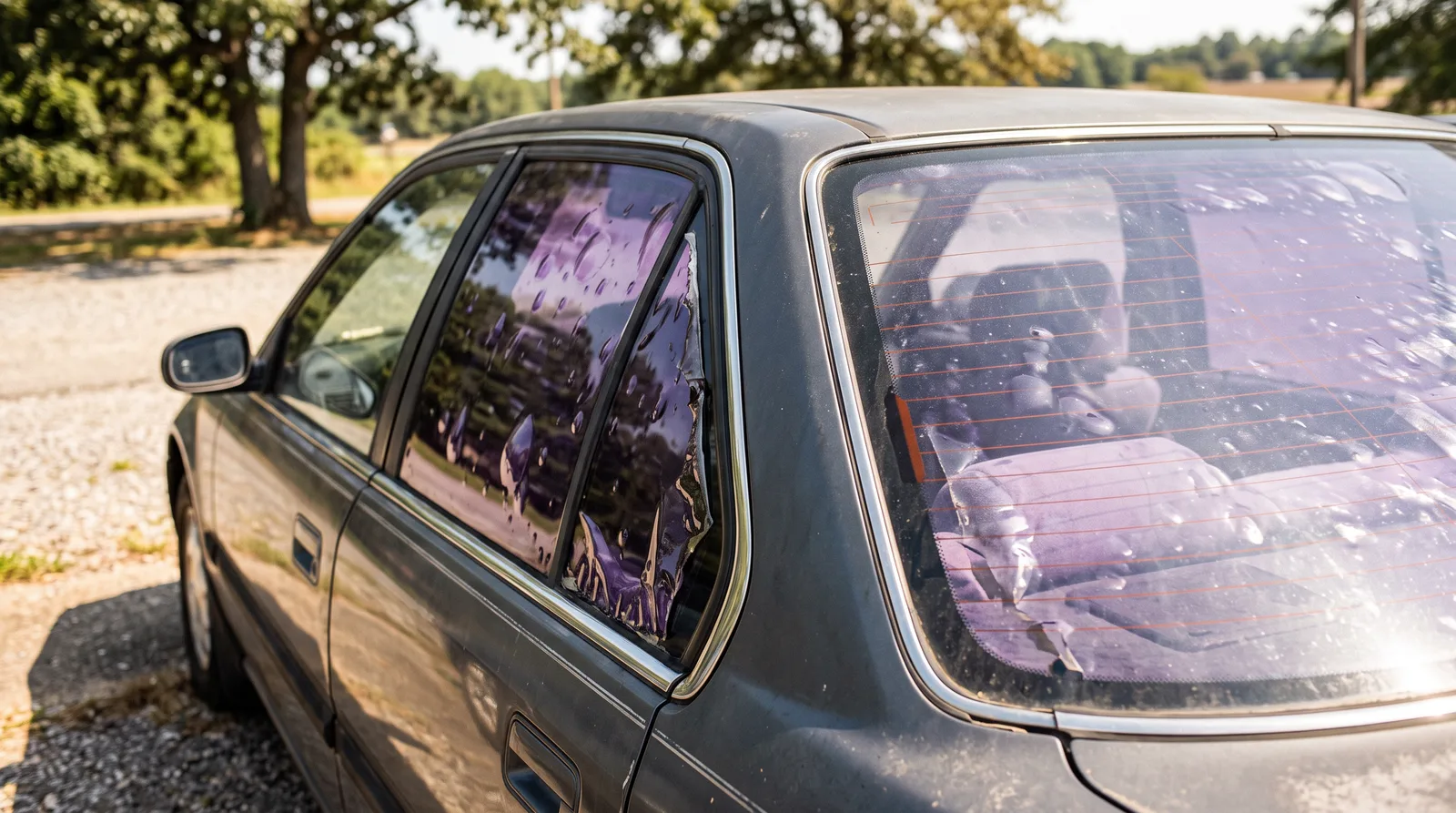
The thin horizontal lines on your rear windshield are the defroster grid. They're conductive lines bonded to the inside of the glass, and the tint sits directly on top of them. Scrape them with a razor and you can cut a line. Peel aggressively and old adhesive can pull a line up with the film. Either way, that section of the grid stops heating, and the glass won't clear fog or frost there. Repairing defroster lines is a separate job, and replacing the rear glass is far more expensive than a professional removal would have been.
One honest note: on very old film, the defroster lines themselves may already be weak. A careful removal minimizes the risk, but it can't restore a line that was already damaged. That's why we check the defroster's function before we start, so you know where things stand.
The film comes off in pieces, and the glue stays behind
New film usually peels in a sheet. Old film often doesn't. Once the polyester has broken down, it tears into small flakes, and each flake leaves its adhesive behind on the glass. Getting the film off is only half the job; the other half is removing every bit of that adhesive so the new tint has a clean surface to bond to. Any residue left behind will show through new film as haze or specks.
Other common DIY damage
- Scratched glass from a razor held at the wrong angle or dragged over grit.
- Heat damage to rubber seals, trim, or the third brake light from a heat gun held too close or too long.
- Interior mess from chemicals and adhesive dripping onto door panels, speakers, and the rear deck, where the electronics live.
- Torn or stained headliners on rear glass jobs where the work is done overhead.
- Hours lost. A single rear windshield with brittle film can take a first-timer most of a day.
If you're weighing the DIY route for a new install rather than removal, our DIY vs. professional window tint breakdown covers that side of the decision.
How professional window tint removal and retint works
A professional strip-and-retint is slow, careful work. The goal is bare, clean, undamaged glass, followed by new film that's installed and metered correctly. Here's how the job generally goes.
- Inspection. We look at the condition of the old film, check how firmly it's still bonded, test the rear defroster, and note any existing scratches or chips in the glass.
- Protect the interior. Door panels, speakers, the rear deck, and electronics get covered so water and adhesive remover don't end up where they shouldn't.
- Soften and lift the film. Heat or steam softens the old adhesive so the film can be lifted with as little force as possible. On side windows, the goal is to bring it off in large pieces.
- Rear glass, with extra care. On the rear windshield, the film is lifted without blades touching the defroster grid, and adhesive is removed with the grid in mind.
- Remove every trace of adhesive. This is usually the longest step, especially with brittle, sun-baked film.
- Deep-clean the glass. The glass is cleaned and inspected under good light so nothing is left that would show through the new film.
- Install new film. The new film is cut to fit and installed in a clean indoor bay, where dust and wind can't get under it.
- Meter and walk through aftercare. We meter the front side windows with a VLT meter to confirm the shade is legal, then explain the cure period before you leave.
For most vehicles, a full removal and retint is a same-day job, typically taking most of the day. Removal alone on a single window or the rear glass is shorter.
Window tint removal cost in Auburn and Opelika
Old window tint removal typically costs about $25–$50 per window in the Auburn-Opelika area. Where a car lands in that range depends on how old the film is, how much adhesive it leaves behind, and whether the window has defroster lines that need extra care. Removal is priced on top of new film, and we quote both together.
| Job | Typical 2026 price range | What moves the price |
|---|---|---|
| Tint removal | $25–$50 per window | Film age and condition, adhesive residue, defroster lines on rear glass |
| Two front windows (new film) | $99–$150 | Film type and shade |
| Full car, sedan (new film) | $300–$500 | Film tier: dyed, carbon, or nano-ceramic |
| Full SUV or truck (new film) | $350–$600 | More glass and a larger rear window |
| Windshield film (full) | $150–$250 | Film choice |
As a rough example, stripping a sedan with five or six tinted windows at $25–$50 each works out to roughly $125–$300 for removal, before the new film. The exact figure depends on the film's condition, so the quickest way to a real number is a look at the car. For a deeper breakdown of new-film pricing, see our window tint cost guide for Auburn and Opelika.
This is also where the real cost of cheap tint shows up. Bargain dyed film that fails in a few summers means paying for removal plus a second full installation. Quality ceramic film installed once is usually the less expensive path over the life of the car.
How to choose replacement tint so you never strip it again
If you're going to the trouble of removal, the replacement should be the last tint the car needs. Focus on four things.
Film type
For most Alabama drivers, nano-ceramic film is the right replacement. It doesn't use dyes for its performance, so it doesn't fade to purple, and it rejects a meaningful share of heat even in lighter, legal shades. It's the film we recommend for most retint jobs at our Opelika window tint shop.
A legal, livable shade
Pick a shade you'll be comfortable with at night, not just one that looks good parked. Front side windows must stay at 32% VLT or lighter. With ceramic film, going lighter doesn't mean giving up much comfort, because heat rejection comes from the film's infrared performance rather than its darkness. Our VLT percentages guide shows how each shade looks and performs.
A clean indoor install
Many early tint failures trace back to the install: dust or hair trapped under the film, poorly finished edges, or film installed outdoors where wind and pollen get underneath. Shop installs in a controlled indoor bay avoid most of that.
A warranty you understand
Ask what the warranty covers, who backs it, and how long it lasts, and keep the paperwork. You can see how we handle coverage on our warranty page.
When to schedule removal in Lee County
The best time to replace failing tint is before the heat of summer, so the new film is doing its job when you need it most. Spring and fall are ideal. That said, failing tint that affects night visibility shouldn't wait for a convenient season.
Plan around the cure period. After a retint, keep the windows up for 3–5 days and hold off on cleaning the inside of the glass. Warm, sunny weather helps film cure faster; cool or humid stretches can extend it toward two weeks. If you have a road trip or a busy week of game-day driving coming up, book a few days ahead of it. And if the car is also due for a full detail or ceramic coating, it's easy to plan those around the same visit.
Why Auburn and Opelika drivers trust us with strip-and-retint jobs
Removal is the part of a tint job where experience shows most. Anyone can lay film on clean new glass. Getting brittle, purple, ten-year-old film and its adhesive off a rear windshield without harming the defroster takes patience, the right technique, and a shop set up for it.
- Shop-based, indoor installs. Every removal and install happens in our shop at 2709 Frederick Road, Opelika, in a clean, controlled bay.
- Defroster checked before we start, so you know the condition of the grid going in.
- Metered, legal shades. We check the front side windows with a VLT meter and won't install film that puts you over Alabama's limit.
- One quote for the whole job. Removal and new film are priced together, with no surprises at pickup.
- 4.9 stars from 200+ reviews from drivers across Auburn, Opelika, and Lee County.
You can learn more about our team or browse all of our services.
Ready to retire that purple tint?
Get one quote for removal and a clean nano-ceramic retint, done in our Opelika shop.
The bottom line
Window tint doesn't heal. Once it turns purple, bubbles after curing, peels at the edges, gets scratched across your line of sight, or blurs your view at night, the film is done, and the longer it stays on, the harder it is to remove. Take a two-minute walk around the car and a quick look through the glass after dark. If you see any of the six signs above, get a quote for removal and a quality retint. Done right, with nano-ceramic film in a legal shade, it should be the last time you need to think about your windows.