Quick answer: No, you do not need to wax a ceramic coated car, and you generally should not. A ceramic coating is a hard, semi-permanent layer bonded to your clear coat, so wax has nothing to add: it can mask the coating's slickness, trap dirt, look streaky or hazy, and make it harder to tell whether the coating is still beading properly. What a coated car does need is a regular hand wash with a pH-neutral, coating-safe soap, a ceramic booster (also called a topper or sealant spray) every 2–3 months, and a professional maintenance detail about once a year.
If you just left a coating appointment, or you are thinking about one, the wax question comes up fast. Wax has been the default "protect my paint" step for decades, and plenty of owners feel uneasy leaving it out. This guide from My Awesome Detailer LLC in Opelika explains why wax and ceramic coating are different tools, what can go wrong when you layer one over the other, which products are safe, and exactly what to do instead to keep a coating performing for the 3–7+ years it is rated for in Auburn and Lee County conditions.
Thinking about a ceramic coating?
Our Service Builder is a short interview about your vehicle, typically 3-5 minutes, then a code we text you, and your exact price is on the screen.
Wax and ceramic coating are not the same kind of protection
Wax sits on top of paint as a soft, temporary layer that wears off in weeks, while a ceramic coating chemically bonds to the clear coat and is designed to last years. That single difference explains almost everything about whether you need wax after a coating.
Traditional car wax, whether carnauba paste or a synthetic sealant, is a film that rests on the surface. It adds depth and some water beading, but it is gradually removed by every wash, by heat, and by rain. In an Alabama summer, a wax job on a car parked outside can be mostly gone in a matter of weeks. That is why wax people re-wax so often.
A ceramic coating is a different category. It cures into a hard, thin layer that becomes part of the surface rather than a film sitting on it. It takes on the work wax was doing (gloss, slickness, water beading, a barrier against UV, road film and contamination) and keeps doing it for years. If you want the full side-by-side, see our ceramic coating vs PPF vs wax comparison.
| Feature | Wax / sealant | Ceramic coating |
|---|---|---|
| How it attaches | Rests on the surface | Bonds to the clear coat |
| Typical lifespan | Weeks to a few months | Rated 3–7+ years with proper care |
| Reapplication | Every few weeks to months | Not needed; maintain with boosters |
| Feel and slickness | Slick at first, fades quickly | Slick and consistent |
| Effect of washing | Wears the wax down | Designed for regular, gentle washing |
| Added to a coated car? | Not recommended. Use a ceramic booster instead. | |
Why waxing over a ceramic coating is a bad idea
Nothing about wax is toxic to a coating, and a single wax job will not destroy anything. The problem is that it works against what you paid for. Here is what we see when owners layer wax over a coating.
It hides the coating's real performance
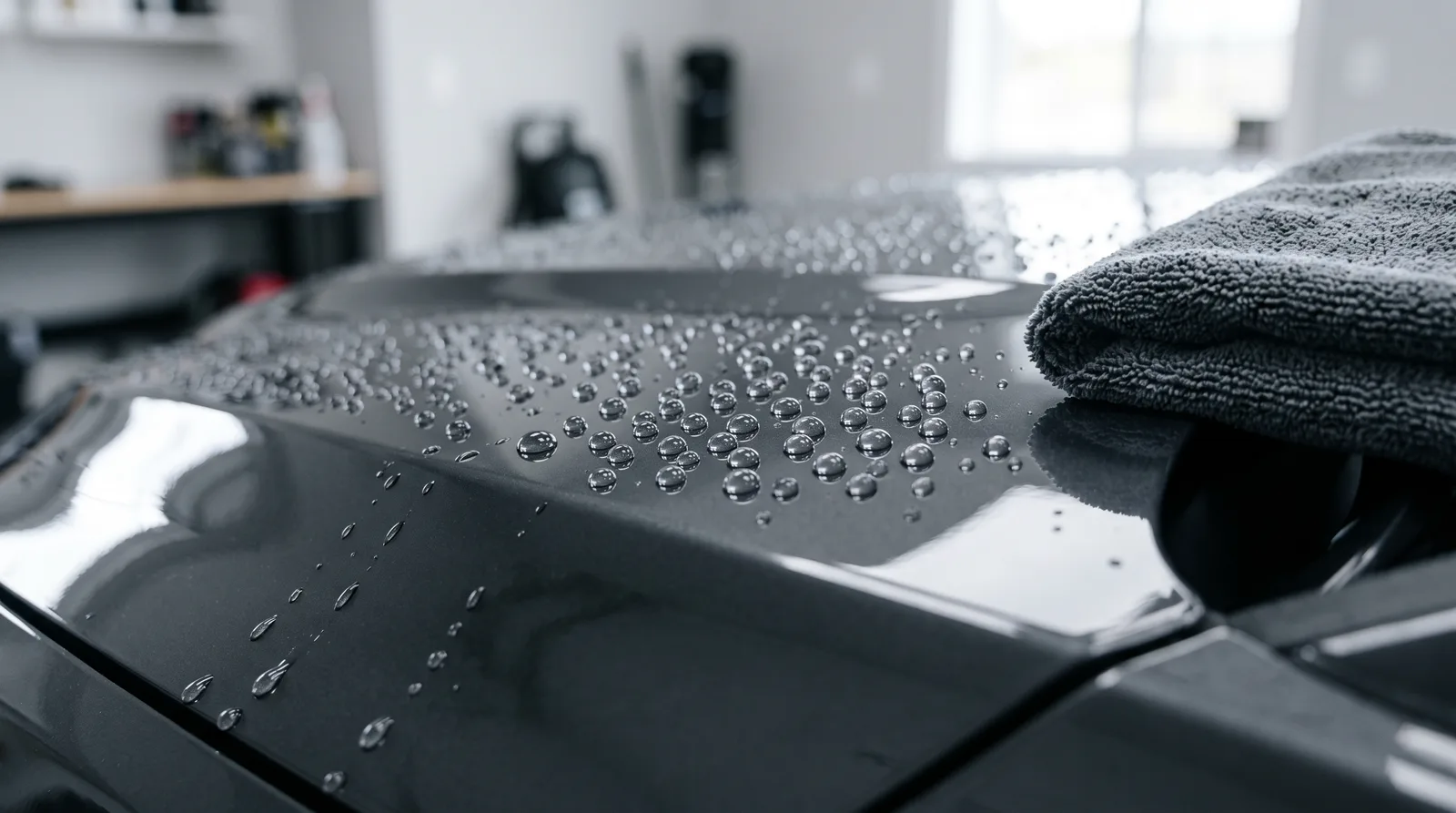
The easiest way to know a coating is healthy is to watch how water behaves on it: tight, round beads and water that sheets off quickly. Wax over the top produces its own beading, so you can no longer tell whether the coating underneath is doing its job. A coating can be quietly wearing out while a layer of wax makes everything look fine, and you lose the early warning.
It can dull the finish
A coating's gloss comes from a clean, smooth, hard surface. Wax adds a soft film that attracts dust and pollen, and uneven application leaves a slight haze or streaks, especially in sunlight. Pollen season in Lee County makes this worse, because the film grabs fine particles that a bare coating would rinse away. The result is paint that looks less sharp than it did the day you picked it up.
It can interfere with the hydrophobic behavior
A coating is designed to be slick and to shed water and dirt. A layer of wax changes the surface the water actually meets, and a heavy or uneven layer can make the surface feel grabby instead of slick and hold onto dirt. That is the opposite of the easy-to-clean behavior most owners want from a coating.
It makes the next maintenance step harder
When it is time for a booster or a maintenance detail, a layer of wax has to be washed off first, because a booster needs to reach the coating itself to bond properly. You end up paying in time or in shop labor to undo the wax, which is the reverse of the low-maintenance ownership a coating is supposed to give you.
You gain nothing
The real issue is simple: there is no protection gap for wax to fill. The coating already handles UV, contamination and water. Waxing a coated car is like putting a second coat of cheap polish on a freshly installed protective layer. It costs time and adds risk with no benefit.
The bigger risk: the wrong products and habits
While wax is mostly an unnecessary extra, some other products and habits do real damage. If you are tempted to "do something" for your coating, avoid these first. Our guide to the things that ruin a ceramic coating covers each one in detail.
- Automatic and tunnel car washes. Shared brushes and strong detergents wear at a coating faster than hand washing.
- Dish soap and household degreasers. They are designed to strip oils and wax, which includes the hydrophobic layer of a coating.
- Clay bars and compound polishes as routine care. These are correction tools that abrade the surface, not maintenance products.
- Leaving bird droppings, sap and bug splatter on the paint. Acidic residue can etch even through a coating if it sits for days.
What to use instead of wax
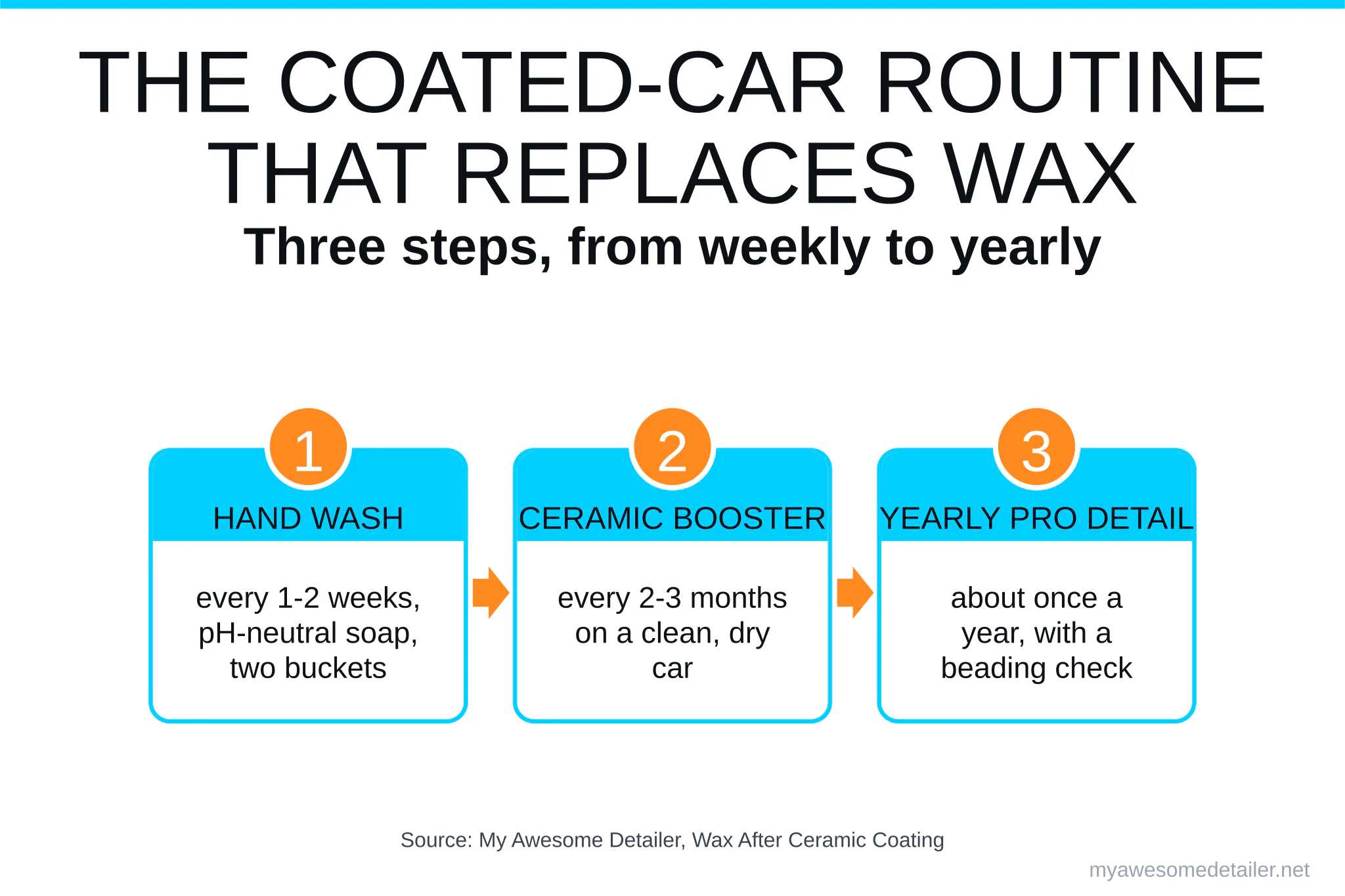
The coating-safe replacement for wax is a ceramic booster, sometimes called a topper or ceramic sealant spray, applied every 2–3 months after a proper wash. It refreshes the surface layer of the coating so beading and slickness stay strong, without the smearing, haze and build-up of wax.
Think of the maintenance routine as three tiers:
- Routine hand wash (every 1–2 weeks). A pH-neutral, coating-safe soap, the two-bucket method and a plush microfiber mitt, then a gentle dry. This does most of the work.
- Ceramic booster (every 2–3 months). A spray-on, wipe-off product applied to a clean, dry car. It takes minutes and tops up the surface performance of the coating.
- Professional maintenance detail (about once a year). A deeper decontamination wash, a check of how the coating is beading, and a booster applied correctly. It catches early wear before it becomes a problem.
How to choose a booster
Look for a product that is clearly labeled as a ceramic booster, topper or coating maintenance spray, not a wax, a "wax and seal" blend or a quick-detailer with carnauba. Check that it is safe for coated surfaces and follow the directions on the bottle: most are applied to a clean panel, wiped on with one towel and buffed off with a second dry one. If you are unsure which products are compatible with your coating, ask the shop that installed it, because different coatings and boosters can be matched.
Our full routine, including wash method and seasonal adjustments, is in the ceramic coating maintenance guide.
How to apply a ceramic booster step by step
- Wash the car properly. Hand wash with pH-neutral soap and rinse thoroughly so no soap film is left behind.
- Dry completely. Use a clean, plush microfiber towel or a filtered blower. A booster needs a clean, dry surface to bond evenly.
- Work in the shade on a cool panel. Direct Alabama sun flashes a product off too fast and causes streaks. Early morning or evening, or a garage, is ideal.
- Apply lightly, one panel at a time. A light mist on the panel or applicator is enough. More product is not better.
- Wipe, then buff. Spread it evenly with one microfiber towel, then buff to a clear finish with a second clean, dry towel.
- Check in angled light. Look for any high spots or streaks and buff them out before the product fully sets.
What if you already waxed your coated car?
Do not panic. One application of wax will not ruin a coating. The usual fix is simple:
- Wash it again with a coating-safe soap. Several washes will gradually remove a thin layer of wax.
- Skip further wax. Switch to a ceramic booster at your next maintenance interval.
- If the finish looks hazy or the water behaves strangely, bring the car in. A professional decontamination wash can strip residue safely without harming the coating, which is better than trying aggressive products at home.
The one thing to avoid is reaching for a clay bar or polishing compound to "get the wax off." Those abrade the surface and are exactly the sort of correction tools a coating does not want as routine care.
Is there ever a time to use wax on a coated car?
For the coated surfaces of the car, we do not recommend it. There are a few related situations worth sorting out:
- Cars without a coating. If your car is not coated, wax is a perfectly reasonable, affordable option, and it is why many owners start there. Just plan to reapply it often. A coating is the longer-lasting upgrade.
- Parts that are not coated. Some trim, plastics and wheels are treated differently. If a part was not part of your coating package, ask what is best for it rather than assuming wax.
- Coating over paint protection film. If you have film, there are specific care rules; see our guide on ceramic coating over PPF.
Alabama conditions: why the maintenance routine matters here
Auburn, Opelika and the rest of Lee County are tough on paint. Strong summer UV, high heat, heavy spring pollen, love bugs, tree sap and red clay dust all land on a car parked outside. A coating is built to handle that environment, but it is doing a lot of work, and a consistent wash schedule and a booster every few months keep it in top form. Wax would be gone quickly in this climate, which is another reason a coated car is better served by a booster than by a wax routine. For more on the heat side, read how Alabama heat damages car paint.
Signs your coating needs a booster or a check
- Water no longer forms tight beads and instead spreads in flat patches.
- The car takes more effort to get clean than it used to.
- The gloss looks flatter even after a wash.
- Contamination such as bugs or pollen clings harder than before.
Often a decontamination wash and a booster restore the surface performance. A full recoat is typically only needed when the coating is genuinely at the end of its life.
Why a coating and wax behave so differently at the surface
It helps to picture what is actually happening on the paint. Under any finish you have the factory clear coat, which is the glossy, transparent top layer of automotive paint. It is relatively soft, it scratches, it fades under UV, and it etches when acidic contamination sits on it.
Wax is applied on top of that clear coat and stays a separate layer. It fills very fine texture in the surface, which is why a freshly waxed car looks deep and wet, but it never becomes part of the paint. Heat softens it, detergent lifts it and friction rubs it away.
A ceramic coating cures into a thin, hard layer that is chemically bonded to the clear coat. It does not fill and smooth the way wax does; instead it forms a durable, slick, easy-to-clean surface that resists contamination. Because it is hard and bonded, it does not need a sacrificial layer on top, and adding one just puts a soft, easily contaminated film back between you and the thing you paid to install.
That is why the right mental model is not "coating plus wax equals extra protection." It is "coating replaces wax." Once you have the coating, your job is to keep the coating itself clean and refreshed.
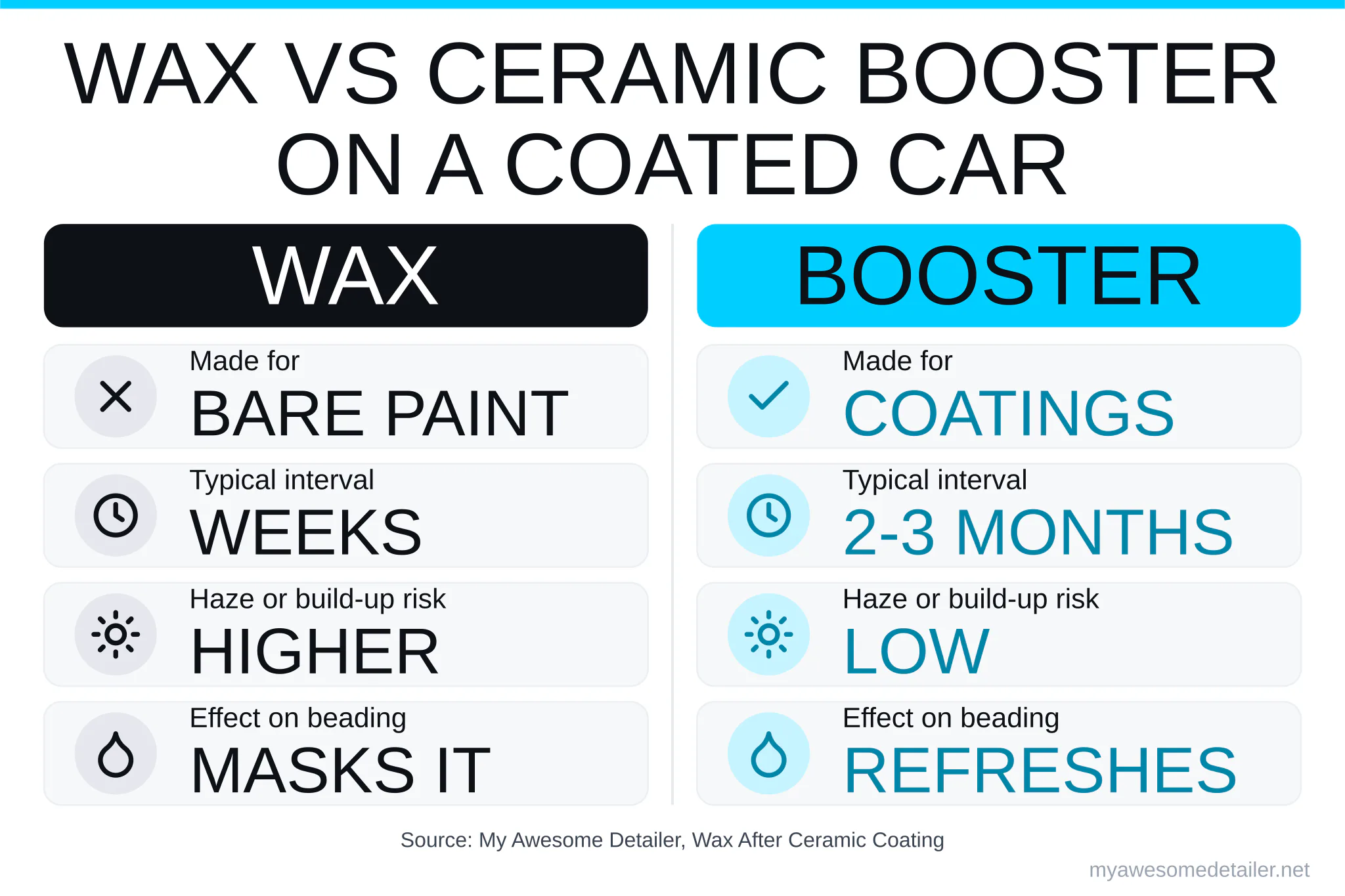
A closer look: wax vs ceramic booster on a coated car
Boosters and waxes can look similar on the shelf, since both are bottles you spray or wipe on, so here is how they differ in practice.
| Question | Wax | Ceramic booster |
|---|---|---|
| Made for coated cars? | No, designed for bare paint | Yes, designed to work with coatings |
| Typical interval | Every few weeks to months | Every 2–3 months |
| Application | Can take time and effort to apply and remove | Typically spray on, wipe, buff off |
| Risk of haze or build-up | Higher on a coated surface | Low when applied lightly to a clean panel |
| Effect on beading | Masks the coating's own performance | Refreshes the coating's beading and slickness |
| Fit for Alabama heat | Wears off quickly in summer | Built to bond and refresh a coating |
The takeaway: if you like the ritual of adding a protective product every so often, a booster scratches that itch the right way. It keeps you in a regular rhythm without fighting the coating.
Seasonal care for a coated car in Auburn and Opelika
You do not need a complicated calendar. A simple seasonal rhythm keeps a coating in good shape year-round:
- Spring. Pollen is the main enemy. Rinse and wash more often so the yellow dust does not sit and bond, and apply a booster after the worst of the pollen has passed.
- Summer. UV, heat, love bugs and sap are the stressors. Wash weekly if the car lives outside, remove bug and sap residue promptly, and wash in the shade, never on a hot panel.
- Fall. Leaves and sap drop onto parked cars. Rinse leaf debris off instead of letting it sit damp on the paint, and book your yearly maintenance detail.
- Winter. Washing is less frequent in cold weather, but road film still builds up. Keep a regular wash going and apply a booster if you are due.
The point is consistency. A coating forgives a missed week, but it does not do well when neglected for months at a time.
Choosing a wash soap for a coated car
Because wax is out, the wash soap becomes your most important product. A coating-safe soap is pH-neutral, meaning it cleans dirt and road film without being aggressive enough to attack the coating's surface. Avoid soaps that advertise "strips wax" or "removes old sealant," because that is a sign they are strong enough to be harsh on a coating. Avoid dish soap and household cleaners entirely.
Some soaps are marketed as "wash and wax" or "wash and seal." For a coated car, skip those too. They deposit the very film we are trying to keep off the surface. Pick a straightforward pH-neutral shampoo, or a shampoo designed to add a coating-compatible boost as you wash, and keep it simple.
Drying and touching up between washes
Water left to dry on a car in Alabama sun leaves mineral spots, and those can be a hassle on any finish. Drying matters more than most owners think. Blot or glide a clean, plush microfiber towel across each panel, or use a filtered blower to push water out of seams, mirrors and trim.
For light dust or fingerprints between washes, a quick detailer that is marked as safe for ceramic coatings is fine, used with a clean microfiber towel. Check the label: some quick detailers contain wax or carnauba. Choose one that is clearly coating-compatible, and never wipe a dry, dusty panel with a dry towel, because that drags dirt across the surface.
What to ask your detailer before and after a coating
Coatings differ, and the most reliable guidance on your car comes from whoever installed it. At pickup, make sure you know:
- What aftercare steps to follow in the first days after the coating is installed.
- Which wash soap and booster products are compatible with your specific coating.
- How often a booster should be applied for your vehicle and how it is parked.
- Whether your coating package includes any maintenance visits or checks, and what the warranty terms require. Our warranty page explains what applies at My Awesome Detailer.
Asking these questions up front is the single easiest way to avoid wax-type mistakes later. If you are still deciding on a coating, you can learn more on our ceramic coating page.
What about the rest of the vehicle?
A full coating job can include more than the paint. Wheels, glass, trim and some interior surfaces can be coated as well, and each behaves a little differently. Wheels and glass in particular get very different maintenance. If you want the details, read our guide to ceramic coating for wheels, glass, trim and interior. As a general rule, the same principle holds: wash, avoid wax and household cleaners on coated surfaces, and use products that are labeled as compatible.
Wax after a coating, in one minute
- A ceramic coating replaces wax. It does not need wax on top.
- Waxing over a coating can hide its performance, add haze, and make maintenance harder.
- Use a pH-neutral soap, hand wash every 1–2 weeks and rinse contamination promptly.
- Use a ceramic booster every 2–3 months instead of wax.
- Book a professional maintenance detail about once a year.
- If you waxed by accident, wash it again and skip further wax; ask us if the finish looks off.
Why owners reach for wax anyway (and what to do about the urge)
Most owners who wax a coated car are not careless; they are trying to do something good for the paint. A few reasons come up again and again, and each has a better answer.
"The car looks a little dull." Dullness on a coated car is almost always surface contamination, such as road film, pollen residue or mineral spots, not a lack of wax. A thorough hand wash often brings the gloss right back. If it does not, a decontamination wash by a professional is the right next step, not a layer of wax.
"The water is not beading like it used to." That is the classic sign that a coating needs a clean surface and a booster. Wax would bring beading back for a few weeks, but it would also cover up the reason it faded. A booster restores the coating itself.
"I have always waxed my cars." Habit is a strong force, and a wax session can feel satisfying. If you enjoy the weekend ritual, keep it: wash, dry, apply a booster, and enjoy the finish. It is the same routine with a product that suits a coating.
"A friend or a video told me to." General car-care advice is written for bare paint, where wax makes sense. Advice for a coated car is different, and your installer knows which coating is on your vehicle. When in doubt, ask the shop before you buy a product.
Keeping that in mind makes the decision easy. If a product says wax, carnauba or "wash and wax" on the label, leave it on the shelf. If it says ceramic booster or coating maintenance and is compatible with your coating, it is the right tool.
Common myths about waxing a coated car
"A coating needs wax on top to last."
The coating is the protection. It does not need a sacrificial layer on top of it, and the maintenance that extends its life is washing and boosters, not wax. We also bust other common misconceptions in ceramic coating myths, busted.
"Wax makes it shinier."
Wax adds warmth and depth on bare paint. On a coating that is already glossy and smooth, it tends to add haze rather than clarity.
"A coated car never needs washing."
A coating makes washing easier, not unnecessary. Dirt still needs to come off, and regular washing is what keeps the coating performing.
Not sure your coating needs a booster?
Bring it by our Opelika shop for a free water-beading check. We will tell you honestly whether it needs a booster, a maintenance wash, or nothing at all.
The bottom line
You do not need to wax after a ceramic coating, and in most cases you should not. Wash by hand with coating-safe soap, apply a ceramic booster every 2–3 months, and get a professional maintenance detail about once a year. That keeps the finish clear, the beading tight and the coating working for the years it was meant to last. If you want to talk through your car, visit us at My Awesome Detailer, 2709 Frederick Road, Opelika, AL 36801, or call (334) 650-6499. We serve Auburn, Opelika and the surrounding Lee County area from our shop.