Quick answer: Fresh water spots are mineral residue sitting on your paint, and a proper decontamination wash or a mild acidic water spot remover usually takes them off. Spots that have been baked in the Alabama sun for days or weeks often etch into the clear coat, leaving a dull ring or crater that no spray, clay bar, or wax can remove. Once a spot is etched, machine polishing (paint correction) is the only real fix. In the Auburn and Opelika area, that typically runs about $250 to $450 for a one-step polish up to $450 to $800 for a two-step correction, depending on the vehicle and how deep the etching goes.
If you have ever washed your car, let it sit in a parking lot at Tiger Town, and come back to a hood covered in little white circles, you already know what hard water spots on a car look like. Most people try a quick detailer spray, then a stronger cleaner, then a clay bar, and some of the spots finally disappear. The ones that don't are the ones this guide is about.
At My Awesome Detailer LLC, 2709 Frederick Road in Opelika, water spot removal is one of the most common reasons people bring a car into our shop. Some of those cars need nothing more than a careful chemical decontamination. Others have spots that have been etched into the clear coat by months of sprinklers, rain, and summer heat, and those need a machine. Below we'll explain the difference, show you how to remove water spots from paint safely at home when that is possible, and help you tell when it is time to stop scrubbing and let a correction do the job.
What water spots actually are
Water is never just water. Tap water, well water, sprinkler water, and even rain carry dissolved minerals and other material. When a droplet sits on your paint and evaporates, the water leaves, but everything dissolved in it stays behind. That leftover ring of residue is a water spot.
The main culprits are:
- Calcium and magnesium. These are the minerals that make water "hard." They leave the classic chalky white ring, and they are the reason hard water spots on a car are so common in areas served by mineral-rich groundwater.
- Sodium and other salts. These leave a softer haze that often wipes away more easily but can still bond if left in heat.
- Acidic contaminants in rain. Rainwater picks up pollution, pollen, and dust on the way down. When it dries, it can leave a residue that is mildly acidic and more likely to eat into the clear coat.
- Chemicals from sprinklers and runoff. Irrigation water often carries fertilizer residue and iron. Iron in particular can leave orange or brown tinted spots, especially on light-colored cars.
On its own, a fresh mineral deposit is mostly a cosmetic problem. The trouble starts when that deposit sits on a hot panel for a long time. Heat speeds up chemical reactions, and Alabama gives your paint plenty of heat. A black hood parked in an Opelika parking lot in July can climb well past 150 degrees on the surface, and that is exactly the condition that turns a harmless spot into permanent damage.
The three types of water spots (and why it matters)
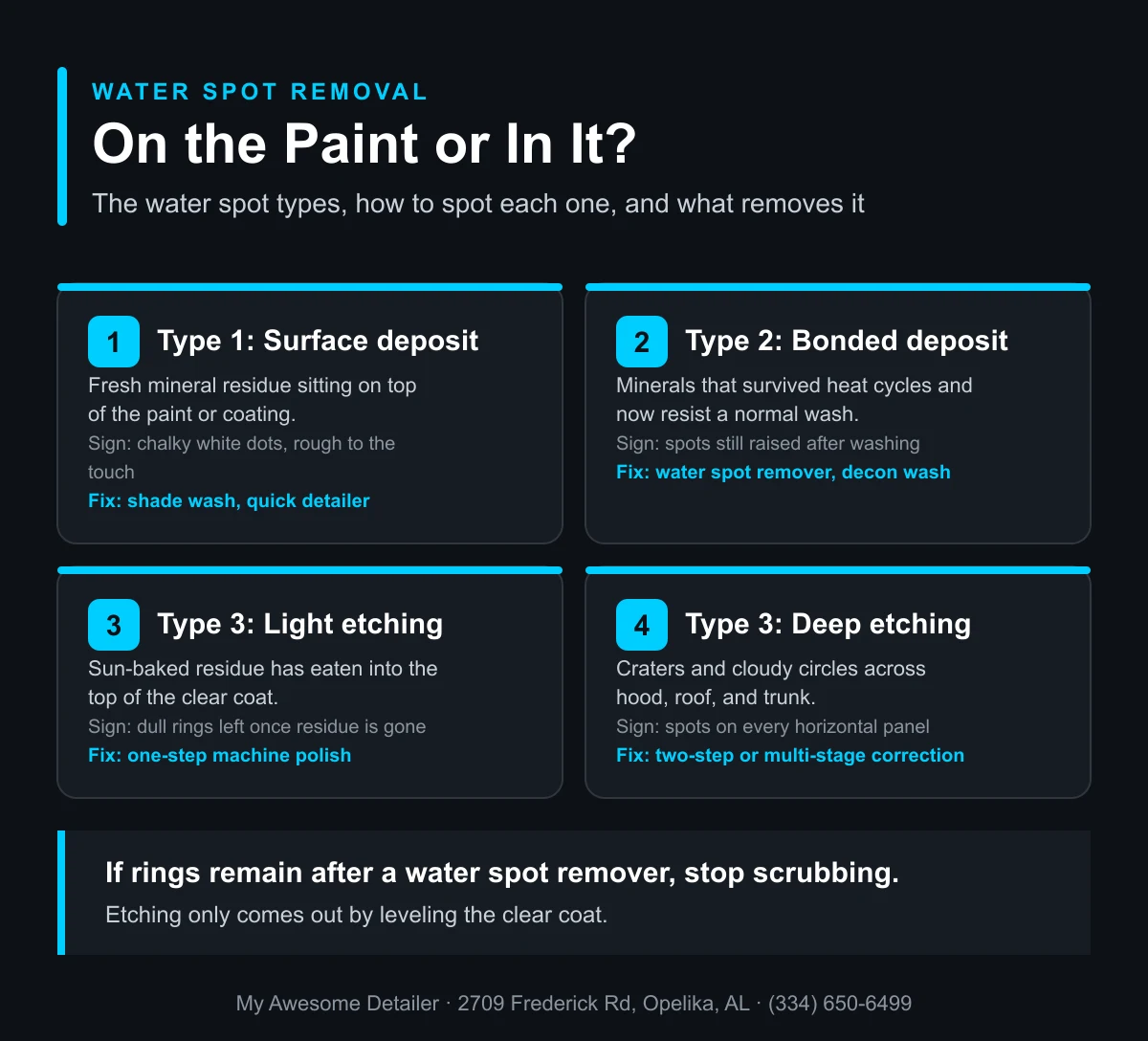
Detailers usually sort water spots into three types. Knowing which one you have tells you whether a bottle from the parts store will work or whether you need paint correction.
Type 1: Mineral deposits sitting on the surface
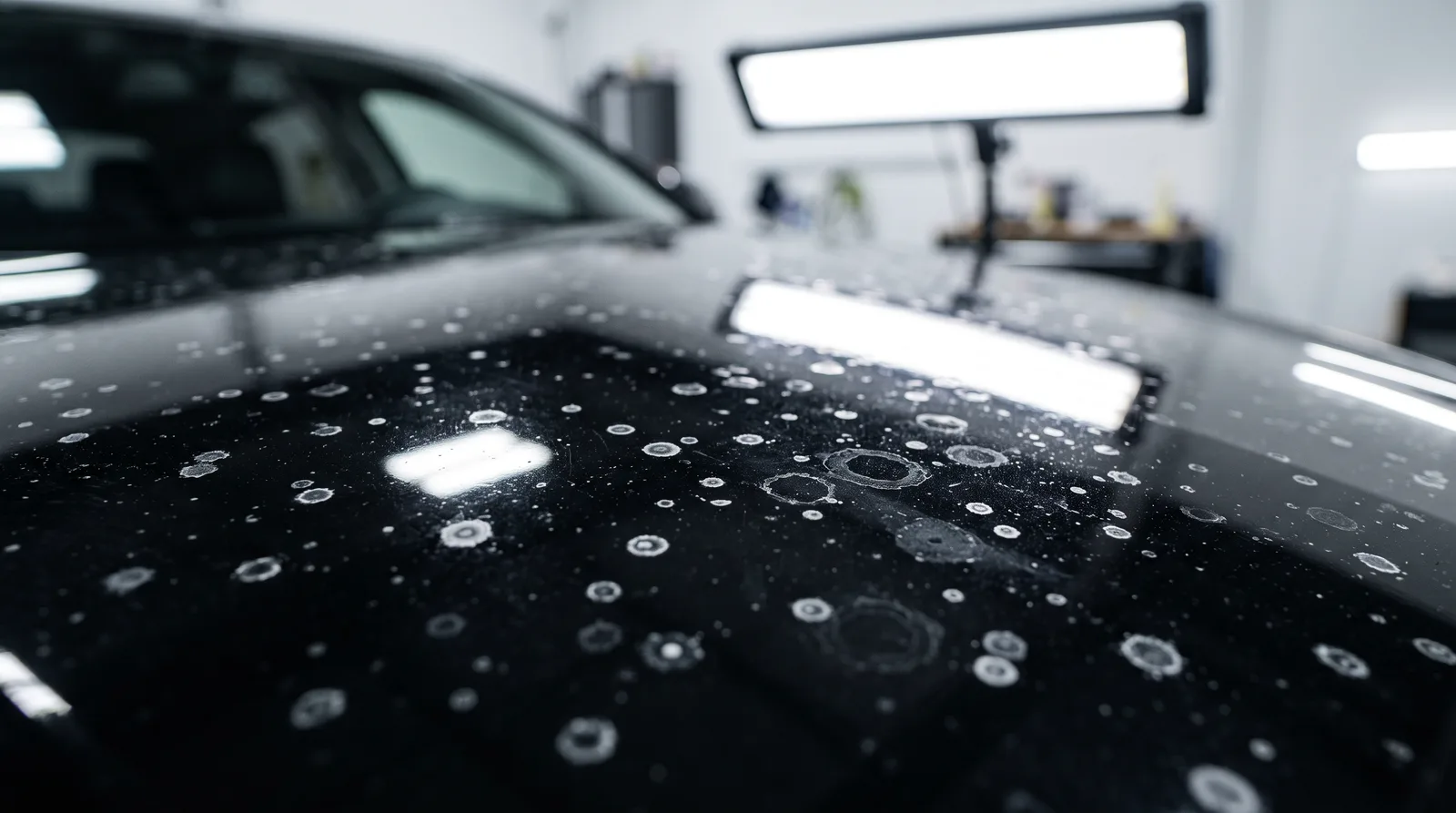
These are fresh spots made of minerals resting on top of the paint (or on top of your wax, sealant, or ceramic coating). They feel slightly rough if you drag a fingertip across them, and they look white or gray. A good wash, a waterless detailer, or a dedicated water spot remover will usually take them off. This is the "cosmetic" category, and it is the one most people can handle at home.
Type 2: Bonded mineral spots
When surface deposits are left long enough, especially through a few heat cycles, they bond more tightly to the surface. A normal wash no longer touches them. A mild acidic water spot remover or a chemical decontamination can still dissolve them in most cases. If you remove the residue and the paint underneath looks perfect, you caught it in time.
Type 3: Etched water spots
This is the one people dread. Over time, minerals and acidic residue, combined with heat, eat into the clear coat itself. When you dissolve the residue, you are left with a dull ring, a faint crater, or a cloudy circle where the spot used to be. The deposit is gone, but the damage is now part of the paint surface. No chemical will "fill" it back in. The only way to remove an etched spot is to level the clear coat around it with machine polishing until the crater is gone.
| Water spot type | What you see | Where it sits | What removes it | Typical cost range |
|---|---|---|---|---|
| Type 1: Surface deposit | White or gray chalky dots, slightly rough to the touch | On top of paint or coating | Wash, quick detailer, mild water spot remover | DIY products, or included in a standard detail |
| Type 2: Bonded deposit | Spots that survive a wash, still raised | Bonded to the surface | Acidic water spot remover, chemical decontamination | Often handled during a decon wash or exterior detail |
| Type 3: Light etching | Dull rings left after the residue is gone | In the top layer of clear coat | One-step machine polish | About $250 to $450, varies by vehicle |
| Type 3: Moderate to deep etching | Visible craters, cloudy circles, spots on every panel | Deeper into the clear coat | Two-step or multi-stage paint correction | About $450 to $800, or more for severe cases |
Ranges are typical for the Auburn and Opelika area. Final pricing depends on vehicle size, paint hardness, and how deep the etching goes, and it is set after an in-person inspection.
Why Alabama is so hard on paint when it comes to water spots
Water spots happen everywhere, but east Alabama has a few things working against your paint at the same time.
Heat and sun do the etching
The single biggest factor in whether a spot stays cosmetic or becomes etched is heat. A droplet that dries on a cool panel in the shade leaves a deposit that usually wipes off. The same droplet drying on a sun-baked hood in August evaporates fast, concentrates its minerals and acids into a tiny ring, and then sits there cooking for hours. Repeat that for a few weeks and the clear coat starts to give way. Dark colors get hotter, so black, dark gray, and deep blue cars tend to show etching first and worst.
Sprinklers at apartments, offices, and campus lots
A lot of cars around Auburn get hit by irrigation every day. Apartment complexes, office parks, and neighborhood lots run sprinklers early in the morning, then the sun comes up and bakes the spray dry. Sprinkler water often comes from a different source than your tap and can be high in minerals and iron. Cars parked next to the same sprinkler head every night often show a heavy band of spots along one side.
Pop-up summer storms
A classic Lee County summer afternoon is a short, heavy storm followed by bright sun. Rain beads up on the paint, the clouds clear, and every bead turns into a tiny magnifying spot that dries in minutes. Rain also carries pollen, dust, and pollution, which add to the residue left behind.
Washing in the sun and letting it air dry
One of the most common sources of water spots is a well-intentioned wash in the driveway at midday. The car gets rinsed, the panels dry before you can towel them, and the minerals in the rinse water are left behind. If your home water is hard, every rinse that air dries leaves a fresh layer of spots.
How to tell if your water spots are cosmetic or etched
Before you buy anything or book anything, it helps to know what you're dealing with. You can do a basic check at home in about ten minutes.
Step 1: Wash and dry the car properly
Wash the car in the shade with a pH-neutral shampoo and dry it right away with a clean microfiber drying towel. If the spots disappear, they were fresh surface deposits and you are done.
Step 2: Feel the surface
Put your hand inside a thin plastic sandwich bag and lightly glide it over a spotted area. Raised, gritty bumps usually mean mineral deposits are still sitting on top. A smooth surface with visible rings suggests the deposit is gone but the outline remains, which points toward etching.
Step 3: Try a mild water spot remover on one small area
Use a product made for water spots, following the label exactly. Apply it to a cool panel in the shade, work a small section, and wipe it off within the dwell time the label gives. Then rinse or wipe the area with a damp microfiber to neutralize it.
Step 4: Look at it under strong light
Use a bright flashlight or your phone's light at a low angle across the panel. If the area looks clean and glossy, you removed a bonded deposit. If you still see faint circles, dull patches, or tiny craters where the spots were, the clear coat is etched.
That last step is where most people find their answer. If rings are still visible after the residue is chemically removed, more chemicals won't help. Repeated scrubbing or stronger acids can actually make things worse by attacking trim, glass coatings, or the paint itself.
How to remove water spots from paint at home (when it is still possible)
If your spots are Type 1 or Type 2, you can often handle them yourself. Here's the safe order of operations, starting with the gentlest option.
1. A proper wash in the shade
Many fresh water spots come off with a good two-bucket wash and immediate drying. Work on a cool surface, out of direct sun, and dry each panel before moving to the next. If your home water is very hard, consider a final rinse with filtered or deionized water, or skip rinsing and use a rinseless wash method.
2. A quick detailer or waterless wash
For a few light spots, a spray detailer and a soft microfiber towel can lift them. Spray the towel and the panel, wipe gently in one direction, and flip to a clean side often.
3. A dedicated water spot remover
These products use mild acids to dissolve mineral deposits. They work well on bonded spots, but they need care:
- Use them only on a cool panel in the shade.
- Work one small section at a time.
- Don't let the product dry on the paint.
- Keep it off plastic trim, rubber seals, and uncoated metal if the label warns against it.
- Wipe or rinse the area afterward so no acid is left behind.
4. Diluted white vinegar (with caution)
A common home remedy is a 50/50 mix of distilled white vinegar and distilled water. Its mild acidity can loosen light mineral deposits. Spray it on a microfiber towel, not the hot paint, hold it on the spot for a short time, wipe, and then rinse the area well. Vinegar can strip wax and some sealants, so plan on reapplying protection afterward. Never let it dry on the car and never use it in direct sun.
5. Clay bar decontamination
A clay bar or clay mitt can pull bonded contamination off the surface, including some stubborn mineral residue. It won't remove etching, and it can mar soft paint if it is used dry or with too much pressure, so always use plenty of lubricant.
What not to do
- Don't scrub with household cleaners. Dish soap, glass cleaner, and kitchen descalers aren't made for automotive clear coat and can damage trim and coatings.
- Don't use abrasive pads or rubbing compound by hand. Hand compounding rarely levels etching evenly and often leaves haze and fresh scratches that need correction anyway.
- Don't keep escalating acids. If a dedicated water spot remover didn't work after one or two careful passes, the problem is almost certainly etching, and stronger chemicals won't fix it.
- Don't use a polishing machine without experience. Rotary and even dual-action polishers can burn through thin clear coat on edges and body lines faster than most people expect.
Not sure if your spots are etched?
Bring the car by our Opelika shop and we'll inspect the paint under proper lighting and tell you honestly whether you need a wash, a decon, or correction.
When paint correction is the only fix for water spots
Once a water spot has etched into the clear coat, you aren't dealing with dirt anymore. You are dealing with a physical change to the surface of your paint. Think of it like a tiny dent in a sheet of glass. Cleaning the glass won't remove the dent. You have to level the area around it.
That's what paint correction does. A trained technician uses a machine polisher, a pad, and an abrasive polish or compound to remove an extremely thin, controlled layer of clear coat across the panel. As the surface is leveled, the etched rings shrink and then disappear, because the bottom of the crater becomes the new top of the paint.
Signs you're past the DIY stage
- Rings or circles are still visible after a chemical water spot remover.
- The spots have a dull, cloudy look and the paint around them is glossy.
- You can see the outline of spots in a pattern that matches a sprinkler or a rainstorm.
- The spots are on horizontal panels like the hood, roof, and trunk, where water sits longest in the sun.
- The car is dark-colored and has been parked outside in Alabama summers.
- Glass is also spotted and doesn't come clean with glass cleaner (glass can etch too).
If several of those apply, you're likely looking at Type 3 water spots. For a broader look at the other paint problems that point to correction, see our guide on the signs your car needs paint correction.
One-step vs. two-step correction for water spot removal
Not every etched car needs the same amount of work. The level of correction depends on how deep the spots go and how hard your paint is.
- One-step polish. A single machine polishing step with a medium polish. It removes light etching and the faint rings left after decontamination, plus light swirls, and it brings back strong gloss. This is the right fit for many water spot cases caught within a season.
- Two-step correction. A cutting step with a compound to level deeper etching, followed by a polishing step to refine the finish and remove any haze from the cut. This is common for cars that sat under sprinklers for months or dark cars with spots baked in through a full summer.
- Multi-stage or targeted spot work. On severe cases, some spots are too deep to remove fully without taking off too much clear coat. In those cases a good technician will reduce them as much as is safe and explain what's left. More on that below.
| Correction level | Best for | What it removes | Typical time | Typical cost range |
|---|---|---|---|---|
| Decontamination wash | Type 1 and 2 spots | Mineral deposits, iron, bonded contamination | A few hours | Part of an exterior detail |
| One-step polish | Light etching, faint rings | Most light etching plus light swirls and haze | About 1 day | About $250 to $450 |
| Two-step correction | Moderate etching on several panels | Most moderate etching, swirls, light scratches | 1 to 2 days | About $450 to $800 |
| Multi-stage correction | Heavy, widespread etching | As much etching as the clear coat safely allows | 2 or more days | About $800 to $1,500 or more |
Ranges vary by vehicle size, paint hardness, and etching depth. We confirm the plan and price after inspecting the paint in person.
For a full breakdown of what drives these numbers, see our paint correction cost guide for Auburn and Opelika.
What happens during water spot correction at our shop
Every car is different, but here's how a typical water spot correction goes when you bring a car to our detailing shop in Opelika.
1. Inspection under proper lighting
We look at the paint under bright, color-accurate inspection lights. Water spot etching is often invisible in a dim garage and obvious under a strong light. We identify which panels are affected, how heavy the etching is, and whether there are other defects like swirls or scratches to handle at the same time.
2. Thorough wash and chemical decontamination
Before any polishing, the car gets a careful hand wash, an iron remover to dissolve embedded metal particles, and a mineral-focused treatment to remove any remaining surface deposits. Removing the residue first shows us exactly how much true etching is left, so we don't polish more than we need to.
3. Clay treatment
A clay step removes bonded contamination so the polishing pad works on clean paint and doesn't drag grit across the surface.
4. Paint thickness awareness and a test spot
Water spots are usually on horizontal panels, and clear coat thickness varies from car to car and panel to panel. We start with a small test section using the least aggressive combination of pad and polish that might work. If the etching comes out, we use that combination across the panel. If not, we step up carefully. This test-spot approach protects your clear coat.
5. Machine polishing, panel by panel
We work each affected panel in small sections, checking our progress under the lights as we go. On a two-step job, a cutting stage levels the etching and a finishing stage refines the gloss.
6. Panel wipe and final inspection
After polishing, we wipe the panels with a cleaner that strips away polishing oils, so what you see is the true finish, not a temporary shine. Then we inspect again under multiple lights.
7. Protection
Freshly corrected paint has no protection on it. At minimum it gets a sealant. Many owners choose a ceramic coating at this point, because it is the best way to keep the new spots from etching in the first place (more on that next).
Can every water spot be fully removed?
Honest answer: most can, but not all.
Your car's clear coat is thin, often about the thickness of a sheet of paper or less. Paint correction removes a tiny fraction of that layer. For light and moderate etching, that is more than enough to make the spots disappear completely. For very deep etching, where acidic residue has eaten far into the clear coat, removing the spot entirely could mean taking off more clear coat than is safe for the long-term health of the paint.
In those cases, a responsible detailer will:
- Reduce the spots as much as is safe, often to the point where they are only visible under a strong light at certain angles.
- Leave enough clear coat behind to protect the paint for years to come.
- Tell you plainly what is left and why, instead of promising 100 percent removal.
Spots that have broken through the clear coat entirely, or that come with clear coat failure (peeling, cloudy patches, or chalky areas), can't be polished out. That kind of damage needs paint work from a body shop. We'll tell you if we see it.
This is also why timing matters so much. The earlier you deal with water spots, the more likely they are to come out with a decontamination or a light one-step polish. Wait a full Alabama summer and the same spots may need a heavier correction or may never come out fully.
Don't forget the glass
Water spots on windows are just as common as spots on paint, and they can be even more frustrating because they affect visibility. Side glass next to a sprinkler and the windshield after a summer of rain often show the same chalky rings.
Like paint, glass spots start as surface minerals and can etch over time. Light spots come off with a dedicated glass water spot remover. Etched glass may need machine polishing with a glass-specific polish. It is worth knowing that if your car has aftermarket window tint, the film is on the inside of the glass, so water spot treatment on the outside won't touch it. We still avoid harsh chemicals near door seals and tint edges.
How to prevent water spots after correction
Once your paint is corrected, the goal is to never need water spot removal again. Here's what actually works in our climate.
Protect the paint with a coating or sealant
A protective layer gives minerals something to sit on other than your clear coat. A good sealant helps for a few months. A ceramic coating goes further. It creates a hard, chemical-resistant layer that bonds to the paint, sheds water quickly so fewer droplets sit and dry, and takes the hit from mineral deposits so the clear coat underneath doesn't.
It is worth being clear about what a coating can and can't do. Ceramic coatings are not "spot-proof." Water can still dry on a coated car and leave spots. The difference is that those spots sit on the coating, they come off much more easily, and if they are left long enough to etch, they etch the coating first instead of your clear coat. Coatings can also be maintained and topped up over time. For more on what a coating can resist and what still harms it, see our post on things that ruin a ceramic coating.
Change how you wash
- Wash in the shade, early in the morning or in the evening, when panels are cool.
- Dry the car immediately with a clean microfiber drying towel or a filtered air blower.
- If your home water is hard, use a rinseless wash or a final rinse with filtered water.
- Use a drying aid or spray sealant to help water sheet off and add a sacrificial layer.
Watch where you park
- Avoid parking in the reach of sprinklers. If you can't, ask property management when they run and move the car on those mornings.
- Park in a garage or in shade when you can, especially after rain.
- After a pop-up storm, a quick wipe-down with a spray detailer before the sun bakes the drops can save you a correction later.
Deal with spots right away
The single best prevention is speed. A spot that is a day old wipes off. A spot that has been through two weeks of 95-degree afternoons might not. Keep a bottle of quick detailer and a couple of clean microfiber towels in the car for exactly this reason.
Keep up with maintenance on coated cars
If your car is coated, regular gentle washes and the occasional decontamination keep minerals from building up on the coating. Our ceramic coating maintenance guide walks through a simple routine that works in the Alabama heat.
Water spot removal options compared
Here's a side-by-side look at the common approaches, so you can choose the right one for your situation.
| Approach | Works on | Does not fix | Risk to paint | Best use |
|---|---|---|---|---|
| Wash and dry in shade | Fresh Type 1 spots | Bonded or etched spots | Very low | Routine care |
| Quick detailer spray | Light, recent spots | Bonded or etched spots | Very low | Spot cleanup after rain |
| Water spot remover (mild acid) | Type 1 and 2 spots | Etching | Low if used as directed | Bonded mineral spots |
| Diluted vinegar | Light mineral spots | Etching, heavy bonding | Low to moderate, strips wax | Occasional home remedy |
| Clay bar | Bonded contamination | Etching | Low with good lubrication | Before polishing or sealing |
| Machine polishing (paint correction) | Type 3 etching, swirls | Clear coat failure | Managed by a trained tech | Etched spots |
| Ceramic coating | Prevention | Existing etching | None when installed on prepared paint | After correction, long-term |
A real-world example from around Auburn
Here's a common scenario we see. A student parks a dark gray SUV in the same apartment lot off Shug Jordan Parkway for a full school year. The sprinklers run every morning before sunrise and catch the driver's side and the back half of the roof. By spring, there is a band of white spots across the doors and roof that won't wash off.
When the car comes in, a decontamination wash removes most of the residue on the doors, and the paint underneath looks fine because it was vertical and the water ran off. The roof is a different story. With the residue gone, the inspection light shows hundreds of dull rings in the clear coat where water sat and baked every day. A one-step polish takes care of the doors' light haze, and the roof gets a two-step correction to level the etching. Afterward, the owner adds a ceramic coating and starts parking two spaces over, out of the sprinkler's reach.
The lesson: the same water, on the same car, created two different problems depending on how long it sat and how much sun it got. That's why an in-person inspection matters before anyone quotes you a fix.
Water spot removal in Auburn and Opelika: the bottom line
Water spot removal comes down to one question: is the spot on the paint or in the paint? Spots on the surface come off with the right wash, a water spot remover, or a decontamination. Spots that the Alabama sun has etched into the clear coat need paint correction, because leveling the surface is the only thing that removes them. After that, a sealant or ceramic coating and better washing and parking habits keep the problem from coming back.
If you've tried the gentle options and still see rings, it's time to stop scrubbing. More chemicals and more elbow grease usually add damage instead of removing it. A proper inspection under good lighting will tell you exactly what you're dealing with and what it will take.
Get rid of etched water spots for good
We remove water spots and etching with professional paint correction at our Opelika shop, serving Auburn, Opelika, and Lee County. Tell us about your car and we'll recommend the right level of work.