Quick answer: The best window tint for a Jeep Wrangler in Alabama is nano-ceramic film: a legal 35% on the front door glass (Alabama's floor is 32% VLT), whatever shade you like on the rear door glass and hardtop windows (Wranglers fall under the SUV rules, so there's no darkness limit behind the driver), and a non-reflective visor strip above the windshield's AS-1 line. Because a Wrangler has thin roof panels, removable doors, and much less insulation than a regular SUV, heat rejection matters more than darkness, and ceramic film delivers that at a legal shade. In Auburn and Opelika, a full Wrangler tint job usually falls within our $350–$600 SUV range, with ceramic at the upper end. Soft-top windows are vinyl, not glass, and shouldn't be filmed.
The Jeep Wrangler is one of the most popular vehicles we see around Auburn, Opelika, and Lake Martin, and it's also one of the most misunderstood when it comes to tint. Owners come into our Opelika shop with questions no sedan owner ever asks: What happens to the tint when I take the doors off? Can you tint my soft top? Does the hardtop glass stay tinted when I pull the top for summer? Is the back of a Wrangler legal to black out?
This guide from My Awesome Detailer LLC answers all of it. We'll go window by window through a Wrangler, explain how Alabama's tint law applies to it, compare film types for an open-air vehicle, cover hardtop and soft-top considerations, and give you realistic 2026 pricing. If you want the deeper background on film technology first, our ceramic tint vs. regular tint comparison is a good companion to this article.
Why tinting a Jeep Wrangler is different from tinting other SUVs
On most SUVs, tint is a straightforward job: five or six pieces of glass, all permanently attached to a sealed, insulated body. A Wrangler breaks almost every one of those assumptions.
It's built to come apart
The doors come off. On a hardtop Wrangler, the roof panels over the front seats lift out, and the whole rear section of the hardtop can be removed. On a soft top, the rear and side windows zip or slide out. That means some of your tinted glass will spend part of its life off the vehicle, on a garage floor, a storage cart, or a wall rack. Tint on a Wrangler needs to be planned around how you actually use the Jeep, not just how it looks parked.
Less insulation, more heat
A typical SUV has a steel roof with a headliner and insulation, thick door panels, and glass sealed tightly into the body. A Wrangler has a thin composite hardtop or a fabric soft top, simple door panels, and weatherstripping designed to be taken apart. On a 95°F Opelika afternoon, heat comes in from every direction. You can't change the roof, but the glass is a big share of the surface area, and that's where good film earns its keep.
Upright, nearly flat glass
Wrangler glass is famously boxy. The windshield stands almost straight up, the door glass is flat, and the hardtop windows are close to flat as well. That upright windshield takes the sun more directly than a raked windshield on a car, which is one reason Wrangler dashboards get so hot. The flat panels are actually good news for tint: flat glass needs less heat-shrinking than a steeply curved rear windshield, so a skilled installer can get very clean, consistent results.
It's used hard
Wranglers go to the lake, the trail, and the tailgate. Dust, mud, sand, pets, coolers, and gear all come in contact with the inside of the glass. Film that's installed well and cleaned correctly holds up fine, but it's worth choosing a durable film and learning a couple of simple care habits, which we cover below.
Alabama window tint law for a Jeep Wrangler
Alabama measures tint by VLT (Visible Light Transmission): the percentage of visible light that passes through the glass and film together. Lower numbers are darker. The key rules for a Wrangler are the same ones that apply to other SUVs, trucks, and vans, because the Wrangler is a multipurpose vehicle rather than a passenger car.
| Window on a Wrangler | Alabama rule | What most Wrangler owners choose |
|---|---|---|
| Windshield | Non-reflective tint above the AS-1 line only | Ceramic visor strip across the top |
| Front door glass | Must allow at least 32% VLT | Ceramic film metered to a legal ~35% |
| Rear door glass (4-door Unlimited) | Any darkness allowed on an SUV | Ceramic, often in a darker shade for privacy |
| Hardtop rear side (quarter) windows | Any darkness allowed on an SUV | Ceramic to match the rear doors |
| Hardtop liftgate glass | Any darkness allowed on an SUV | Ceramic to match, installed around the defroster lines |
| Reflectivity (front) | No more than 20% reflective | Non-mirrored ceramic film |
The single most common mistake we see is a Wrangler with dark film on the front doors to match the factory-darkened rear glass. It looks cohesive, but anything below 32% on the fronts is illegal, and remember that the meter reads the glass and film together. Factory glass isn't perfectly clear, so the film itself often needs to be rated a bit lighter than 32% for the combined reading to pass. That's why we meter every finished install instead of trusting the number on the box.
For the full breakdown, including medical exemptions and what happens if you're stopped with illegal film, see our guide to Alabama window tint laws in 2026. If you're trying to picture what 35% or 20% looks like in person, our VLT percentages guide walks through each shade.
A note on factory privacy glass
Many Wrangler hardtops leave the factory with darkened rear glass. That privacy glass is tinted in the glass itself, and it does a good job of cutting visible light, but it isn't a heat-rejecting film. Owners are often surprised that the back of the Jeep still bakes even though the rear windows look dark. Adding ceramic film over factory privacy glass is common and legal on a Wrangler, and it's usually where the biggest comfort improvement comes from in the rear seat and cargo area.
Best tint for a Jeep Wrangler, window by window
Here's how we approach a Wrangler when an owner asks us for the best tint for their Jeep. The short version: ceramic film everywhere there's glass, with the shade chosen by the law up front and by your taste in the back.
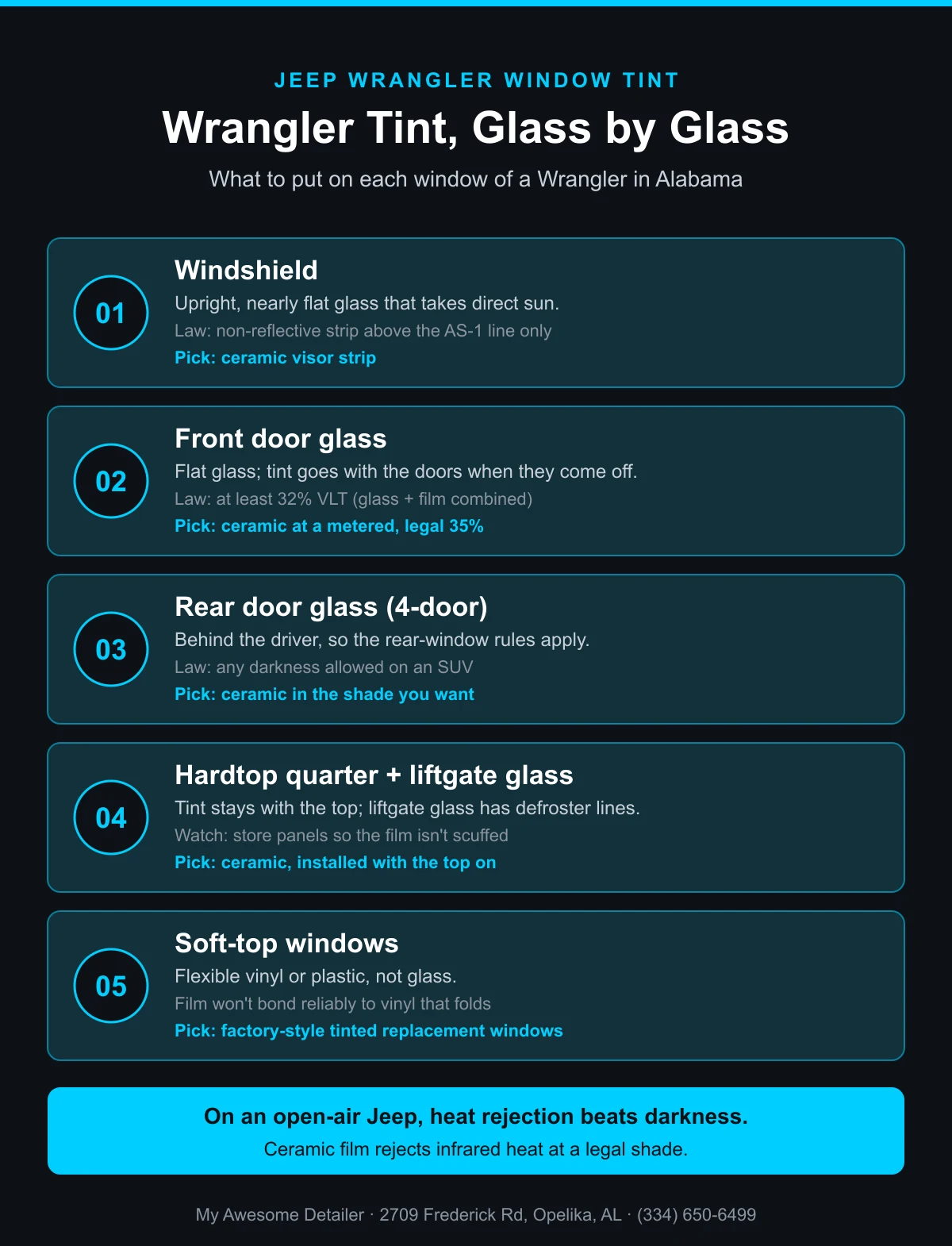
1. Windshield: a ceramic visor strip
The Wrangler's upright windshield puts the morning and evening sun right in your eyes, especially heading east on I-85 in the morning or west on US-280 in the evening. Alabama allows a non-reflective strip above the AS-1 line etched near the top corner of the glass. A ceramic visor strip cuts glare where you need it most without touching your view of the road.
One Wrangler-specific tip: Wrangler windshields are exposed and upright, so rock chips and cracks are common, especially if you drive gravel roads or follow trucks. If you expect a windshield replacement soon, it's worth doing that first. A visor strip goes with the glass, so a new windshield means a new strip.
2. Front door glass: ceramic at a legal shade
The front doors are where the law is strictest and where you sit, so this is where film quality matters most. A ceramic film metered to about 35% gives you a rich, factory-style look, cuts glare, and rejects a large share of infrared heat before it reaches your arm and shoulder. Because Wrangler door glass is flat, the film can be cut with consistent, clean edges that don't catch on the window seals.
When you take the full doors off for summer, the tint goes with them. That isn't a problem as long as the doors are stored so the glass isn't leaning against anything hard. More on storage below.
3. Rear door glass on a 4-door Unlimited
On a Wrangler Unlimited, the rear door glass falls behind the driver, so Alabama's SUV rules allow any darkness. Most owners pick a darker ceramic shade here for privacy and to keep the back seat cooler for kids and pets. If you'd rather keep a uniform look all the way around, running the same shade as the fronts is fine too. Ceramic's heat rejection doesn't depend on darkness, so a lighter shade still performs.
4. Hardtop quarter windows and liftgate glass
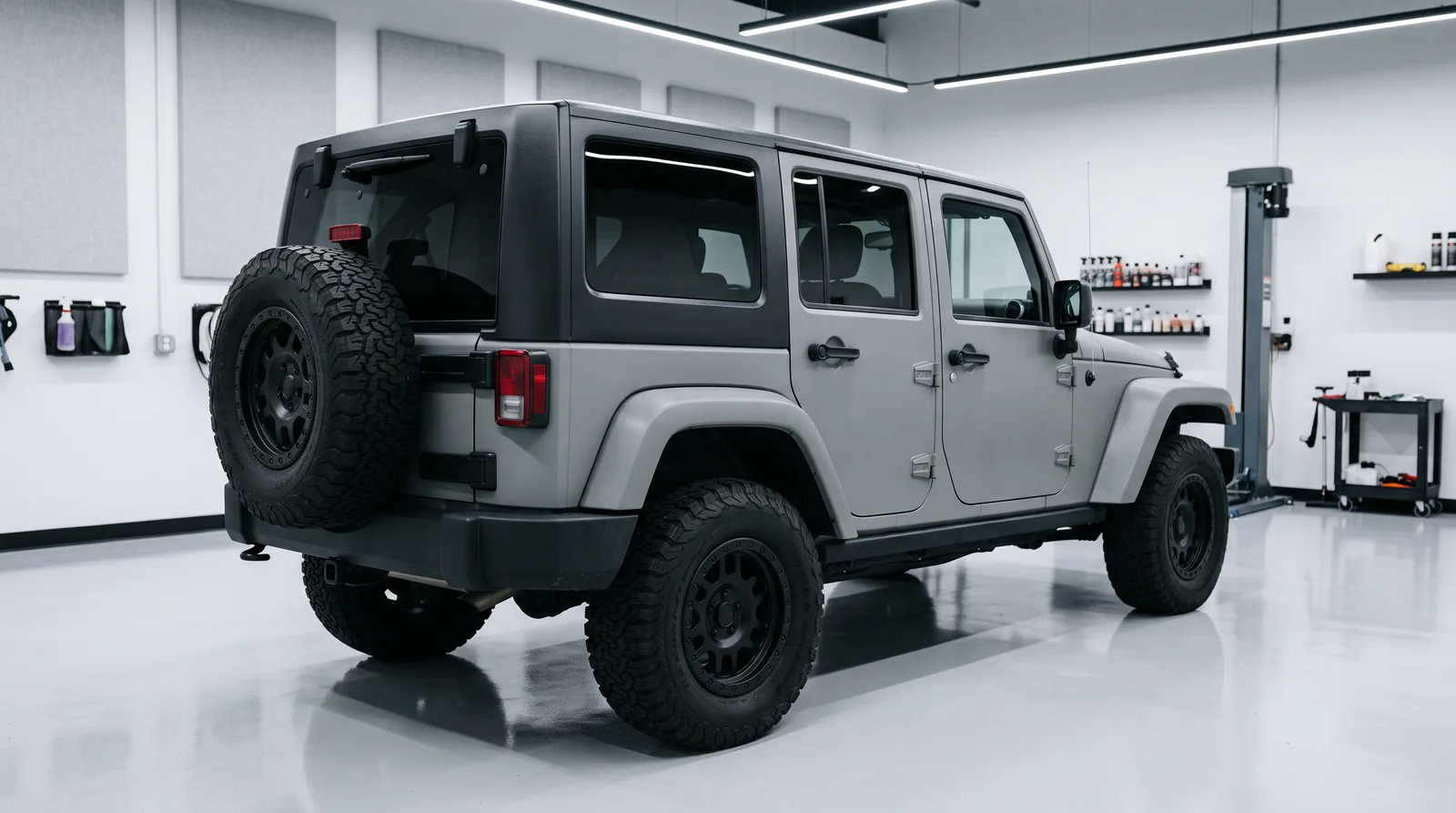
On a hardtop Wrangler, the rear side windows and the liftgate glass are part of the removable rear section of the top. Tint on these windows stays with the hardtop, so if you pull the top off for the summer, that film comes off with it and goes right back on when the top returns.
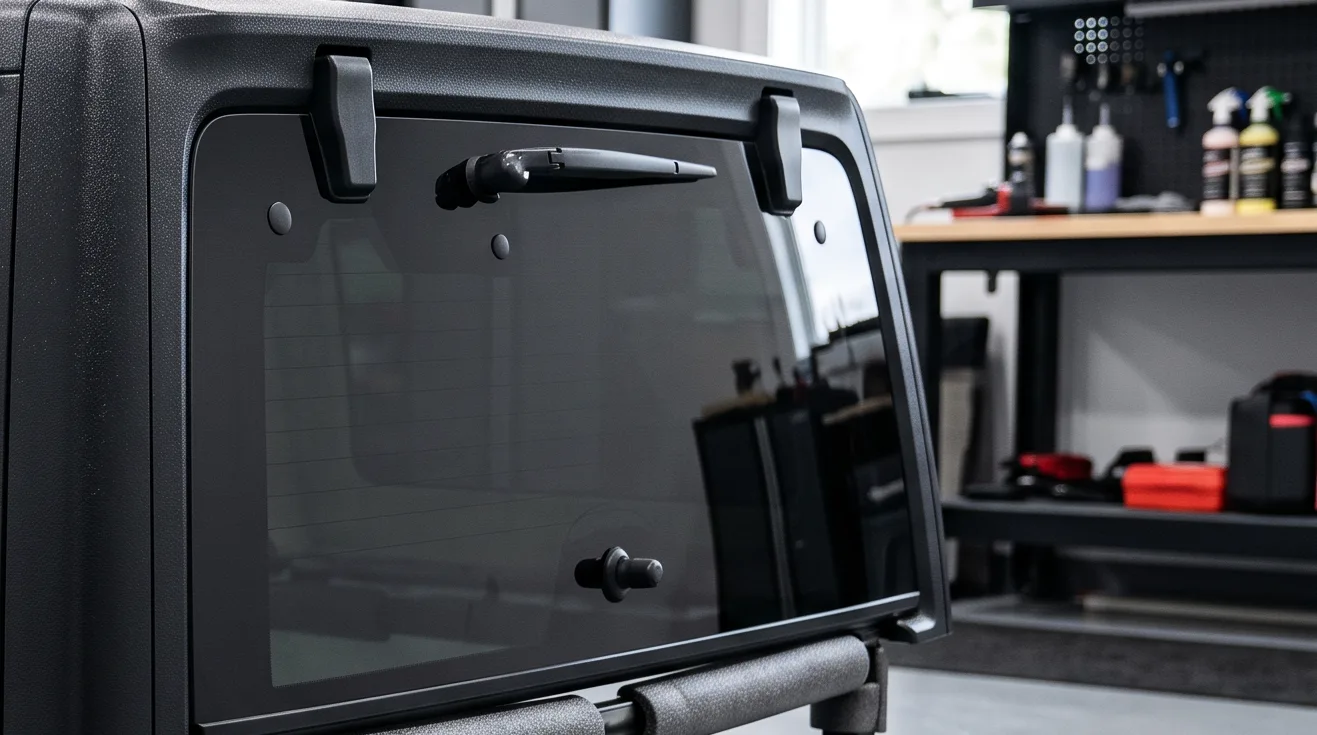
The liftgate glass has defroster lines, and on a hardtop those lines connect to the vehicle through a wiring connector that gets unplugged whenever the top comes off. Film goes on the inside of the glass, over the grid, and a careful install doesn't interfere with the defroster at all. The part to be careful with is removal: scraping old film off a rear glass is where defroster lines get damaged. We cover that in detail in why window tint bubbles or peels.
We prefer to tint hardtop glass with the top installed on the Jeep. It keeps the panels secure, gives the installer consistent access, and lets us check how the film edges sit against the hardtop seals.
5. Soft-top windows: don't film them
Soft-top rear and side windows are flexible clear vinyl or plastic, not glass. They fold, roll, flex in the wind, and change shape with temperature. Window film is designed to bond to rigid glass, and on a soft-top window it's prone to wrinkling, lifting, and peeling, especially when the window is rolled or stored. We don't recommend it.
If you have a soft top and want darker rear windows, the better route is a set of tinted replacement windows made for your soft top. You can still tint the door glass and windshield strip on a soft-top Wrangler with full doors, since those are real glass.
Want your Wrangler tinted right the first time?
We'll spec a legal ceramic film for every piece of glass on your Jeep and meter the fronts before you leave our Opelika shop.
Jeep Wrangler ceramic tint vs. other film types
Most searches for the best tint for a Jeep Wrangler end up at the same question: is ceramic worth it on a vehicle that often has its roof or doors off? For an Alabama Wrangler, our answer is yes, and the open-air design is actually part of why.
When the top is on, a Wrangler behaves like a small greenhouse with thin walls. The glass lets in visible light, UV, and infrared heat. Dyed film mostly just darkens the glass; the infrared heat you feel on your skin passes through. Ceramic film targets that infrared energy specifically. On a vehicle with less insulation, cutting the heat that comes through the glass makes a noticeable difference in how quickly the A/C catches up.
| Film type | Heat (IR) rejection | UV protection | Fading / color change | Signal interference | Fit for a Wrangler in Alabama |
|---|---|---|---|---|---|
| Dyed | Low (~15–25% IR) | Partial | Can fade and turn purple in a few summers | None | Budget only; weak on heat |
| Metallized | Moderate | Good | Resists fading | Can affect phone, GPS, and radio | Not recommended; shiny look and signal issues |
| Carbon | Good (~40–55% IR) | Good | Color-stable | None | Solid mid-tier choice |
| Nano-ceramic | Best (up to ~99% IR on top film lines) | About 99% UV blocked | Color-stable | None | Best overall; strong heat rejection at a legal shade |
IR rejection varies by film line and shade, so ask for the spec sheet on the specific film you're considering. We're happy to show ceramic and dyed samples side by side on your glass.
Why signal-friendly film matters on a Wrangler
Wrangler owners tend to run a lot of electronics: phone navigation on the trail, Bluetooth, satellite radio, toll transponders, and sometimes aftermarket GPS or communication gear. Metallized film can interfere with those signals. Nano-ceramic film is non-metallic, so it doesn't. That's one more reason we default to ceramic on Jeeps.
Protecting the interior
With the top on, a Wrangler interior sits under a lot of glass for its size, and the upright windshield puts the dash in the sun for much of the day. Film that blocks about 99% of UV slows the fading and drying of the dash, seats, and trim. That matters for comfort, and it matters when it's time to sell, because Wranglers hold their value and buyers notice a faded, cracked interior.
Removable doors, hardtops, and soft tops: tint care you should know
This is the part no general tint guide covers, and it's where Wrangler tint either lasts for years or gets scratched up in one season.
Storing tinted hardtop panels
Window film sits on the inside surface of the glass. When the hardtop is off, that inside surface is exposed and easy to scuff if the top is leaned against a wall, set on concrete, or stacked with other gear. A few simple habits protect it:
- Use a padded hardtop cart, hoist, or wall mount so the glass never carries the weight or touches the floor.
- Keep soft padding between the glass and anything it might touch, like foam pads or a moving blanket.
- Don't stack tools, coolers, or doors against the inside of the glass.
- Cover the top if it's stored in a dusty garage or barn, so grit doesn't settle on the film.
The same goes for Freedom-style roof panels and removed doors. Doors with tinted glass should hang on a door rack or lie flat on padding, glass up, rather than stand on edge against a wall.
Don't pull the top or doors during the cure
New tint is installed with a slip solution, and it needs several days to dry and set, sometimes longer in a humid Alabama stretch. During that cure period, leave the windows up and leave the top and doors in place. Flexing the hardtop during removal or rolling the door glass too soon can disturb a film edge before it has bonded. Our window tint installation and aftercare guide explains the cure period in detail.
Cleaning after the trail or the lake
Wranglers get dusty inside. When the glass is gritty, don't dry-wipe it, because dragging sand across the film can leave fine scratches. Instead:
- Rinse or gently blow off loose dust first.
- Spray an ammonia-free glass cleaner onto a clean microfiber towel, not directly onto the window.
- Wipe gently, then follow with a dry microfiber.
- Never use razor blades, scrapers, or abrasive pads on the inside of tinted glass.
For a complete list of safe products and habits, see our window tint care and maintenance guide.
Mounts, stickers, and trail gear
Phone mounts, trail stickers, and dash cameras are part of Wrangler culture. Keep suction cups and adhesive mounts off the film itself; mount to the dash, the grab handle, or the windshield frame instead. Pulling a suction cup or sticker off window film can lift or tear the top layer.
How much does Jeep Wrangler window tint cost in Auburn and Opelika?
Every Wrangler is quoted individually, because the number of glass pieces depends on the body style (2-door or 4-door Unlimited), whether it has a hardtop or soft top, and whether old film has to be removed first. As a general guide for 2026, using the same ranges from our Auburn and Opelika window tint cost guide:
| Wrangler tint job | Typical 2026 range | What's included / what affects it |
|---|---|---|
| Front doors only | About $99–$150 | Driver and passenger door glass, metered to a legal shade |
| Full Wrangler, hardtop | About $350–$600 | All door glass plus hardtop quarter and liftgate glass; 2-door usually lower in the range, ceramic toward the top |
| Full Wrangler, soft top | Quoted per vehicle | Door glass only (soft-top vinyl windows aren't filmed) |
| Windshield visor strip | Quoted with the job | Non-reflective strip above the AS-1 line |
| Old tint removal | About $25–$50 per window | Depends on film age, adhesive left behind, and defroster lines |
These are ranges, not fixed quotes. The fastest way to an exact number is to call us at (334) 650-6499 or request a free quote with your year, body style, and top type.
Is ceramic worth the extra cost on a Jeep?
Dyed film on a Wrangler is a false economy in our climate. It does little for heat, which is the main problem in an open-air vehicle, and cheap film is the type most likely to fade, bubble, and need removal within a few Alabama summers. Removal plus a second install usually costs more than doing ceramic once. Our ceramic installs are backed by a lifetime no-fault warranty, which you can read about on our warranty page.
Flat vs. curved glass: what makes a Wrangler install go well
People sometimes assume a Wrangler is an easy tint job because the glass is flat. The flat glass does help, but a Wrangler has its own details that separate a clean install from a sloppy one.
Edges and seals
Wrangler door glass seals against a frame and weatherstripping that sees a lot of flexing, especially when the doors come off and go back on. Film has to stop at exactly the right point near the top edge so it doesn't catch the seal every time the window goes up. Film that's trimmed too high will eventually wear and lift, which is one of the most common causes of peeling we see.
Hardtop window gaskets
The fixed hardtop windows sit in gaskets, and the film needs to be tucked neatly to the edge of the visible glass. A good installer works the film close to the gasket without forcing it underneath, so the edge stays sealed and invisible.
Dot matrix and defroster lines
The liftgate glass has defroster lines, and some glass has a dotted ceramic border (called a dot matrix or frit) around the edges. Film doesn't bond as easily over those dots, so they need careful handling for the edge to lie flat instead of showing a silvery, lifted border.
A clean, enclosed shop
Wranglers come in dusty. We clean the glass and the surrounding seals thoroughly and install in our enclosed shop at 2709 Frederick Road in Opelika, which keeps dust and pollen from getting trapped under the film. If you're weighing a DIY kit, our DIY vs. professional window tint article explains why the environment matters so much.
Picking a shade: common Wrangler tint setups
There's no single right look, but most Wrangler owners we work with land on one of these setups:
| Setup | Front doors | Rear doors + hardtop glass | Best for |
|---|---|---|---|
| Uniform and legal | Ceramic ~35% | Ceramic ~35% | A clean factory look all the way around with the best night visibility |
| Classic SUV look | Ceramic ~35% | Ceramic ~20% | Privacy for gear and passengers without going extreme |
| Max privacy in back | Ceramic ~35% | Ceramic ~5% | Hiding gear in the cargo area; limo-dark rear glass |
| Heat-first, low profile | Light ceramic | Light ceramic | Owners who want comfort without a darker look |
Two things to keep in mind. First, very dark rear glass on a Wrangler can make backing up at night harder, especially with a tire carrier and spare partly blocking the view. Second, darker isn't cooler by itself. A lighter ceramic film can reject more heat than a very dark dyed film, so choose your shade for looks and privacy, and choose your film type for heat.
Why local Wrangler owners care so much about heat
East Alabama is hard on Jeeps in the summer. Long, humid stretches with afternoons in the 90s, strong sun most of the year, and plenty of time parked in open lots all add up. Wranglers parked around Auburn on game days, at the boat ramp at Lake Martin, or in an open lot at work turn into ovens with the top on, and with the top off, the sun is overhead all day.
Tint can't help you with the roof panels off, but on the days the top is on, which for most people in Lee County is a lot of summer, the difference between plain glass and ceramic film is something you feel every time you get in. For more on why tint is close to a necessity here, read why window tint is a necessity in Alabama's climate.
Bring your Wrangler to our Opelika shop
We'll show you ceramic samples on your own glass, explain what's legal on each window, and give you an exact price.
Other protection Wrangler owners pair with tint
Since the Jeep is already in the shop, many owners add protection built for how Wranglers are used:
- Paint protection film on the hood, fenders, and other areas that take rock chips from gravel roads and trails.
- A ceramic coating on the paint and exterior glass so mud, bugs, and lake water rinse off more easily.
- An auto detail to deep-clean the dust and sand that work their way into the carpet, seat tracks, and door jambs.
You can see everything we offer on our services page, or learn more about our film options on our window tint service page.
Why Wrangler owners choose My Awesome Detailer
My Awesome Detailer LLC is a shop-based detailing and protection studio at 2709 Frederick Road in Opelika, serving Auburn, Opelika, and the rest of Lee County, with customers also coming from Phenix City and Columbus, GA. We hold a 4.9-star rating from more than 200 reviews and are an Owner's Pride Select installer, a designation held by a small group of top shops across the U.S.
For Wrangler tint, that means:
- Honest advice on each piece of glass, including telling you when something, like soft-top vinyl, shouldn't be filmed.
- Premium nano-ceramic film that rejects heat at a legal shade and doesn't interfere with your electronics.
- Metered front windows, so your install passes Alabama's 32% VLT rule.
- Careful work around hardtop gaskets and defroster lines, done in a clean, enclosed shop.
- A lifetime no-fault warranty on our ceramic tint installs.
Frequently asked questions
The best window tint for a Jeep Wrangler in Alabama comes down to three decisions: ceramic film for heat rejection, a legal 35% on the front doors, and whatever rear shade suits you. Plan around your top and doors, store removed panels carefully, and skip film on soft-top vinyl. If you're ready to cool down your Jeep, get in touch or call (334) 650-6499 and we'll get your Wrangler scheduled at our Opelika shop.