Quick answer: Spring pollen does not usually hurt car paint the day it lands, but it can over a few weeks. Pollen is a fine, gritty, organic dust. Once dew, rain or sprinkler mist wets it, it holds moisture against the clear coat, mixes with road film and tree sap, and can leave faint ring marks or etching if it sits and bakes in the Alabama sun. The biggest damage, though, usually comes from how people remove it: wiping it dry or running it through a brush wash grinds the grains into the paint as swirl marks. The safe approach is to rinse first, wash with a proper contact wash, and keep a slick protective layer such as a ceramic coating on the paint so pollen has a harder time bonding and rinses away easily.
If you live in Auburn, Opelika or anywhere in Lee County, you know the first warm weeks of spring. One morning the black car is yellow-green, the windshield has a film you can write your name in, and your sinuses are in open revolt. That heavy yellow dusting is so routine that most of us just turn on the wipers and ignore it. This guide explains what is actually happening to your paint while that pollen sits there, what is a real risk versus a myth, how to remove it without scratching, and how a coated car behaves differently during the worst weeks.
At My Awesome Detailer LLC, 2709 Frederick Road in Opelika, spring is the season we see the most “why does my car look dull and spotty” questions. We are a shop-only studio, so everything below is based on cars that come to us and on how the products behave, not on promises about any one car. Where the answer depends on your vehicle, we say so.
What pollen actually is (and why it sticks)
Pollen is the male reproductive dust of trees, grasses and weeds. Each grain is a tiny capsule with a tough outer wall, and many species have a sticky, oily coating that helps the grain cling to whatever it lands on. That coating is the reason pollen clings to a bee and, unfortunately, to your hood.
Why East Alabama gets so much
The Auburn–Opelika area sits in the middle of a lot of pine, oak, hickory and other hardwood. Pine in particular is famous for the thick yellow clouds that show up in March and April. Mild winters and warm, dry spells followed by a rain can lead to big releases all at once. You do not need exact counts to see the pattern: the dusting is heaviest on cars that are parked outside under or near trees, and lighter on cars kept in a garage.
Why it looks worse on some cars
Yellow-green pollen is highly visible on black, dark gray, dark blue and deep red paint, so those cars look dirtier even if the layer is the same. On white and silver cars the same dusting hides in plain sight. Visibility is not the same as damage, so a very yellow black car is not necessarily worse off than a white one that looks clean.
Is pollen actually harmful to paint?
Honest answer: pollen by itself is a mild problem, and what it becomes depends on time, moisture and heat. There are four different things going on, and they are worth separating.
1. Dry pollen is mostly an abrasion risk
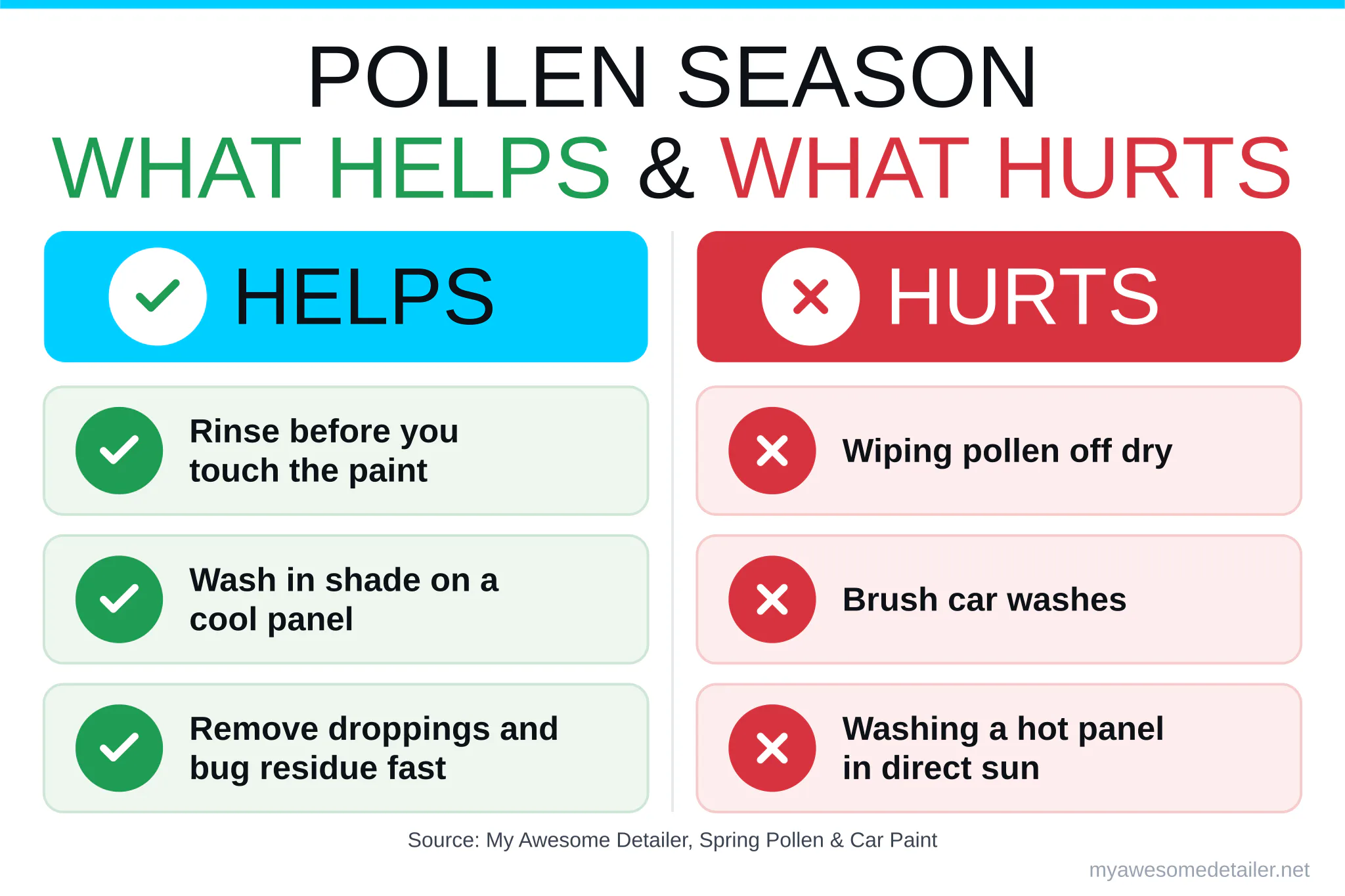
A dry layer of pollen is a fine dust. Dust is harmless sitting on the paint, but the moment you drag a dry towel, a feather duster or a glove across it, you are pushing small hard particles over clear coat. The result is fine swirl marks and light scratches that show up in direct sun. This is the number one way spring pollen hurts paint, and it is entirely avoidable.
2. Wet pollen holds moisture against the surface
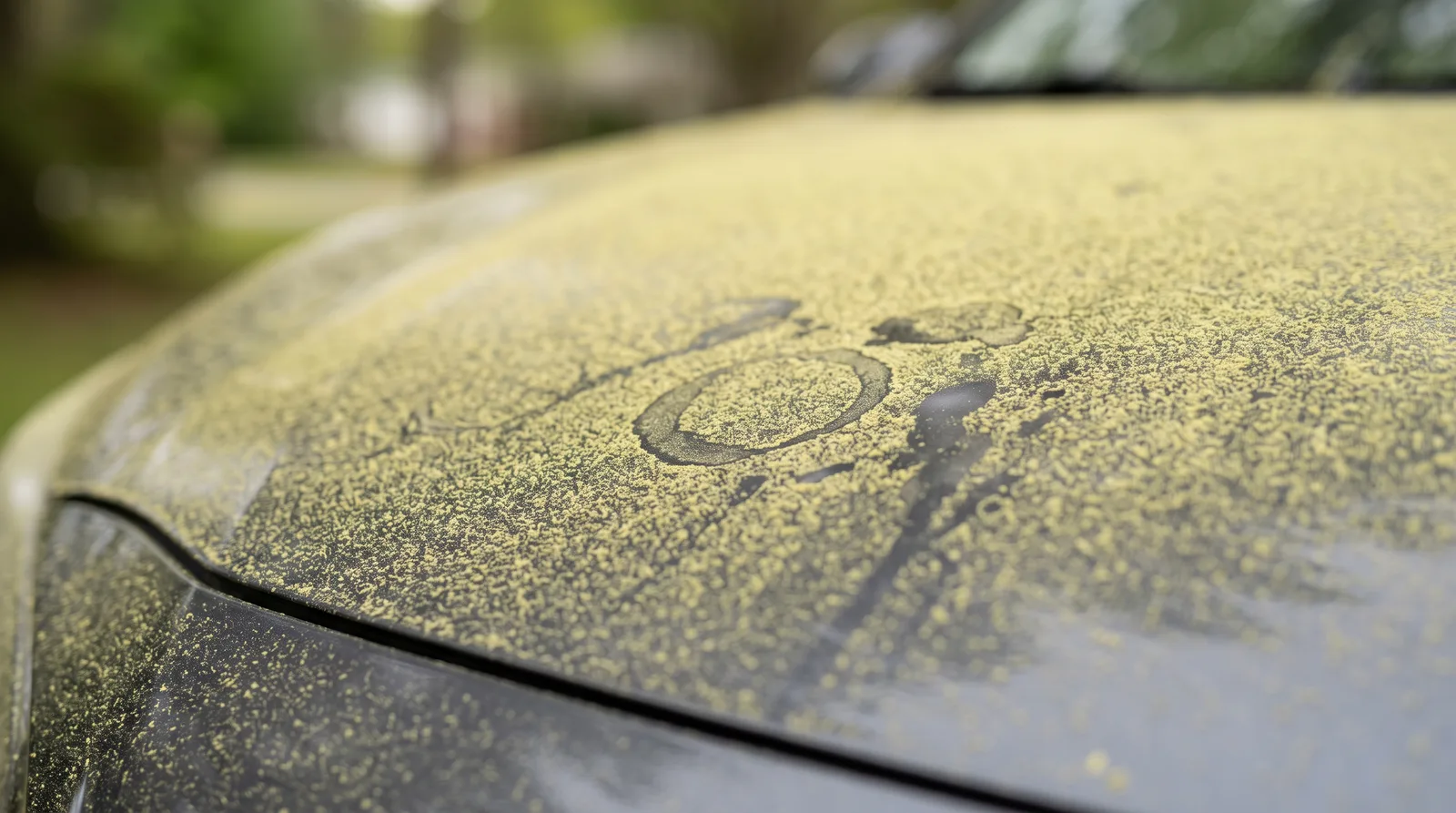
When dew, light rain or a sprinkler wets the dusting, the pollen turns into a damp paste. That paste holds water against the paint for far longer than a clean, slick surface would. In the morning heat, the water evaporates and leaves a ring or a dried film behind. On an uncoated or neglected finish those rings can be hard to wash off, and the paint can look spotty and dull even after a rinse.
3. Pollen mixed with sap, bird droppings and road film
Pollen does not fall alone. It lands on top of sap mist from pines, bird droppings, bugs and the usual road film. When all of that gets wet and then baked, it gets harder to remove. Acidic contaminants such as bird droppings and some saps can etch clear coat when they sit long enough, and pollen just adds a layer of moisture and glue on top. For the full removal windows on those, read our guide on bird droppings, sap and love bugs.
4. Heat bakes it all in
Alabama sun can make a dark panel very hot to the touch. Heat speeds up evaporation, which means wet pollen paste dries quickly and hardens. A hot, dry panel is the worst place to start scrubbing, and it is also where staining is most likely to set. If you are going to wash, do it in shade on a cool panel.
Pollen vs. other spring hazards: what matters most
| Contaminant | Main way it hurts paint | How urgent is removal? |
|---|---|---|
| Dry pollen dust | Scratching if wiped or brushed off dry | Low: rinse it off before touching the paint |
| Wet pollen film | Holds moisture, leaves ring marks and a dull film | Medium: wash within days, sooner on dark cars in direct sun |
| Tree sap mixed with pollen | Sticky bond, can etch if left to bake | Medium to high: do not scrub, soften and lift it |
| Bird droppings | Acidic, can etch clear coat | High: remove as soon as you can do it safely |
| Red clay splash | Abrasive and stains light paint and trim | Medium: rinse before wiping (see our red clay guide) |
| Love bug residue | Acidic, bakes on quickly in heat | High in season: remove within a day or two |
The ranking surprises many owners: the big yellow dusting looks the scariest and is actually the least urgent, as long as you do not scrub it dry. Droppings, bug residue and sap mixed into the pollen are the items that deserve fast attention.
The wrong ways to remove pollen
Most pollen “damage” we see in the shop is self-inflicted. These are the habits to drop.
- Dry wiping with a towel, shirt or duster. Even a clean microfiber towel drags grit across clear coat when there is a layer of dust underneath it.
- Running the wipers on a dusty windshield. Wipers smear pollen into a film, and it can leave fine marks in the glass over time. Use washer fluid and a short rinse first when you can.
- Brush car washes. Spinning brushes and cloth strips carry grit from every car before yours. Pollen season is when the whole line of cars is gritty.
- Washing in direct sun on a hot panel. Soap and water dry before you can rinse, which leaves spotting that looks a lot like pollen damage but is not.
- Leaf blowers and compressed air on the paint. Blowing dry dust across the finish pushes particles around rather than lifting them away.
- Using one dirty sponge for the whole car. The sponge becomes sandpaper by the time you reach the lower doors.
How to wash pollen off safely at home
You do not need fancy gear for a light dusting. You do need to do the steps in the right order. This is the same sequence we follow in the shop, scaled for a driveway wash.
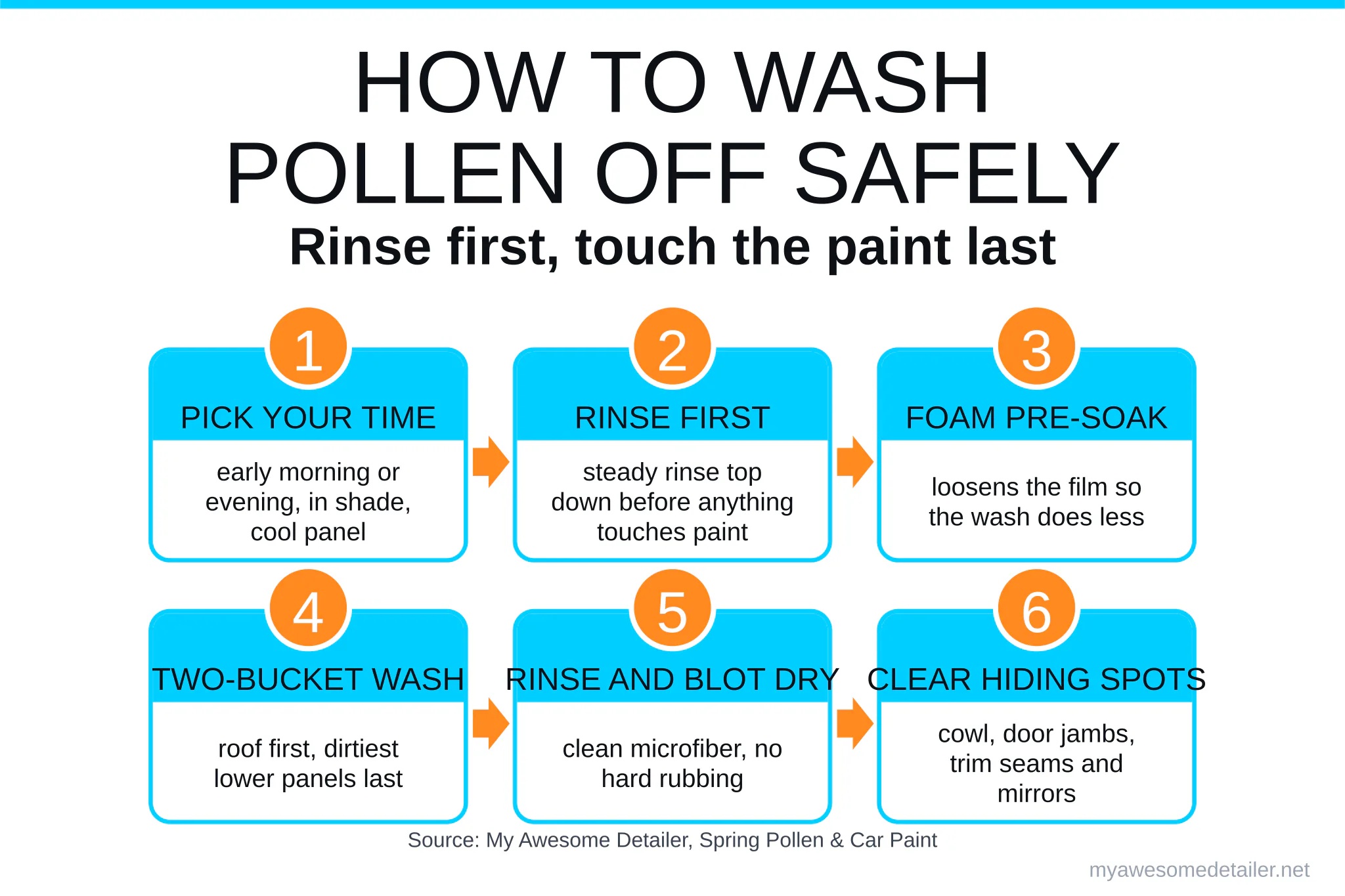
- Pick your time. Early morning or evening, in shade, on a cool panel.
- Rinse thoroughly first. A steady rinse from the top down lifts most of the loose dust before anything touches the paint. Spend more time here than you think you need to.
- Pre-soak with foam if you can. A foam or pre-wash soak loosens the film so the contact wash has to do less.
- Use a two-bucket contact wash. One bucket with soap, one with clean rinse water for the mitt. Start at the roof, work down, and do the dirtiest lower panels last.
- Rinse and dry gently. Use clean, soft microfiber, and blot or lay the towel and pull it lightly rather than rubbing in circles.
- Do the glass and trim too. Pollen collects in door jambs, wiper cowls, window channels and trim seams. If it stays there it re-releases onto clean paint the next time you open a door.
Do not forget the places pollen hides
The cowl under the windshield wipers, the gaps around the hood and trunk, the door jambs and the mirror housings all hold pollen. Rinse those areas, because they feed yellow streaks down a freshly washed car after the first drive.
What about the interior?
Pollen rides in on shoes, clothes and the cabin air. It settles on dashboards and in carpet. A damp microfiber on hard surfaces works better than dry dusting, which just puts it back in the air. Most modern cars have a cabin air filter, and replacing it on the schedule in your owner’s manual helps keep pollen out of the cabin. For more on interior care, see our guide to interior detailing in Auburn.
How often should you wash during pollen season?
There is no single number that fits every car, but a few simple rules cover most situations:
- Garage-kept car, light dusting: a rinse and wash every two weeks is usually plenty.
- Parked outside near pines or oaks: plan on a wash every week during the heaviest weeks, and a quick rinse in between if you can.
- Dark paint parked in direct sun: shorten the interval, because heat dries the pollen paste faster.
- After a rain on a pollen-covered car: wash within a few days, because rain does not rinse it off. It turns it into a film.
Rain is the myth worth killing. Many people assume a good rain washes the car. On a pollen-covered car it usually does the opposite: it wets the dust, spreads it and leaves a spotty film behind once it dries.
Want pollen to rinse off instead of cling?
Our ceramic coating service gives your paint a slick, protective layer. Build your service online in a short interview about your vehicle, then get the exact price on screen.
What a ceramic coating changes during pollen season
A professionally installed ceramic coating is a thin, hard, hydrophobic layer bonded to the clear coat. It does not make a car pollen-proof, and it does not replace washing. What it changes is how the pollen behaves on the surface and how easy it is to remove.
Slick surface, less sticking
A coated finish is smoother and more water-repellent than bare clear coat. Dust and pollen have less to grip, so more of it rinses off with plain water and a gentle wash. That means less contact with the paint, which means fewer opportunities for wash-induced swirl marks.
Water beads and rolls instead of pooling
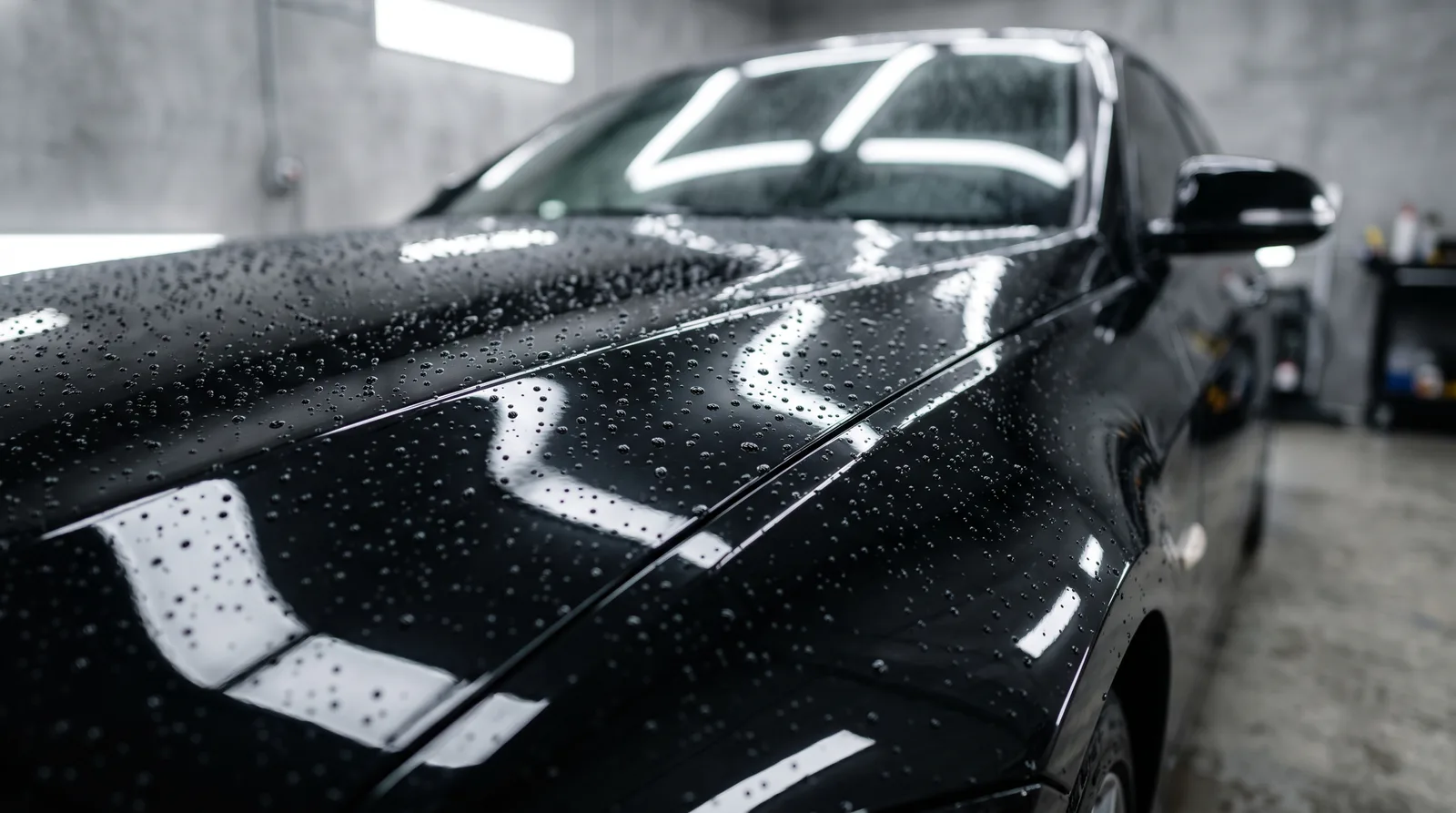
Instead of lying flat and holding a wet film, water on a coated panel gathers into beads and runs off, carrying part of the pollen with it. Less standing moisture means fewer dried rings and a lower chance that a damp film bakes onto the finish.
A sacrificial barrier between the pollen and your paint
The coating is the layer that takes the exposure. If a contaminant sits too long, the coating is what you are dealing with first, not your factory clear coat. That is a meaningful buffer in spring, when sap, bugs, droppings and pollen all pile up at once.
What it does not do
- It does not stop pollen from landing. A coated car still turns yellow.
- It does not make the paint scratch-proof. Dry wiping a coated car can still scratch it.
- It does not mean you can skip washing. It makes washing faster and gentler.
- It does not make acidic contaminants harmless. Bird droppings and bug residue still need prompt removal.
For maintenance after your coating is installed, see our guide to ceramic coating maintenance in Auburn.
Coated vs. uncoated: what to expect in a bad pollen week
| What you notice | Uncoated, waxed or bare paint | Ceramic-coated paint |
|---|---|---|
| Pollen sticking | Clings more, especially after dew | Clings less, rinses off more easily |
| Water behavior | Sheets and pools, holds a film | Beads and rolls off |
| Washing effort | More contact needed to lift the film | Often a rinse and gentle wash is enough |
| Ring marks and dull film | More likely if left several days | Less likely, easier to wash off |
| Acidic contaminants | Reach the clear coat sooner | Reach the coating first, still need prompt removal |
| Scratch risk from washing | Higher with poor technique | Lower with fewer passes, still possible with poor technique |
What if pollen has already left marks?
If you have washed the car and still see ring marks, a hazy film or spotty areas, a few things could be going on. The first step is always a proper wash and decontamination, because many marks that look like damage are only bonded film.
- Wash it properly first. Follow the wash steps above and check again in the shade.
- Look at it under different light. Some marks are only visible in direct sun or under a flashlight, which helps you tell surface film from marks in the clear coat.
- Do not chase it with an aggressive product. Rubbing compounds and heavy cleaners can make the finish worse.
- Bring it to a professional. An exterior detail with a full decontamination wash often lifts what a home wash cannot. Marks that sit below the surface of the clear coat are a different problem. We are upfront about what we offer: paint correction is not something we do right now. Our gloss enhancement polish brings up the gloss, but deeper marks will still be there.
If you want a deeper look at how professional washing differs from a quick wash, read car wash vs. detailing in Auburn.
Beyond the paint: glass, wheels, trim and the engine bay
Pollen does not stay on the paint. It settles on every surface of the car, and each one has its own habits.
Windshield and glass
A pollen film on glass is the first thing most drivers notice, because it scatters sunlight and makes morning and evening glare worse. Resist the urge to run the wipers dry. Rinse the glass first, then clean it with a proper glass cleaner and a clean towel. Check the wiper blades too: a worn blade smears pollen into a haze that no amount of washer fluid will clear, and replacing blades is cheap compared with a hazy windshield in low sun.
Wheels and tires
Wheels are rarely where pollen does damage, but brake dust and pollen together make a gritty paste on the barrels. Use a separate wash mitt for wheels and never reuse it on the paint. Coated wheels release this film more easily, which is one reason our guide to coating wheels, glass, trim and interior is worth a read.
Black plastic trim and rubber seals
Textured trim holds pollen in its grain, and it dries to a pale, chalky look that is easy to mistake for sun fade. A soft brush and a trim-safe cleaner usually lift it. If the trim keeps looking chalky after cleaning, the plastic itself may be aging, which is a different issue than pollen.
Door jambs, cowl and engine bay
Pollen collects in the cowl under the windshield, where it mixes with leaves and drains slowly. Clear the cowl by hand when you wash, so water can drain instead of sitting. A clogged cowl is a bigger long-term problem than the yellow dust itself.
Different cars, different pollen seasons
Daily commuters and students
If your car lives in a campus lot or an apartment complex under pine trees, expect the heaviest dusting and the fewest chances to wash in shade. A quick rinse at a self-serve bay with no brush use, followed by a proper wash at home or a professional visit, is a realistic routine. Never use the foaming brush at a self-serve bay on your paint, since it is full of grit from earlier users.
Dark and black cars
Dark paint shows every flaw and runs hot in the sun. It is the car most likely to look bad in pollen season and the one that benefits most from a gentle routine and a protective layer. Wash in the early morning, and do not let wet pollen bake.
New cars
New paint is no tougher against wipe-off scratches than old paint. In fact, the first months are the best time to set good washing habits and consider protection, because the finish is at its best and you are protecting something worth keeping. See our guide on new car protection for more.
Trucks and SUVs
Large flat panels like hoods, tailgates and roofs collect the most pollen, and they are the hardest to reach. Use a sturdy step stool rather than leaning across the paint, and wash the roof first, since that is where most of the dust sits.
Common questions we hear from Lee County drivers
Over a typical spring, a few themes come up at the shop again and again. People ask whether the yellow film means they need a repaint (it does not), whether a quick drive-through wash is okay (it is a trade-off, since brushes can scratch), whether a cover is worth it (only on a clean car), and whether pollen can get under a coating (it sits on top, and it comes off with a proper wash). The answers above cover all four, and the FAQ section below goes into more detail.
A simple spring pollen plan for Auburn and Opelika drivers
Before the season
- Get a good wash and decontamination on the car so the paint is clean and any protection is working at its best.
- Consider a ceramic coating if you park outside, since it is easier to put protection on before the heavy weeks than during them.
- Replace the cabin air filter if it is due.
- Stock clean microfiber towels, a wash mitt and two buckets.
During the season
- Rinse before you touch anything. Every time.
- Wash in shade, on a cool panel.
- Remove bird droppings, bug residue and sap promptly, even if the car is covered in pollen.
- Rinse the cowl, door jambs and trim so pollen does not re-release.
- Park in a garage or covered spot when you can.
After the season
- Do a full wash and inspect the paint in sunlight for ring marks or film.
- Check the state of your protection. Water that no longer beads is a sign the surface needs attention.
- Book a detail if the finish looks dull, because bonded film is easier to remove sooner than later.
Pollen myths worth clearing up
“Pollen eats through clear coat.”
Not on its own, and not quickly. The real risks are scratching when it is removed badly and the moisture-and-heat cycle on a neglected surface. The truly acidic items are droppings, bug residue and some saps.
“Rain will clean it off.”
Usually it makes a damp film. Wash the car after the rain, not instead of washing.
“Wax or a coating means I can skip washing.”
No. Protection makes washing easier and safer. It does not replace it.
“A car cover is the answer.”
A clean, well-fitting car cover on a clean car can help in a garage or carport, but putting a cover on or off a pollen-covered car drags the dust across the paint. If you use one, make sure the car is clean first.
“Dark cars get more pollen.”
They show it more, and they run hotter in the sun, which dries it faster. They do not attract more of it.
Why choose a shop for pollen season
A shop has things a driveway does not: shade and a controlled indoor space, proper foam pre-wash equipment, a stack of clean towels per vehicle, and the experience to tell a film from a defect. At My Awesome Detailer, we are a shop-only studio in Opelika. Cars come to us at 2709 Frederick Road, and we are an Owner’s Pride Select installer, a program reserved for roughly the top 40 shops in the U.S. Our reviews average 4.9 stars from 200+ reviews.
If you are thinking about a coating, the process starts with a short online interview about your vehicle, typically 3–5 minutes, and then we text you a code. The exact price for your vehicle is on the screen, so there is no guessing and no back-and-forth. You can read more about the service on our ceramic coating page or our auto detailing page.
Ready for a spring that is easier on your paint?
Build your service in a short interview about your vehicle, then book a time to bring it to our Opelika studio.
The bottom line
Spring pollen in Auburn and Opelika is mostly a nuisance, but it turns into a paint problem when it is wiped off dry, left wet in the heat, or mixed with sap and droppings. Rinse first, wash with a clean contact method, work in the shade, clear the acidic items quickly, and keep a slick layer of protection on the paint so the next yellow week costs you minutes instead of marks. If you would like help getting ahead of it, we are in Opelika and happy to talk it through.