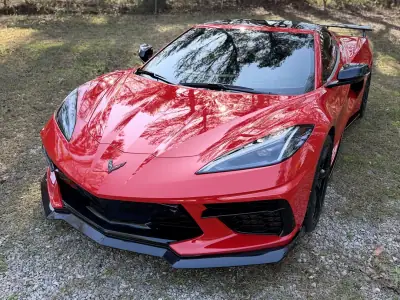
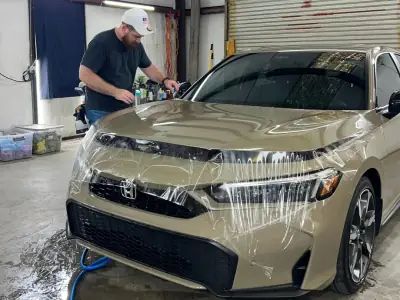
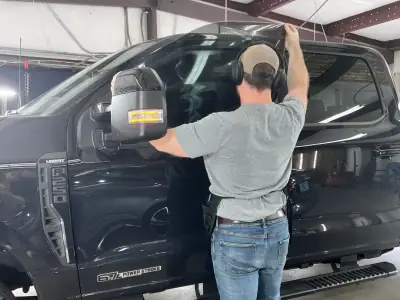
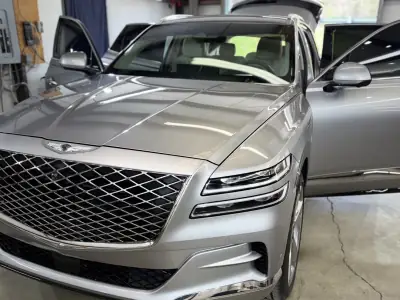
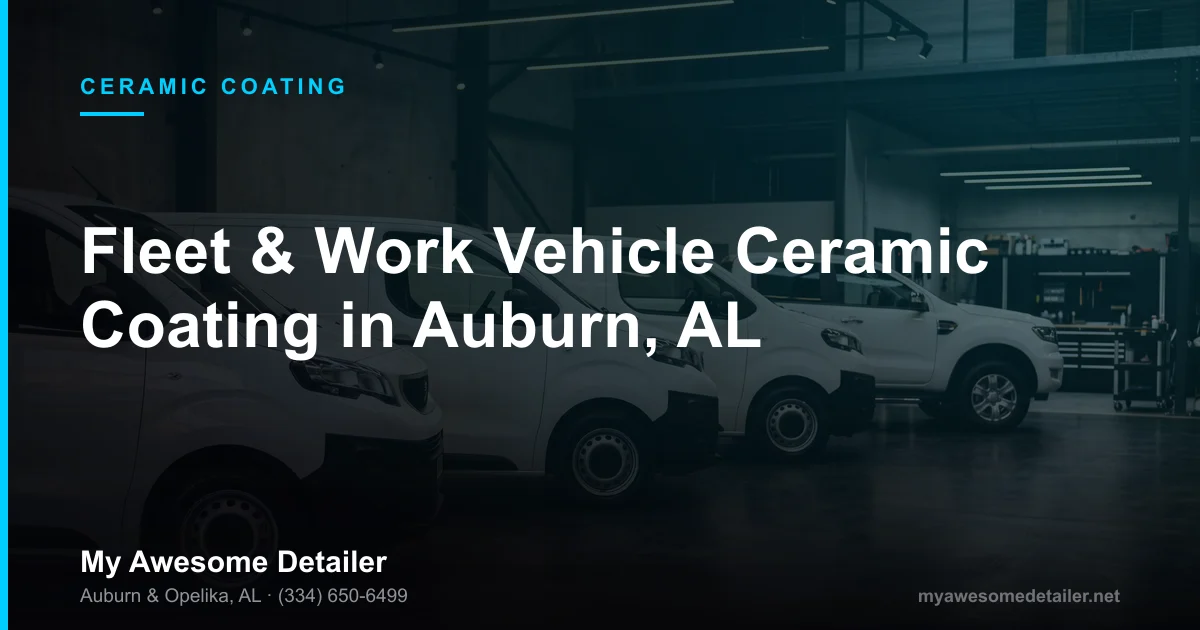
Quick answer: Fleet ceramic coating protects company trucks and vans with a multi-layer nano-coating that cuts wash time by roughly half, keeps job-site grime and road film from bonding to paint, and stops UV fade from turning a fleet of matching vehicles into a mismatched patchwork of chalky and glossy panels. For a typical Auburn-area fleet of 3-10 work vehicles, professional coating is quoted per fleet and pays for itself in reduced wash-crew labor and stronger resale numbers when trucks rotate out at 80,000-100,000 miles.
If you run a business in Auburn, Opelika, or anywhere in Lee County with more than one vehicle on the road, your trucks and vans are doing something a lot of business owners underestimate: they're a rolling billboard, every single day, whether you planned it that way or not. A customer waiting at a red light behind your service van, a homeowner watching your crew pull into their driveway, a prospective client glancing at the fleet parked outside your shop — every one of those moments is either reinforcing that you run a tight operation, or quietly suggesting the opposite. Faded paint, water spots baked into the hood, and a film of red Alabama clay dust do that work against you before a single word gets said.
We coat fleets for contractors, HVAC companies, landscapers, real estate teams, and delivery operators across Auburn and Opelika, and the question we hear most from a fleet manager booking their first appointment isn't "does ceramic coating work" — it's "does it actually make sense at scale, or is this a boutique service for one nice car." This guide breaks down what ceramic coating changes for a working fleet specifically: the washdown math, the brand-image case, the resale angle when vehicles turn over, and how fleet pricing works in the Auburn market.
Why Commercial Fleets Need More Than a Standard Wash
Work vehicles accumulate contamination faster than personal cars — job-site dust, diesel exhaust film, tar, brake dust from stop-and-go routes, and in Lee County, a steady coating of red clay — and an uncoated finish lets all of it bond directly to the clear coat instead of sitting on a protected barrier that rinses off in minutes. A personal car might get washed once a week and see light daily use. A fleet vehicle can rack up 150-300 miles a day, sit outside at a job site for eight hours in direct Alabama sun, and get washed on whatever schedule an already-stretched operations team can manage — which in practice is often "when it looks bad enough that a customer might notice."
That gap between how fast a fleet vehicle gets dirty and how often it realistically gets washed is exactly where paint damage compounds. Contaminants that sit on unprotected clear coat for weeks between washes don't just sit there — tree sap, bird droppings, and road tar start etching into the surface, and repeated dry-wiping or quick pressure-washer-only cleanings (common on job sites, with no soap or proper technique) introduce fine scratching that dulls the finish over months. None of this shows up as a single dramatic problem. It shows up as a fleet that looks five years older than its actual age within two or three years of service.
- Job-site grime — concrete dust, drywall dust, and mud track onto lower panels and wheel wells daily.
- Extended sun exposure — vehicles parked at job sites or on routes all day get more UV load than a car that's garaged most of the time.
- Infrequent, inconsistent washing — fleet washdowns get deprioritized when the crew is busy, so contamination has longer to bond.
- Red clay and road film — Lee County's clay-heavy soil and rural routes leave a fine mineral dust that's abrasive if wiped rather than rinsed.
- Mixed washing methods — pressure-washer-only cleanings without proper soap or technique introduce swirl marks over time.
A ceramic coating doesn't stop any of that grime from landing on the truck. What it does is stop it from bonding to bare clear coat. Coated paint is smoother at a microscopic level and chemically resistant to the acids in sap, bird droppings, and road film, so contamination sits on top of the coating instead of etching into it — which is the entire reason coated vehicles wash faster and hold their finish longer under exactly the kind of abuse a working fleet delivers every day.
What Ceramic Coating Solves for Work Trucks and Vans
For a commercial fleet, ceramic coating's real value isn't showroom gloss — it's faster washdowns, more consistent appearance across every vehicle, and a paint surface that resists the specific abuse of job-site work: grime, UV, hard water, and rushed cleaning schedules. Every one of these translates into either time saved or a cost avoided down the line.
| What coating does | Why it matters for a fleet |
|---|---|
| Hydrophobic, slick surface | Dirt and mud rinse off with lower water pressure and less scrubbing — a wash crew or self-serve bay gets through each truck faster |
| Chemical resistance | Diesel film, tree sap, bird droppings, and job-site chemicals don't etch into the clear coat between washes |
| UV protection | Slows oxidation and fading, so a fleet of matching-color vehicles stays visually matched instead of some trucks fading faster than others |
| Scratch resistance | Harder surface resists the fine marring caused by dry-wiping dust or a rushed pressure-wash-only cleaning |
| Consistent gloss | Every truck in the lot reads as well-maintained, reinforcing the same professional image at every job site and every red light |
The washdown-time savings is the number fleet managers care about most once they see it in practice. A crew washing an uncoated work truck has to actually break down bonded grime — agitation, sometimes a clay bar pass, sometimes a second soap cycle on stubborn panels. A coated truck rinses closer to clean before a wash mitt ever touches it, because most of what's on the surface never bonded in the first place. Multiply that time difference across a fleet of six, ten, or twenty vehicles washed weekly, and it becomes a real labor-hours number, not a marginal convenience.
Get a quote for your fleet.
Tell us how many vehicles and what they do — we'll walk you through coating options and scheduling that fit a working fleet, not a showroom car.
Fleet Ceramic Coating vs. Standard Washing: The Real Cost Comparison
On paper, ceramic coating is an upfront cost that standard washing doesn't have — but standard washing alone doesn't stop UV fade, etching, or the wash-time creep that comes from grime bonding to bare paint, so the comparison isn't coating vs. free, it's a planned cost now vs. a growing labor and repaint cost later. The table below lays out how the two approaches actually compare over the working life of a fleet vehicle.
| Factor | Standard wash-only fleet | Ceramic-coated fleet |
|---|---|---|
| Wash time per vehicle | Longer — grime is bonded and needs agitation | Meaningfully shorter — most contamination rinses off before scrubbing |
| Appearance between washes | Dulls and streaks faster, especially on dark colors | Holds gloss and beads water between washes |
| UV fade over 3-5 years | Noticeable, uneven fading across a mixed-exposure fleet | Significantly slowed, more uniform appearance fleet-wide |
| Risk of etching from sap, bird droppings, road film | Higher — nothing blocks chemical bonding to bare clear coat | Lower — coating resists the acids that cause etching |
| Resale/trade-in condition at fleet turnover | Paint condition often drags the appraisal down | Documented protection supports a stronger trade-in number |
| Upfront cost | None (beyond ongoing wash costs) | Coating cost per vehicle (Coating Club or Select, For Life); fleets quoted by a person |
The honest framing here isn't that ceramic coating is free money — it's a real upfront line item, and any fleet manager evaluating it should treat it like the equipment investment it is. What it changes is the trajectory: an uncoated fleet's paint condition degrades in a way that compounds (faster fading, more etching, harder washes, lower trade-in value), while a coated fleet's paint condition holds closer to flat for years. For a full breakdown of single-vehicle coating pricing, see our ceramic coating cost guide for Auburn.
Coating Club or Select, For Life: Matching Protection to Duty Cycle
Not every vehicle in a fleet needs the same coating — a work van doing daily deliveries around town has different needs than a flagship truck the company plans to keep for a decade, and matching the right option to each vehicle's role keeps the fleet protection budget efficient. The decision comes down to how long each vehicle stays in the fleet and whether you want the maintenance handled for you.
| Option | What you pay (per vehicle) | Best fit for fleets |
|---|---|---|
| Coating Club | A monthly membership | Most service trucks, HVAC vans, and contractor vehicles: we maintain each one with a ceramic performance maintenance visit every 90 days, and a vehicle that leaves the fleet can be cancelled anytime |
| Select, For Life | Paid once, owned outright | Flagship or branded lead-vehicle trucks, or vehicles held long-term: multi-layer, self-healing, guaranteed for life on that vehicle |
A common approach for mixed fleets is matching by vehicle role: the working trucks and vans that see the heaviest daily exposure go on the Coating Club, so the maintenance never slips on a busy schedule, while the one or two trucks that represent the company most visibly and will stay the longest get Select, For Life. That keeps the per-vehicle cost proportional to how long each truck actually stays in service. Fleets of more than one vehicle are quoted by a person, so the plan is built around your actual vehicles.
Brand Image: What Your Trucks Say Before You Do
A fleet's paint condition is one of the few brand signals a customer forms an opinion about before any interaction happens — a faded, water-spotted, or swirl-covered truck pulling into a driveway undercuts a sales pitch or a service call before your team says a word, regardless of how good the actual work is. This matters more for service businesses than almost any other marketing spend, because the vehicle is often the first physical thing a customer sees representing the company.
Think about the categories of businesses running fleets around Auburn and Opelika: HVAC and plumbing companies whose vans sit in a driveway for hours during a job, landscapers whose trucks are parked at the curb all afternoon, real estate teams whose branded vehicles sit outside open houses, delivery and courier operations logging highway miles daily. In every one of those cases, the vehicle is doing marketing work whether anyone budgeted for it or not. A glossy, clean, well-maintained truck reads as a company that pays attention to detail — which is exactly the impression a service business wants before a technician even knocks on the door. A dull, streaked, or chalky-faded truck reads the opposite way, even if the technician inside is excellent at their job.
- First impression before the pitch — a customer sees the truck before they hear the sales conversation or watch the work happen.
- Consistency across a fleet — coated vehicles fade more uniformly, so a fleet with matching branding actually looks matched, not patchwork.
- Faster turnaround between jobs — quicker washdowns mean a truck can look presentable for the next stop without eating into route time.
- Fewer "why does our truck look bad" conversations — a documented protection plan takes the guesswork out of fleet appearance standards.
This is also where the gap between a coated and uncoated fleet becomes most visible over time, not on day one. A brand-new truck looks good regardless of coating. The difference shows up at year two or three, when an uncoated truck's clear coat has started to chalk and dull under Alabama's UV load while a coated one still beads water and holds gloss under the same sun exposure and the same job-site conditions.
Fleet Quotes and Scheduling for Multi-Vehicle Fleets
A fleet of more than one vehicle is quoted by a person, based on your vehicle count, vehicle types and current paint condition, and scheduling is usually staggered — a few vehicles at a time — so the fleet never has more trucks out of service at once than the business can absorb. This is the piece that differentiates a fleet quote from a single-vehicle retail quote, and it's the first question most fleet managers ask.
| Fleet size | Typical pricing approach | Scheduling approach |
|---|---|---|
| 2-4 vehicles | Quoted for your fleet | Often batched over 1-2 weeks, 1-2 trucks at a time |
| 5-9 vehicles | Quoted for your fleet; Club and Select can be mixed | Staggered over several weeks to limit vehicles out of service simultaneously |
| 10+ vehicles | Quoted for your fleet | Rolling schedule coordinated around route/dispatch needs |
Every fleet quote starts with an actual conversation about vehicle types, current condition, and how many trucks can realistically be out of rotation at once — a landscaping company running two crews can't afford to have both trucks in the bay on the same day, and we build the schedule around that reality rather than a one-size-fits-all timeline. Correction time is also part of the estimate: a fleet with existing swirl marks or oxidation from years of uncoated wear needs paint correction before coating goes on (the same as any individual vehicle would), which our step-by-step ceramic coating process guide covers in detail. Fleets in better starting condition move through the process faster and at lower correction cost per vehicle.
Protecting Resale Value at Fleet Turnover
Most commercial fleets cycle vehicles out around 80,000-100,000 miles or after a set lease/ownership term, and paint condition is one of the few things a buyer or trade-in appraiser can actually see and judge in a walkaround inspection — which makes it one of the highest-leverage things a fleet manager can control before a vehicle changes hands. Mechanical condition matters for a trade-in number too, but it's often invisible until an inspection. Paint condition is the first thing anyone evaluating the vehicle actually looks at.
An uncoated work truck at 90,000 miles has typically seen years of accumulated etching, fading, and fine scratching that no wash can fully reverse — the paint reads its age even if the engine and transmission are in great shape. A coated truck at the same mileage, especially one that's had an annual maintenance check along the way, tends to present noticeably better: less oxidation, fewer water spots baked in, more consistent gloss. That difference is exactly the kind of thing that moves a trade-in appraisal or a resale listing price, because it's the visible proxy a buyer uses to judge how well the whole vehicle was cared for.
For fleets that rotate multiple vehicles per year, this compounds into a real number across the fleet's total resale return — not a one-time bonus on a single truck, but a repeatable improvement every time a vehicle cycles out and a new one comes in. It's worth planning coating into the fleet's onboarding process for exactly this reason: a truck coated in its first weeks of service protects its resale position for its entire time in the fleet, rather than trying to correct years of accumulated wear right before a trade-in appointment.
The Fleet Coating Process: What to Expect
Fleet coating follows the same core process as an individual vehicle — inspection, decontamination wash, correction where needed, coating application, cure time — scaled and scheduled to move multiple vehicles through without shutting down operations. Here's how a typical fleet job runs at our Opelika studio.
Every vehicle gets a walkaround inspection first, since fleet vehicles rarely arrive in identical condition — a two-year-old van and a six-year-old truck in the same fleet often need very different amounts of correction before coating. From there, the decontamination wash strips bonded grime, iron particles, and tar that a standard wash leaves behind, correction addresses any existing swirl marks or oxidation, and the coating goes on and cures before the vehicle heads back into rotation. We coordinate the return-to-service timing with your dispatch schedule so a coated truck isn't sitting idle waiting on cure time when it could be back on a route.
Common Fleet Vehicles We Coat in the Auburn and Opelika Area
The most common fleet vehicles we coat locally are contractor and service trucks, cargo and passenger vans for HVAC and delivery operations, and pickup trucks used for both work and branding — each with slightly different problem areas that coating addresses. Pickup trucks tend to show the most gravel-road paint chipping and bed-rail wear from job-site cargo; cargo vans show more UV fading on flat panels from long daily routes and extended parking; branded lead vehicles get the most scrutiny for gloss and color consistency since they're the ones customers see most often.
- Contractor and service trucks — job-site grime, gravel-road chipping, frequent short washes between appointments.
- HVAC and plumbing vans — long daily idle time parked at customer properties, high visibility to homeowners.
- Landscaping trucks — heavy mud, grass clippings, and debris exposure; curbside parking for hours at a time.
- Delivery and courier vehicles — high daily mileage on highway corridors like I-85 and US-280, meaning more UV and road-debris exposure per week than most fleet classes.
- Real estate and branded lead vehicles — lower mileage but highest visual scrutiny, since these are parked at open houses and events where appearance matters most.
For fleets running a lot of pickup trucks specifically, pairing ceramic coating with paint protection film on high-impact areas (hood, front bumper, fenders) is worth considering for trucks that see regular gravel-road or job-site debris exposure — coating handles the UV and chemical side, film handles the physical impact side. Our guide to ceramic, PPF and tint working together covers how the two combine for maximum protection on a vehicle that takes real abuse.
What Fleet Ceramic Coating Costs in Auburn
For a single vehicle, ceramic coating at My Awesome Detailer is the Coating Club, a monthly membership, or Select, For Life, paid once and owned outright. A fleet of more than one vehicle is quoted by a person. Every fleet gets an in-person or photo-based condition assessment before final pricing, since correction time is the single biggest variable.
Vehicles in rougher starting condition — heavier oxidation, more existing swirl marks, years of uncoated wear — take longer to correct and cost more per vehicle than a fleet that's kept up with regular washing and gets coated early. This is the same logic covered in our guide to what actually shortens a ceramic coating's life: starting from clean, well-corrected paint isn't optional, it's what makes the coating perform to its rated durability in the first place. A quick call with your vehicle count and rough condition gets you a real range before we schedule an in-person walkaround.
Ready to protect your fleet?
Fleet quotes, staggered scheduling that works around your routes, and a process built for trucks that actually work for a living.
The Bottom Line for Auburn Fleet Owners
A fleet's paint condition is doing marketing and resale work whether a business plans for it or not. Ceramic coating doesn't eliminate the need to wash a work truck — it changes how fast that wash goes, how consistently the fleet looks between washes, and how much of the paint's condition survives to trade-in day. For businesses running multiple vehicles across Auburn, Opelika, and Lee County, that's a maintenance-budget decision as much as a cosmetic one.
As a Top 40 ceramic installer nationwide with a 4.9-star rating across 200+ reviews, My Awesome Detailer coats fleets for contractors, service companies, and delivery operations across the region — with fleet quotes and scheduling built around keeping your trucks on the road, not sitting in a bay.
Talk to us about your fleet.
Tell us your vehicle count and we'll put together a coating plan and schedule that fits how your business actually runs.